
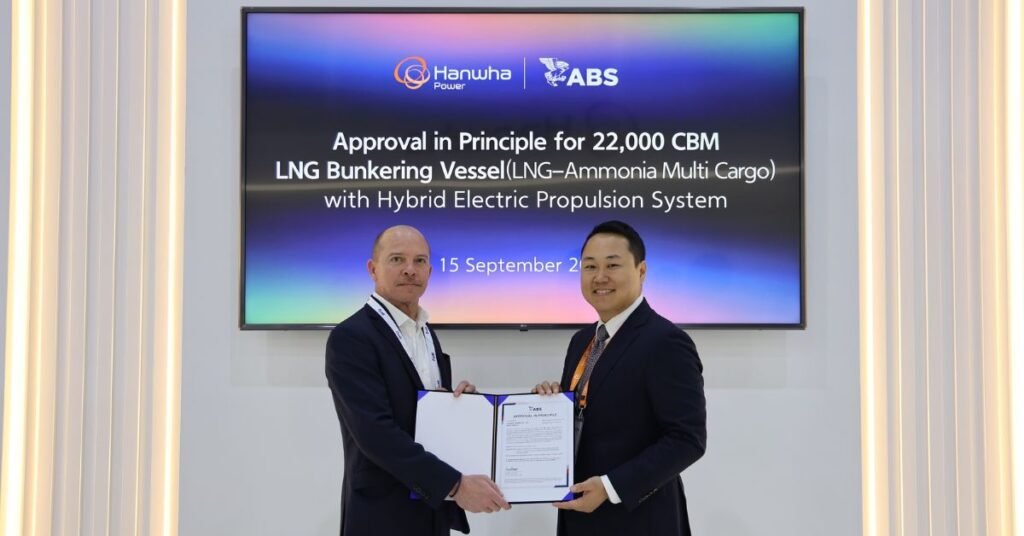
Hanwha Power has obtained Approval in Principle (AiP) from the American Bureau of Shipping (ABS) for the concept design of a 22,000 cubic metre LNG bunkering vessel, unveiled at Gastech 2026, the world’s largest gas and energy exhibition, held in Bangkok, Thailand.
What was announced and where?
The certificate presentation ceremony took place on September 15, with Hanwha Power Marine Solution Business Division Head Hoon-min Kim, Vice President Jong-kyu Hwang, who oversees Technical Solutions, and senior ABS representatives in attendance. Hanwha Power operated a joint exhibition booth at Gastech alongside fellow Hanwha Group affiliates Hanwha Ocean and Hanwha Engine, showcasing the group’s integrated marine and energy solutions spanning eco-friendly vessels, propulsion systems and marine equipment.
How does this fit into Hanwha Power’s LNG bunkering vessel lineup?
With this latest AiP, Hanwha Power has completed its range of medium and large-scale LNG bunkering vessels, spanning from 7,500 cubic metres to 22,000 cubic metres, giving the company a full suite of vessel sizes to serve shipowners across different bunkering volume requirements.
What makes this concept design technically distinctive?
A key feature of the design is its LNG-ammonia multi-cargo capability, allowing the vessel to transport both LNG and ammonia, an emerging next-generation bridge fuel gaining traction in shipping’s decarbonisation efforts. The design incorporates high-manganese steel cargo containment technology, known as Mc-C, enabling the vessel to adapt to future alternative fuel transitions with minimal design modifications, offering shipowners greater long-term flexibility as fuel requirements evolve.
What propulsion system has been applied to the vessel?
Given that bunkering vessels typically operate in coastal waters, Hanwha Power has applied a hybrid electric propulsion system integrating an Onshore Power Supply (OPS) system with an Energy Storage System (ESS). The system is designed to minimise harmful emissions while the vessel is berthed or operating in coastal areas, while also improving operational efficiency and economic performance.
What other Hanwha technologies are integrated into the design?
The concept design incorporates several of Hanwha Group’s core technologies, including dual-fuel generator sets, energy storage systems, electrical power system integration, an integrated automation system and a cargo handling system. By combining these capabilities, Hanwha Power aims to strengthen the competitiveness of its integrated engineering and procurement (EP) package, covering both engineering and procurement services for shipowners.
What did Hanwha Power say about the significance of this approval?
Hoon-min Kim, Head of Hanwha Power’s Marine Solution Business Division, said the ABS AiP marks another important milestone demonstrating the company’s technological reliability and commercial viability in the global eco-friendly vessel market. He said Hanwha Power would continue building on the wider Hanwha Group’s clean-technology capabilities to provide global shipowners with optimised integrated solutions supporting the transition to more sustainable marine transportation.
What is Hanwha Power’s background in marine solutions?
Hanwha Power established its Marine Solution Business Division in 2023 and has since pursued projects involving vessel retrofits, alternative-fuel propulsion and energy-efficiency improvements. The company provides eco-friendly marine solutions to global shipping companies, including vessel retrofits, onboard regasification and re-liquefaction systems, increased cargo containment capacity, and alternative-fuel conversions.
What does this mean for the LNG bunkering vessel market?
ABS, founded in 1862 and headquartered in the United States, is a leading international classification society that evaluates and certifies the technical compliance and safety of ships and offshore structures throughout their design, construction and operation. Approval in Principle from a classification society of ABS’s standing signals growing confidence in flexible, multi-fuel bunkering vessel concepts as LNG and ammonia infrastructure continues to expand across global ports.
Recent Posts
Policy
V.O. Chidambaranar Port Authority hosts India Green Fuel Conclave ’26 on green fuel exports
Fuels
Brookfield to invest up to $600 million in ACME green fuels business
Technology
Yokogawa wins KHI orders for automation systems for large liquefied hydrogen carrier