
Summary
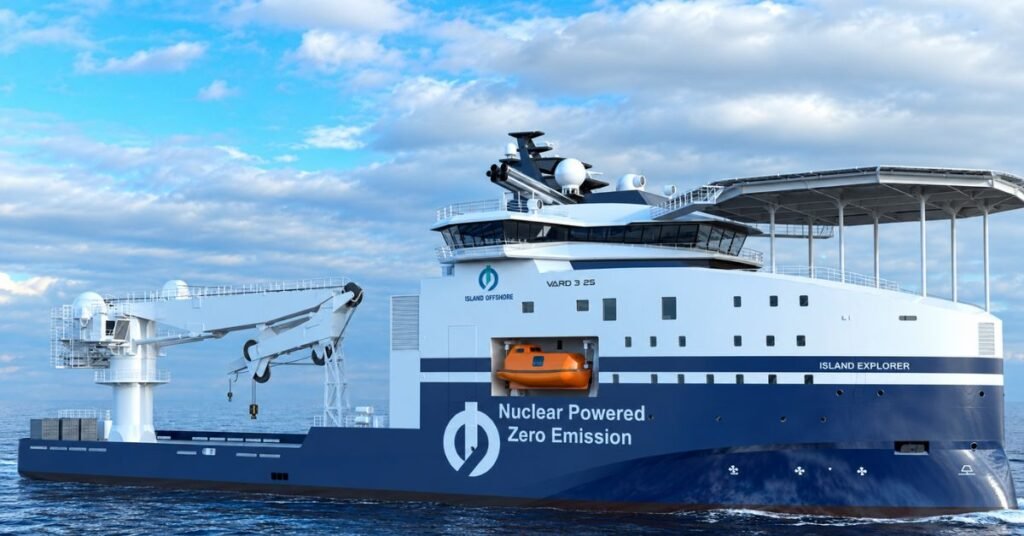
Norway’s Research Council has awarded NOK20 million to a maritime nuclear propulsion pilot led by Emerald Nuclear Norway. The consortium plans a non-nuclear integrated test facility in 2027, bringing together reactor technology and shipboard power systems. Island Offshore is targeting a first vessel installation in 2031–32, subject to further development.
Grant advances system integration work
The maritime nuclear propulsion pilot, known as MarNuPS, has secured initial public funding to support its progression from design studies towards physical integration and testing.
The Research Council of Norway’s published funding results list a NOK20 million award, approximately US$2 million, to Emerald Nuclear Norway. The award appeared in results published on 23 September 2026, ahead of the project announcement in October.
The consortium includes VARD Group, Vard Electro, Island Offshore, the Norwegian University of Science and Technology (NTNU), Imperial College London and Maskindynamikk.
The partners collectively cover reactor development, ship design, electrical integration, vessel operations and research. Their immediate task is to establish how the proposed energy system would function as an integrated marine installation.
First stage will use electric heating
Stage 1 is planned for 2027 at Stette, near Ålesund, Norway.
The facility will assemble a full-scale representation of the shipboard propulsion system, using electric heating instead of nuclear fuel. This will allow the partners to evaluate interactions between components under conditions representing vessel operations.
The proposed architecture combines Emerald Nuclear’s 5 MWe Gem microreactor technology with energy storage, power conversion, vessel power management, automation and bridge controls.
Testing will cover routine operation, rapid changes in power demand, transient conditions, system performance and crew interaction.
The distinction is central to the project’s status. The 2027 work concerns a non-nuclear test installation, allowing integration questions to be examined before any subsequent reactor deployment.
Industry funding exceeds the initial grant
The first stage has an estimated total cost of approximately NOK150 million, with the project partners providing substantial financing alongside the Research Council contribution.
Island Offshore intends to become the first shipowner to install the proposed reactor and energy system, targeting deployment in 2031–32.
That date is a development ambition rather than confirmation of an approved nuclear-powered vessel entering service.
For the operator, participation provides an opportunity to shape the system around practical offshore requirements. For technology suppliers and ship designers, it creates a route to test their assumptions against an owner’s operating needs.
Earlier Norwegian research provides the foundation
MarNuPS builds on previous Norwegian research into nuclear propulsion for merchant shipping, including the NTNU-led NuProShip programme.
In January 2026, VARD presented work under NuProShip II examining the integration of advanced reactors into specialised offshore vessels. The case study involved DNV, Emerald Nuclear, Vard Electro, Island Offshore and NTNU.
The earlier NuProShip I programme concluded in December 2024 before transitioning into the two-year NuProShip II initiative.
The progression illustrates a shift from assessing potential applications towards testing an integrated system. Each stage addresses a different question: whether a concept appears feasible, whether its components work together, and ultimately whether it can meet the requirements for vessel deployment.
Offshore operations shape the commercial question
The project’s focus on offshore vessels makes power-system response an important part of the assessment.
Testing changes in demand and interactions with energy storage should help the partners understand how the proposed arrangement could support operating conditions at sea.
For shipowners, the commercial proposition will require more than demonstrating that a reactor can produce electricity. The complete installation must provide dependable power, fit the vessel’s operating profile and be supported by workable maintenance and management arrangements.
The initial test programme can generate evidence on those integration issues without being presented as proof of commercial readiness.
Qualification remains a longer-term task
NuProShip’s published research has also identified engagement with national and international regulators as an important requirement, particularly because ships move between jurisdictions.
The grant therefore marks a research and development milestone. The next substantive step is establishing the planned test facility and demonstrating coordinated system performance.
Results from that work will provide a stronger basis for evaluating the proposed vessel installation, the remaining qualification programme and the resources required to progress towards deployment.
FAQs
How much funding has been awarded?
NOK20 million, approximately US$2 million, from the Research Council of Norway.
Who leads MarNuPS?
Emerald Nuclear Norway, working with shipbuilding, vessel-operation and research partners.
Will the 2027 tests use nuclear fuel?
No. Electric heating will simulate the heat source for integrated system testing.
What is the estimated first-stage cost?
Approximately NOK150 million, including partner financing.
When is vessel deployment targeted?
Island Offshore is targeting 2031–32, subject to further development and qualification.
Recent Posts
Power & Propulsion
WinGD Signs First Engine Licensing Agreement with HD Hyundai Marine Engine
LNG
LNG Carrier Surplus Forecast Raises Questions Over New Ship Orders
Policy
UK ETS Site Visits: DNV Urges Early Action Before First Reporting Deadline