
Summary
Shanghai Chimbusco Marine Bunker has launched a two-year pilot to standardise methanol bunkering services, targeting completion by the end of 2028. The initiative will develop procedures covering the full delivery process, drawing on operating experience and technical guidance as Shanghai expands its role in alternative marine fuel supply.
Pilot moves into implementation
The Shanghai methanol bunkering pilot has entered its implementation phase, with Shanghai Chimbusco Marine Bunker working to establish service standards that could be replicated more widely.
The company announced the initiative on 27 October 2026, following a launch meeting and technical training session held on 20 October.
Selected for Shanghai’s 2026 standardisation pilot programme, the project will run for two years. Its framework will cover personnel, equipment, materials, methods and the operating environment, alongside procedures before, during and after bunkering.
Shanghai Academy of Quality Management will provide technical support, while the bunker supplier will contribute practical operating experience. The next tasks include developing the framework, drafting standards and implementing the pilot.
The 2028 target concerns completion of the standardisation project. It does not mark the start of methanol bunkering in Shanghai, where deliveries have already taken place.
Consistent procedures support commercial growth
The initiative addresses the service framework surrounding fuel delivery, rather than production capacity alone.
For shipowners, access to methanol depends on more than the availability of the product. Delivery arrangements must be compatible with vessel schedules, port operations and the responsibilities of the parties involved.
A common framework can help suppliers organise personnel, equipment checks and operating procedures consistently. It can also provide a clearer basis for training and reviewing performance.
The project’s emphasis on the stages before and after transfer is commercially relevant. Preparations, communication and completion records are part of delivering a dependable service, alongside the physical movement of fuel.
Earlier deliveries provide an operating foundation
Shanghai’s methanol bunkering development predates the new pilot.
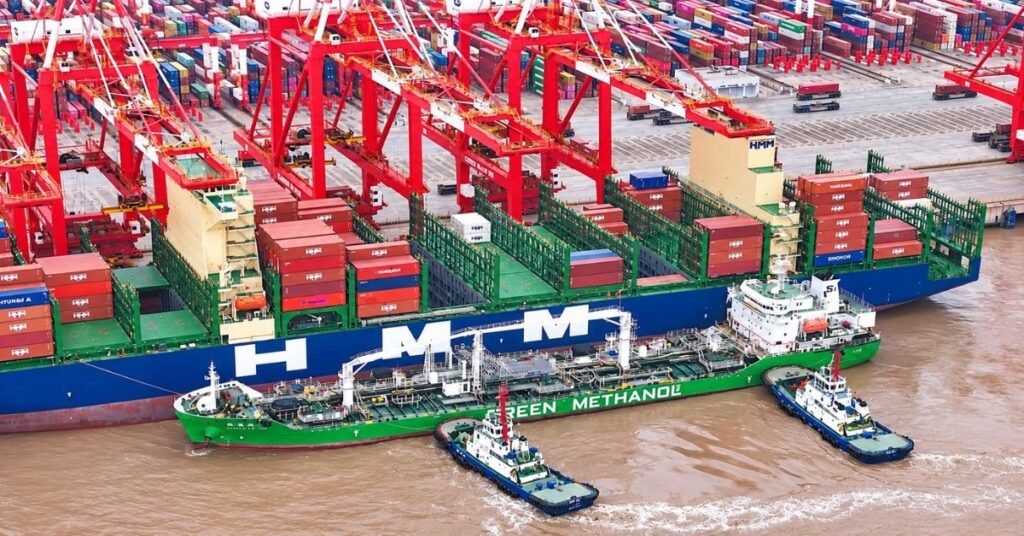
On 10 April 2024, Yangshan port carried out China’s first ship-to-ship green methanol bunkering for a large dual-fuel container vessel.
The operation involved the bunker vessel Hai Gang Zhi Yuan supplying Astrid Mærsk. It established an early operational milestone for Shanghai’s alternative-fuel services.
The standardisation initiative represents a subsequent stage: using operational experience to develop repeatable service practices.
That progression matters as activity expands. A successful individual transfer demonstrates capability, while recurring commercial deliveries require consistent preparation, execution and coordination across different ships and operating conditions.
Local production adds another supply component
Shanghai has also developed local methanol production.
A project at the Shanghai Chemical Industry Park in Jinshan district began commercial operations on 29 December 2025, with annual capacity of 100,000 tonnes.
The facility converts biogas into methanol using urban food waste as a feedstock. Before its operation, green methanol supplied to vessels at Shanghai Port had been sourced from outside the city.
The project had obtained ISCC EU and ISCC PLUS certification in September 2025.
This is separate infrastructure from the bunkering standards pilot. Together, however, production and delivery capabilities address different requirements within the same supply chain.
For customers, dependable access requires coordination from fuel sourcing and storage through transport and final delivery.
Wider policy targets a 2030 fuel hub
The pilot also sits within Shanghai’s broader ambition to become an international centre for green shipping fuel bunkering and trading.
A national plan released in February 2026 envisaged a supply system encompassing LNG, green methanol and biofuels.
It identified production, storage, transport and bunkering infrastructure as priorities, including development around chemical industrial parks, Hengsha Island, the Yangtze River estuary and Yangshan Port.
The plan also called for coordinated development of bunker vessels, shore stations and tank trucks, alongside marine-fuel carbon-footprint accounting standards.
Implementation will determine wider usefulness
The immediate task is to translate the pilot’s objectives into procedures that can be applied consistently.
Its usefulness will depend on whether the resulting standards reflect actual delivery conditions and can be adopted beyond the initial project.
For Shanghai, the initiative adds an operational element to investment in fuel supply and infrastructure. For shipping customers, the potential benefit is greater consistency in how methanol bunkering services are prepared, delivered and documented as the market develops.
FAQs
Who is leading the pilot?
Shanghai Chimbusco Marine Bunker, supported by Shanghai Academy of Quality Management.
When is completion targeted?
By the end of 2028.
What will the standards cover?
Personnel, equipment, materials, methods, operating conditions and procedures across the bunkering process.
Has Shanghai already conducted methanol bunkering?
Yes. A landmark ship-to-ship delivery to Astrid Mærsk took place at Yangshan in April 2024.
Does the pilot create a new methanol production plant?
No. It focuses on standardising bunkering services.
Recent Posts
Power & Propulsion
WinGD Signs First Engine Licensing Agreement with HD Hyundai Marine Engine
LNG
LNG Carrier Surplus Forecast Raises Questions Over New Ship Orders
Policy
UK ETS Site Visits: DNV Urges Early Action Before First Reporting Deadline