
Summary
Amazon and Tata Motors have announced a three-year programme to deploy 3,000 electric trucks across Amazon’s Indian transportation network, beginning with an initial rollout of 20 vehicles in Delhi. The initiative will extend electric mobility beyond last-mile deliveries to freight movements between logistics facilities, with plans to expand onto major highway corridors through partnerships with fleet operators and charging infrastructure providers.
Initial Deployment Begins in Delhi
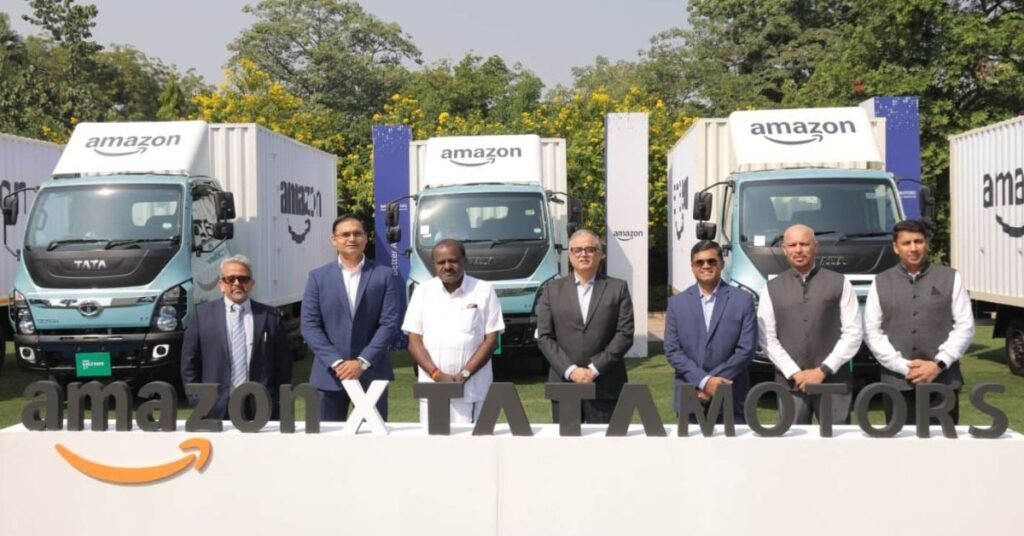
Amazon’s electric truck deployment programme entered its first phase on 27 October 2026, with 20 Tata Ultra E.7 electric trucks flagged off in New Delhi by Union Minister for Heavy Industries and Steel H. D. Kumaraswamy.
Under the agreement, the companies plan to introduce 3,000 electric trucks across Amazon’s transportation network within three years. The companies described the initiative as the largest electric-truck deployment announced by an e-commerce company in India.
The initial fleet will support freight transportation during the festive season, moving goods between logistics facilities and handling intra-city cargo movements. The programme extends electrification into middle-mile and inter-facility transportation, where trucks carry consolidated shipments rather than individual customer parcels.
Carrier Partners to Purchase and Operate the Fleet
Tata Motors will supply the electric trucks, while Amazon’s carrier partners will purchase and operate the vehicles across its transportation network.
The operating model places vehicle ownership and fleet management responsibilities with transport partners, while Amazon provides the transportation demand through its logistics operations. Carrier participation will therefore be central to the programme’s implementation and expansion.
The commercial viability of electric freight operations will depend on several factors, including vehicle utilisation, electricity costs, charging availability, maintenance requirements and financing arrangements. Operators will also need to ensure that vehicle performance and charging schedules remain compatible with cargo movement and delivery commitments.
Regular routes between established logistics facilities could provide an initial operating base, allowing transport schedules, loading requirements and charging windows to be coordinated.
Delhi–Bengaluru–Chennai Corridor Included in Expansion Plans
Beyond the initial urban deployment, Amazon and Tata Motors intend to expand electric trucking across major freight routes in India.
One of the stated objectives is to electrify the approximately 2,800-km Delhi–Bengaluru–Chennai corridor along National Highway 48. The proposed route covers seven states and connects six major e-commerce regions.
The expansion will require charging infrastructure at suitable locations along the corridor. Amazon is working with commercial-vehicle charging infrastructure provider Yahhvi, which is developing charging hubs to support the programme. Amazon’s previous collaboration with Yahhvi includes the development of 10 charging yards across India.
The availability of charging facilities will be a key consideration in determining route feasibility, vehicle utilisation and operational schedules. Long-distance electric freight operations will require coordination between vehicle range, charging locations, cargo schedules and turnaround times.
Tata Ultra E.7 Specifications and Operating Range
The first 20 vehicles deployed under the programme are Tata Ultra E.7 light-duty electric trucks.
According to Tata Motors’ published specifications, the vehicle has a gross vehicle weight of 7.5 tonnes, a 14-foot load deck and a payload capacity of 3.1 tonnes with a container fitted.
The electric truck is equipped with a 96 kWh lithium iron phosphate battery and has a stated driving range of up to 130 km. Its features include CCS2-compatible DC fast charging, regenerative braking, an integrated electric axle and connected fleet-monitoring capabilities.
These specifications position the Ultra E.7 for urban freight distribution and transportation between nearby logistics facilities. However, actual operating range will vary depending on payload, traffic conditions, driving patterns and energy consumption.
The vehicle’s stated range also highlights the need for different vehicle configurations and charging arrangements as the programme moves towards longer highway routes.
Previous Electric Freight Trials Provide Operational Background
Amazon has previously participated in electric freight initiatives extending beyond last-mile delivery.
Through Laneshift, a zero-emission freight initiative associated with The Climate Pledge, Amazon conducted trials involving long-range heavy-duty electric trucks on the 350-km Bengaluru–Chennai corridor in collaboration with industry partners.
The earlier trials provide operational experience relevant to the proposed expansion of electric freight transportation. The new programme, however, will require a larger supporting ecosystem covering vehicle procurement, fleet servicing, charging infrastructure and coordination with carrier partners.
The planned deployment reflects the growing adoption of electric vehicles in India’s commercial freight sector. Its implementation will depend on the ability to maintain fleet availability, manage operating costs and develop charging capacity in line with transportation requirements.
The three-year deployment period will provide a framework for assessing how electric trucks can be integrated into regular freight operations and expanded across longer-distance transportation networks.
FAQs
How many electric trucks will Amazon deploy in India?
Amazon and Tata Motors plan to deploy 3,000 electric trucks across Amazon’s Indian transportation network over three years.
When did Amazon’s electric truck deployment begin?
The initial deployment began on 27 October 2026, with 20 Tata Ultra E.7 electric trucks flagged off in Delhi.
Who will purchase and operate Amazon’s electric trucks?
Amazon’s carrier partners will purchase and operate the vehicles, while Tata Motors will supply the electric trucks.
Which highway corridor is included in the electric truck expansion plan?
The companies have outlined plans to electrify the approximately 2,800-km Delhi–Bengaluru–Chennai corridor along National Highway 48.
What are the specifications of the Tata Ultra E.7 electric truck?
The Tata Ultra E.7 has a gross vehicle weight of 7.5 tonnes, a 14-foot load deck, a payload capacity of 3.1 tonnes with a container fitted, a 96 kWh lithium iron phosphate battery and a stated range of up to 130 km.
Which company is supporting charging infrastructure for the programme?
Yahhvi, a commercial-vehicle charging infrastructure provider, is developing charging hubs to support the expansion. Amazon’s previous work with the company includes 10 charging yards across India.
What is the significance of the Amazon–Tata Motors electric truck programme?
The programme extends electric mobility into middle-mile and inter-facility freight transportation, moving beyond last-mile parcel deliveries. It also creates a framework for expanding electric commercial vehicle operations across urban networks and major highway corridors.
Recent Posts
Power & Propulsion
WinGD Signs First Engine Licensing Agreement with HD Hyundai Marine Engine
LNG
LNG Carrier Surplus Forecast Raises Questions Over New Ship Orders
Policy
UK ETS Site Visits: DNV Urges Early Action Before First Reporting Deadline