
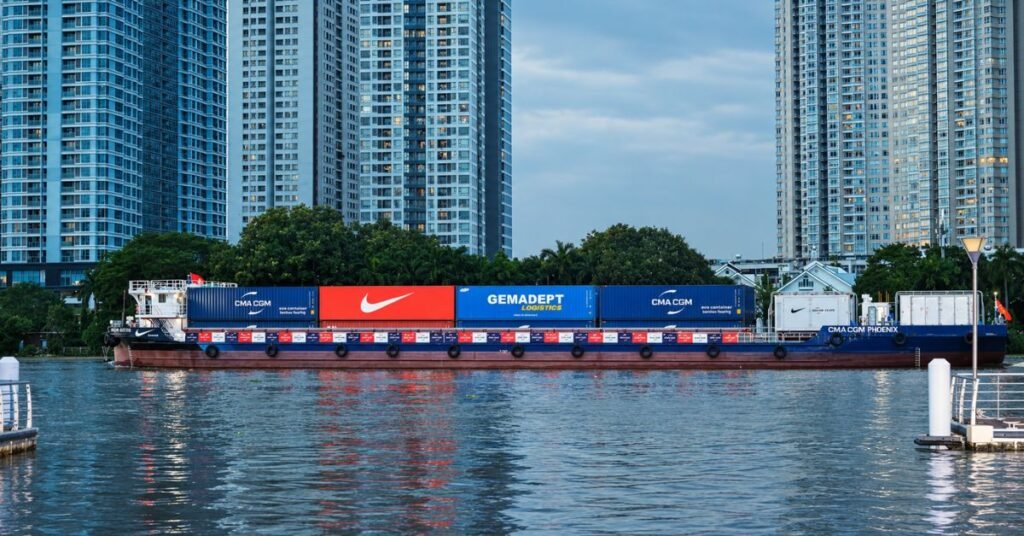
CMA CGM, Nike and Vietnamese port and logistics operator Gemadept have launched a fully electric container barge service in Vietnam, connecting Nike’s inland cargo operations in Ho Chi Minh City with the Gemalink deep-sea terminal at Cai Mep. Announced by CMA CGM on 29 October 2026, the service combines battery propulsion, terminal charging infrastructure and renewable electricity to reduce emissions from inland freight transport.
The partners expect the service to avoid approximately 778 tonnes of carbon dioxide emissions annually. Nike describes the vessel as Vietnam’s first fully electric river barge, introducing a new transport option for its supply chain in the country.
What route will the electric barge serve?
The barge operates on a 180-kilometre round trip between Nike’s inland drop-off location in Ho Chi Minh City, in the area formerly identified as Binh Duong province, and Gemalink at Cai Mep.
Designed to transport more than 50,000 twenty-foot equivalent units (TEUs) annually, the service provides an inland waterway alternative to road transport for container movements to the deep-sea terminal. The annual figure represents planned transport throughput, rather than the vessel’s capacity on an individual sailing.
The route links inland cargo consolidation with the maritime gateway used for onward shipping, placing electric propulsion within an established container logistics chain.
How will the vessel receive renewable power?
Developed by CMA CGM’s newbuilding and research and development teams, the barge uses battery technology supplied by CATL. Recharging takes approximately four hours, according to CMA CGM.
Dedicated charging equipment at Gemalink is supplied through a solar farm developed at the terminal. The arrangement combines the vessel, shoreside charging and certified renewable electricity within one transport service.
An earlier project announcement said the solar installation was expected to generate up to one gigawatt-hour of electricity annually. It positioned terminal-based power supply as a central component of the electric barge operation.
What does zero direct emissions mean?
The partners describe the barge’s operation as producing zero direct greenhouse gas emissions, with propulsion provided entirely by batteries.
That operational claim is distinct from a statement that the vessel and its supporting infrastructure have no emissions across their entire lifecycle. Separately, the partners forecast annual carbon dioxide savings of approximately 778 tonnes from the transport solution. This remains an expected reduction rather than a reported full-year operational result.
How was the partnership developed?
The launch follows an earlier agreement between CMA CGM and Gemadept to establish Green River Transportation, a joint venture intended to operate the electric barge and manage river transport services in the Mekong Delta.
Nike was identified as the first customer to commit cargo to the service, linking its Vietnam manufacturing network with Gemalink. The original project plan combined customer demand with investment in a vessel and its charging facilities.
How does the project fit Nike’s transport strategy?
Nike identifies transportation as one of four priorities for reducing value-chain emissions, alongside materials, manufacturing and its own operations. Its transport programme includes reducing air freight, expanding lower-carbon maritime fuels and increasing electric vehicle use.
The company reported that its wider measures helped reduce inbound and outbound transportation emissions by 56% in financial year 2025 compared with financial year 2020. The newly launched barge represents an additional initiative.
Nike’s 2030 science-based targets include reducing emissions across its extended supply chain by 35% from the financial year 2020 baseline.
Recent Posts
Fuels
ONE Symphony Joins 14,000-TEU Fleet as ONE Expands Alternative-Fuel-Ready Newbuildings
Dual-Fuel
COSCO Ethylene Carrier Investment Adds LNG Dual-Fuel Capacity to Fleet Plans
Ammonia
MOL Ammonia-Fuelled Bulkers Named as 2027 Delivery Programme Advances