
Summary
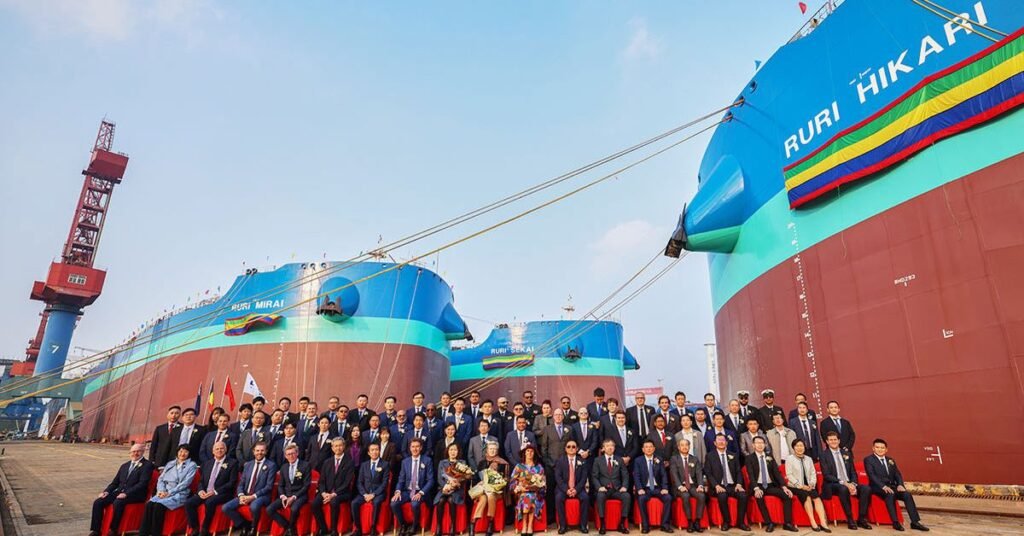
Mitsui O.S.K. Lines has named three ammonia-fuelled bulk carriers being developed with Belgium’s CMB.TECH. The vessels, Ruri Mirai, Ruri Sekai and Ruri Hikari, are scheduled for phased delivery from early 2027, marking a further step towards introducing ammonia propulsion into MOL’s ocean-going operations.
Naming ceremony precedes commercial deployment
The MOL ammonia-fuelled bulkers were named on 29 October at CSSC Qingdao Beihai Shipbuilding in China. MOL and CMB.TECH will jointly own the vessels, with MOL planning to employ them under long-term charter arrangements.
Each ship has approximately 209,800 tonnes of deadweight capacity, a length of 299.95 metres and a breadth of 50 metres. Two ammonia fuel tanks provide a combined storage capacity of 6,000 cubic metres per vessel.
MOL said it is developing operating procedures and comprehensive safety measures with relevant stakeholders ahead of deployment.
The naming ceremony marks construction progress. Delivery and entry into commercial service remain the next milestones, followed by the practical task of integrating a different fuel into routine operations.
Long-term charters underpin the investment
The programme forms part of a broader agreement announced by MOL, MOL Chemical Tankers and CMB.TECH in March 2025.
That agreement covered nine vessels: three ammonia-fitted Newcastlemax bulk carriers and six chemical tankers. CMB.TECH specified 12-year charters to MOL for each bulker, providing a substantial employment horizon for the jointly owned ships.
The chemical-tanker component comprised two ammonia-fitted vessels and four ammonia-ready ships, with charter periods of 10 and seven years respectively. Their deliveries were scheduled for 2028 and 2029.
The distinction between ammonia-fitted and ammonia-ready vessels is commercially important. The former incorporates the equipment needed for ammonia operation, while readiness describes provision for a subsequent conversion.
For the partners, long-term employment helps connect investment in new propulsion technology with a defined customer relationship. It also provides a framework within which operating experience, maintenance requirements and fuel arrangements can be developed.
Singapore bunkering demonstration planned
MOL has been working on fuel-delivery arrangements alongside vessel development.
In August 2025, it announced a joint development agreement with ITOCHU for ship-to-ship ammonia bunkering demonstrations in Singapore. The companies planned to use an ammonia bunkering vessel and MOL’s ammonia dual-fuel Capesize bulkers.
The demonstrations were scheduled for the second half of 2027, with the aim of supporting the early introduction of ammonia-fuelled shipping and dedicated bunkering services.
ITOCHU’s associated newbuilding is a 5,000-cubic-metre ammonia bunkering vessel ordered in June 2025 from Japan’s Sasaki Shipbuilding. At the announcement, delivery was scheduled for 2027, with registration under the Singapore flag.
These earlier plans illustrate the need to develop ships and their fuel-supply chain together. A vessel’s ability to consume ammonia must be matched by access to suitable fuel, transfer equipment and operating arrangements at the locations it serves.
Environmental performance depends on the fuel pathway
Ammonia contains no carbon and does not generate carbon dioxide from the ammonia itself during combustion. That characteristic explains its attraction as a potential marine fuel.
However, the environmental assessment extends beyond exhaust emissions. The International Maritime Organization’s lifecycle approach considers emissions from fuel production and supply through to use aboard the ship, covering carbon dioxide, methane and nitrous oxide.
The practical implication is that an ammonia-capable ship does not automatically deliver net-zero transport. Performance depends on the production pathway of the fuel supplied, onboard consumption and the control of other greenhouse-gas emissions.
For cargo customers evaluating lower-emission transport, credible fuel information and verified operational performance will therefore matter alongside the vessel specification.
Commercial operation will test the wider model
Introducing three large bulk carriers gives the partners an opportunity to build experience across a series of ships rather than a single installation.
The commercial task will encompass fuel procurement, bunkering coordination, crew preparation and dependable vessel operation. Long-term charters provide continuity, while the planned bunkering demonstrations address one of the practical links between fuel availability and ship deployment.
The phased deliveries from early 2027 will move the programme towards that operational stage. Its wider significance will rest on demonstrating that ammonia propulsion can support reliable bulk transportation alongside the infrastructure and procedures required for its use.
FAQs
What are the three vessels called?
Ruri Mirai, Ruri Sekai and Ruri Hikari.
When will deliveries begin?
Phased deliveries are scheduled from early 2027.
Who will own and operate them?
MOL and CMB.TECH will jointly own the vessels, with MOL employing them under long-term charters.
What is each vessel’s capacity?
Approximately 209,800 deadweight tonnes, with 6,000 cubic metres of ammonia fuel storage.
Are ammonia bunkering trials planned?
MOL and ITOCHU previously announced plans for ship-to-ship demonstrations in Singapore during the second half of 2027.
Recent Posts
Fuels
ONE Symphony Joins 14,000-TEU Fleet as ONE Expands Alternative-Fuel-Ready Newbuildings
Dual-Fuel
COSCO Ethylene Carrier Investment Adds LNG Dual-Fuel Capacity to Fleet Plans
Ammonia
MOL Ammonia-Fuelled Bulkers Named as 2027 Delivery Programme Advances