
Summary
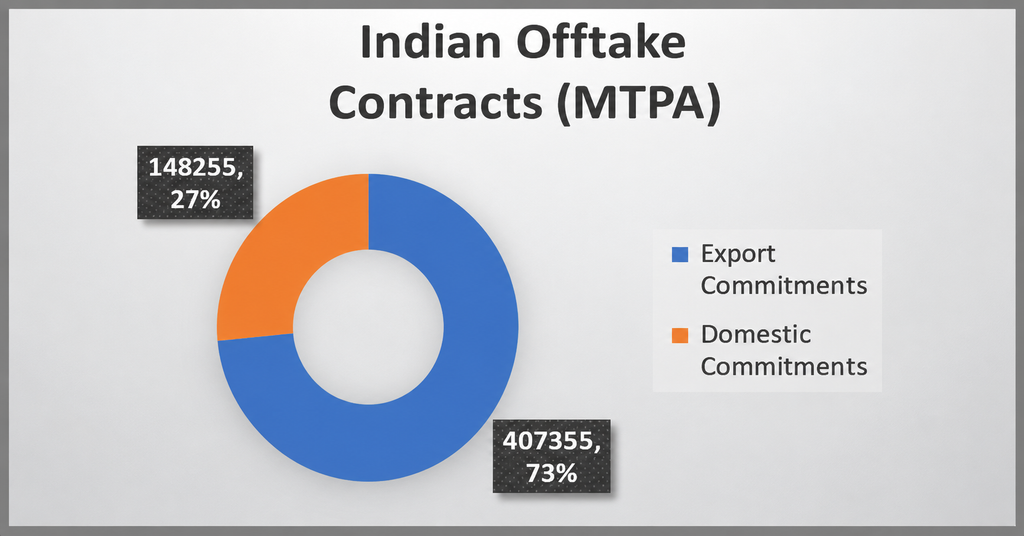
Indian companies have secured green hydrogen offtake commitments equivalent to 555,610 tonnes annually, with more than 70% earmarked for exports. The agreements strengthen demand visibility for proposed production projects and associated maritime supply chains. Delivering the commitments will require substantial investment, infrastructure development and the commissioning of production facilities.
Export agreements strengthen the project pipeline
India green hydrogen offtake commitments reached 555,610 metric tonnes per annum on a hydrogen-equivalent basis by October 2026, the Ministry of New and Renewable Energy announced on 29 October.
Indian companies signed 18 agreements during 2026, covering more than 400,000 tonnes annually of hydrogen equivalent. Since the National Green Hydrogen Mission began in 2023, the total has reached 23 contracts.
The government estimates that fulfilling the domestic and international agreements would require investment exceeding ₹90,000 crore. These figures describe contracted demand and prospective project expenditure. They do not represent current production or investment already completed.
Offtake agreements give developers a clearer view of future sales, helping them advance discussions with lenders, investors and infrastructure providers. Their commercial value ultimately depends on the contractual terms and the ability of both suppliers and buyers to meet their obligations.
Hydrogen-equivalent volumes require careful interpretation
The headline figure combines commitments involving hydrogen and derivatives such as green ammonia and green methanol.
Hydrogen-equivalent accounting provides a common basis for comparing these products. Physical tonnes of ammonia or methanol cannot therefore be added directly to the headline hydrogen figure.
For ports and shipping companies, the distinction is particularly relevant. Cargo-handling requirements depend on the actual product being transported, its physical volume, storage conditions and delivery schedule.
A hydrogen-equivalent commitment signals demand for production. Translating it into maritime business requires a further assessment of the derivative, export location, receiving terminal and transport arrangements.
Kakinada agreement connects production with marine fuel demand
A recent agreement between JERA and AM Green illustrates how an Indian project could serve an overseas maritime fuel market.
On 27 October, the companies announced a binding Heads of Agreement covering approximately 70,000 tonnes of green ammonia annually over five years, with provision for an extension.
Supply is planned from AM Green’s Kakinada facility in Andhra Pradesh, which is targeted for commissioning in 2028–29. The proposed production system combines renewable electricity, pumped-hydro storage and alkaline electrolysis.
In Japan, the ammonia is intended to pass through receiving, storage and distribution facilities being developed beside JERA’s Hekinan Thermal Power Station in Aichi Prefecture.
The principal intended customer is a proposed venture involving Kawasaki Kisen Kaisha and Nippon Yusen Kabushiki Kaisha, which plans to supply ammonia-fuelled car carriers using a bunkering vessel.
The arrangement shows that securing a buyer is one part of a longer chain extending from renewable power generation to fuel delivery aboard ships.
Domestic demand complements overseas commitments
Domestic procurement is also developing through the Strategic Interventions for Green Hydrogen Transition programme.
Agreements cover 670,000 tonnes annually of green ammonia for 11 fertiliser units. Projects have separately been awarded for 30,000 tonnes annually of green hydrogen for refineries operated by Indian Oil, Bharat Petroleum, Hindustan Petroleum and Numaligarh Refinery.
These procurement volumes are stated in their respective products. They should not be added to the national hydrogen-equivalent commitment figure without establishing the accounting basis and whether any volumes overlap.
Domestic industrial demand can provide another route to market alongside exports, connecting production projects with established users of hydrogen and ammonia.
Mission targets provide the longer-term context
The National Green Hydrogen Mission aims to develop capacity to produce at least five million tonnes of green hydrogen annually by 2030.
Its original framework identifies petroleum refining, fertilisers, steel and transport fuels among the potential applications. It also recognises that delivered costs extend beyond electrolysers and renewable electricity to financing, water treatment, storage, distribution and conversion into derivatives.
The latest commitments amount to roughly 11% of the mission’s annual production target. That comparison indicates the scale of demand secured, rather than the proportion of production capacity commissioned.
For India’s maritime industry, the opportunity lies in converting those commitments into dependable cargo flows and fuel services. Production facilities, storage terminals, shipping arrangements and receiving infrastructure will need to progress together for signed agreements to become sustained trade.
FAQs
How much green hydrogen offtake has India secured?
Commitments total 555,610 tonnes annually on a hydrogen-equivalent basis as of October 2026.
What proportion is earmarked for exports?
More than 70% of the contracted volumes.
Does this figure represent operational production?
No. It measures supply commitments, including hydrogen derivatives, rather than commissioned output.
What is the National Green Hydrogen Mission’s target?
Annual green hydrogen production capacity of at least five million tonnes by 2030.
How does the JERA agreement relate to shipping?
The planned ammonia supply from Kakinada is intended primarily to support bunkering for ammonia-fuelled car carriers in Japan.
Recent Posts
Fuels
ONE Symphony Joins 14,000-TEU Fleet as ONE Expands Alternative-Fuel-Ready Newbuildings
Dual-Fuel
COSCO Ethylene Carrier Investment Adds LNG Dual-Fuel Capacity to Fleet Plans
Ammonia
MOL Ammonia-Fuelled Bulkers Named as 2027 Delivery Programme Advances