
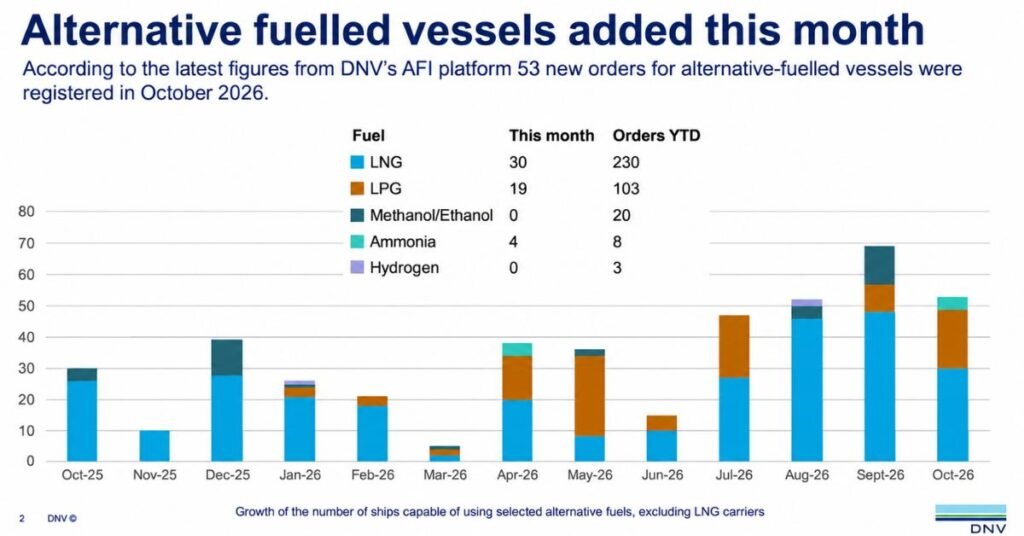
Shipowners ordered 53 alternative-fuel-capable vessels in October 2026, taking the global total for the first ten months to 364, up 57% against the same period last year, according to DNV’s Alternative Fuels Insight (AFI) platform. Liquefied natural gas (LNG) remained the leading choice, with container ships and car carriers driving demand.
Which fuels led October’s orders?
LNG accounted for 30 orders during October, comprising 18 container ships and 12 car carriers. The monthly additions also included 19 liquefied petroleum gas (LPG) carriers and four ammonia-fuelled car carriers.
Across January–October, LNG vessel orders reached 230. Container ships accounted for 134 of these, followed by 75 car carriers, together representing approximately nine in ten LNG orders.
Jason Stefanatos, Global Decarbonisation Director at DNV Maritime, linked LNG’s continued prominence to its comparatively established fuel supply and expanding bunker-vessel fleet. He also highlighted the option of moving towards lower-carbon fuels during a vessel’s operating life.
The figures show that alternative-fuel investment remains concentrated in vessel segments closely connected to consumer supply chains, particularly containerised goods and vehicle transport.
How does October compare with the recent recovery?
October followed an exceptionally active third quarter, when AFI recorded 168 alternative-fuel vessel orders, the highest quarterly total since the third quarter of 2024.
September contributed 69 orders, including 48 LNG vessels, 12 ethanol-fuelled bulk carriers and nine LPG-fuelled vessels. That month took the January–September total to 311, up 53% year on year.
Although October’s 53 orders were below September’s total, contracting continued at a level sufficient to increase the year-on-year growth rate. The September bulk-carrier orders also demonstrated that investment was extending beyond the container and vehicle-carrier segments.
DNV’s September assessment described the recovery as following a slower start to 2026, with owners continuing to invest in alternative-fuel capability despite differing operating requirements across shipping sectors.
Does vessel capability guarantee lower emissions?
A ship’s ability to use an alternative fuel does not establish which fuel it will consume throughout its service life. Fuel availability, cost, infrastructure and regulatory incentives remain important determinants of actual uptake.
DNV’s broader research identifies low-carbon methane as a potential pathway for LNG-capable vessels. Bio-LNG and synthetic LNG could allow existing ships and infrastructure to support lower-emission operations as suitable supplies become available.
However, the transition requires more than compatible engines. DNV identifies technology and safety, demand and costs, and fuel availability as three central barriers to scaling lower-greenhouse-gas fuels.
Its research also highlights the need for crew competence and training as more ships enter service with unfamiliar fuel-handling requirements.
What will determine the next phase of investment?
DNV’s Maritime Forecast to 2050, published in August 2026, examines how different regulatory outcomes could influence fuel demand and fleet investment.
The report projects shipping demand for low-greenhouse-gas fuels at between 4 million and 22 million tonnes of oil equivalent by 2030, depending on regulatory developments. This wide range illustrates the uncertainty facing fuel producers and shipowners.
Current project pipelines indicate a potential maximum global supply of 270 million tonnes of oil equivalent by 2030. DNV cautions that actual output is likely to be lower because of delays and other uncertainties, while shipping will compete with other industries for available volumes.
The organisation recommends evaluating fleet strategies across several regulatory and market scenarios. Energy-efficiency upgrades, operational improvements and fuel flexibility can help owners manage changing costs and requirements while the production and distribution of lower-emission fuels develops.
Recent Posts
Technology
ClassNK Updates Ship Cyber Security Guidelines to Align with Major Vetting Schemes
Marine
Lloyd’s Register Report Examines How Ports Worldwide Are Preparing for Maritime Fuel Transition
Methanol
OOCL Grace takes on 983 tonnes of green methanol at Yantian