
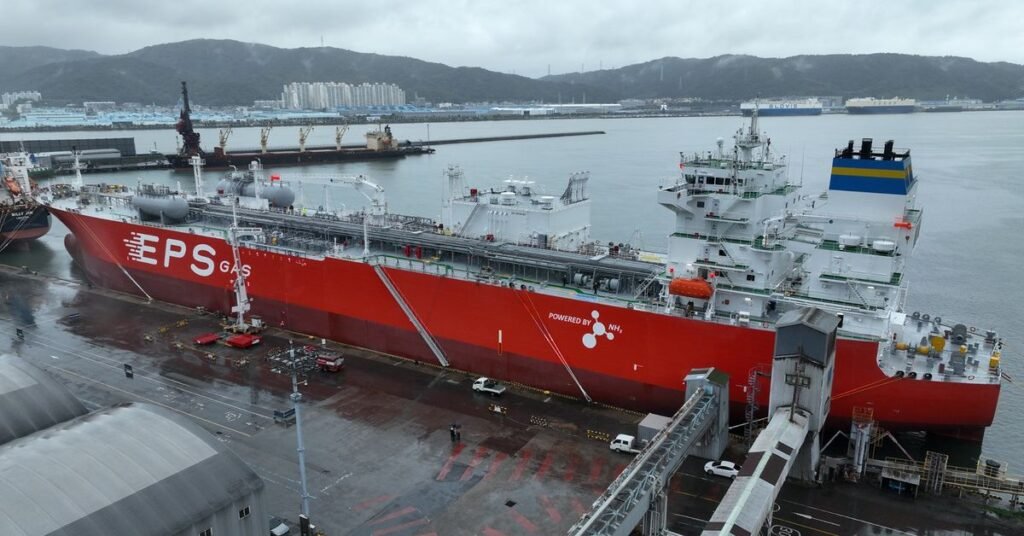
Ulsan Port has supplied 800 tonnes of renewable-energy-based ammonia to Terra Clove, completing what Ulsan Port Authority (UPA) described as South Korea’s first commercial ammonia marine-fuel supply demonstration. The operation took place at Pier 2 of Ulsan Main Port on 25–26 October 2026, with the authority announcing completion on 27 October.
How was the ammonia transferred?
The very large ammonia carrier received fuel through a port-to-ship arrangement, directly connecting shoreside facilities to the vessel by pipeline.
Five organisations participated: UPA, fuel supplier Lotte Fine Chemical, shipbuilder and sea-trial partner HD Hyundai Heavy Industries, site-management company Shinheungsa, and vessel owner Eastern Pacific Shipping (EPS).
This was Ulsan’s fourth ammonia marine-fuel supply demonstration since April 2026. The previous three supported sea trials for medium-sized carriers. UPA distinguished the latest operation as commercial fuel supply to a very large carrier.
The authority plans to use the experience to expand its commercial ammonia supply arrangements. UPA President Byeon Jae-young said continued cooperation with participating organisations would support Ulsan’s development as an alternative marine-fuel hub.
What makes Terra Clove significant?
Built by HD Hyundai Heavy Industries, Terra Clove has a cargo capacity of 93,000 cubic metres. EPS named the vessel at the shipbuilder’s Ulsan yard on 22 October.
Its propulsion system features an Everllence B&W 6G60ME-C10.5-LGIA ammonia dual-fuel two-stroke engine, manufactured under licence by HD Hyundai Heavy Industries’ Engine & Machinery Business Unit.
The vessel can operate on ammonia while retaining the ability to use conventional marine fuel. EPS identifies it as the world’s first ammonia dual-fuel very large ammonia carrier.
The project follows a collaboration formalised in September 2023 involving EPS, the shipbuilder, Everllence, the Maritime and Port Authority of Singapore, and classification society American Bureau of Shipping. Work extended beyond propulsion development to regulatory engagement, technical assurance and specialised crew training.
Where does the green ammonia come from?
E-ammonia is produced by combining nitrogen with hydrogen obtained through water electrolysis powered by renewable electricity.
Ahead of the bunkering operation, EPS identified Envision Energy as the producer of the green ammonia to be supplied through Lotte Fine Chemical in Ulsan. The owner said the fuel would support Terra Clove’s ammonia-burning trials and provide practical operating experience.
EPS says renewable-energy-based ammonia offers the potential for significant lifecycle greenhouse gas reductions compared with conventional marine fuels. The vessel’s dual-fuel capability alone does not establish its actual emissions performance.
How is ammonia-fuel safety developing?
The International Maritime Organization approved interim safety guidelines for ammonia-fuelled ships in December 2024. These address arrangements including containment, ventilation, leak detection, shutdown systems and personnel protection.
The guidelines seek safety and reliability comparable with conventional oil-fuelled machinery. They are provisional and intended to evolve as operational experience increases.
Their scope excludes ships covered by the international gas-carrier code and does not address using ammonia cargo as fuel, an important distinction when considering ammonia carriers. They nevertheless form part of the wider international work supporting ammonia’s introduction across shipping.
What support is Ulsan offering fuel users?
UPA introduced a cash-incentive scheme in 2026 for qualifying international cargo vessels bunkering liquefied natural gas, methanol, ammonia or hydrogen at Ulsan.
Announced on 3 April, the scheme offers up to KRW10 million per vessel, with a lower ceiling of KRW5 million for delivery departures and transit vessels. The authority allocated KRW100 million, with support available on a first-come basis until the budget is exhausted.
The programme complements existing port-charge measures and is intended to reduce bunkering-related costs while attracting alternative-fuel demand.
Recent Posts
Technology
ClassNK Updates Ship Cyber Security Guidelines to Align with Major Vetting Schemes
Marine
Lloyd’s Register Report Examines How Ports Worldwide Are Preparing for Maritime Fuel Transition
Methanol
OOCL Grace takes on 983 tonnes of green methanol at Yantian