
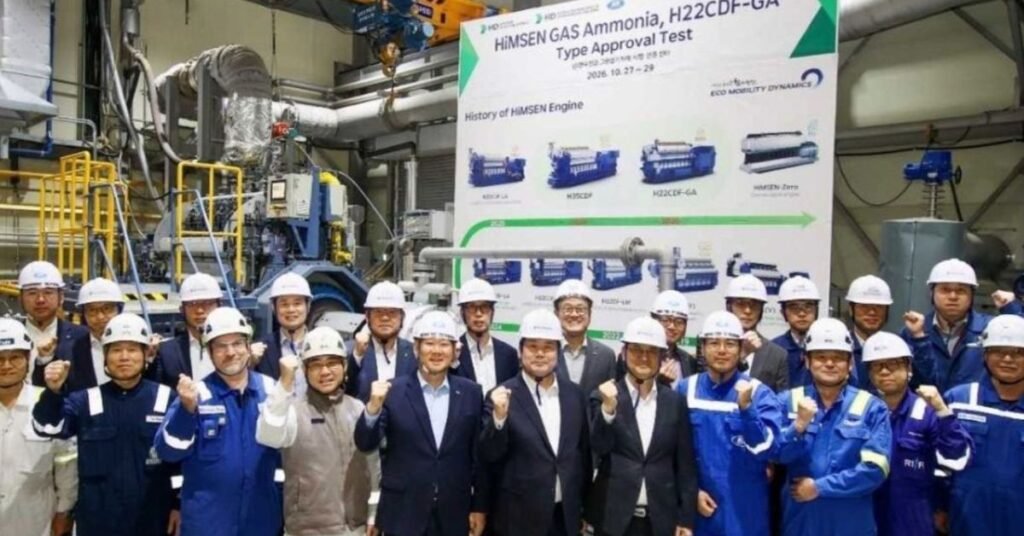
HD Hyundai Heavy Industries Engine & Machinery (HHI-EMD) has completed type approval testing for its HiMSEN H22CDF-GA low-pressure gaseous ammonia dual-fuel engine, expanding the fuel-system options available in its ammonia engine portfolio.
Testing took place from 27–29 October 2026 at Korean Register’s Green Ship Equipment Test & Certification Center in Gunsan, South Korea. Representatives from seven classification societies witnessed the programme, including Korean Register, American Bureau of Shipping, Bureau Veritas, DNV, ClassNK, Lloyd’s Register and RINA.
How does the new ammonia engine differ?
The H22CDF-GA uses a low-pressure gaseous ammonia supply system based on the Otto-cycle concept. HHI-EMD says this arrangement simplifies fuel supply compared with its high-pressure liquid ammonia designs.
The company’s existing H22CDF-LA and H32CDF-LA models use the Diesel-cycle concept and completed type approval testing in 2024 and 2025 respectively.
HHI-EMD says the expanded range allows it to match different customer requirements through both liquid and gaseous ammonia technologies.
The Gunsan programme also marked the first HiMSEN engine type approval test conducted at Korean Register’s specialised facility. The companies plan to extend their technical cooperation on performance verification and certification for alternative-fuel engines.
How has the HiMSEN ammonia range developed?
The earlier H32CDF-LA programme expanded the output available from HHI-EMD’s four-stroke ammonia engines.
Built on the H32C diesel-engine platform, that model supports power requirements of up to 5.4 megawatts, compared with up to 2.2 megawatts for the H22CDF-LA.
Its development incorporated high-pressure direct-injection combustion technology and an electro-hydraulic fuel-boosting unit. HHI-EMD said the larger engine broadened the range of power requirements that its ammonia portfolio could address.
The H32CDF-LA underwent classification testing at the company’s Engine Technology Center from 29 September to 2 October 2025. The manufacturer linked that programme to its plans to develop alternative-fuel machinery and expand into electric-propulsion applications.
Ammonia propulsion testing extends beyond HiMSEN
HHI-EMD has also participated in the development and testing of ammonia-fuelled two-stroke propulsion equipment.
In January 2026, WinGD completed type approval and factory acceptance testing of its X52DF-A-1.0 engine at HHI-EMD’s South Korean facility. The programme involved a 52-centimetre-bore engine intended for an EXMAR gas carrier with a cargo capacity of 46,000 cubic metres.
WinGD’s X-DF-A technology uses high-pressure ammonia injection, supported by a targeted pilot-fuel contribution of around 5% at full load. Lloyd’s Register and representatives of other classification societies witnessed the tests under EXMAR’s supervision.
That programme illustrates the parallel development of ammonia machinery across different engine types and vessel requirements.
What does ammonia adoption require at vessel level?
Engine development forms one part of the wider work needed to introduce ammonia safely as marine fuel.
The International Maritime Organization approved interim guidelines for ammonia-fuelled ships at its Maritime Safety Committee meeting in December 2024. These provide a basis for assessing ship designs and fuel installations.
The UK Maritime and Coastguard Agency identifies toxicity, corrosiveness and storage requirements among the principal design challenges. Ammonia’s lower energy density also means vessels require greater fuel-tank capacity than comparable diesel arrangements.
Its guidance calls for risk-based assessment, appropriate handling systems, crew preparation and coordination with ports and suppliers. The agency also notes that ammonia’s potential for low lifecycle emissions depends on its production pathway, including the use of renewable energy.
For shipowners considering ammonia machinery, these requirements connect engine selection with vessel layout, operational procedures and dependable fuel infrastructure.
Recent Posts
Marine
Petrobras advances Tupi Field redevelopment with LR approval for FPSO concept
Power & Propulsion
Wärtsilä secures engine and propulsion order for Delfin LNG’s first FLNG vessels
Marine
StormGeo and CCS link emissions platforms to support digital verification in China