
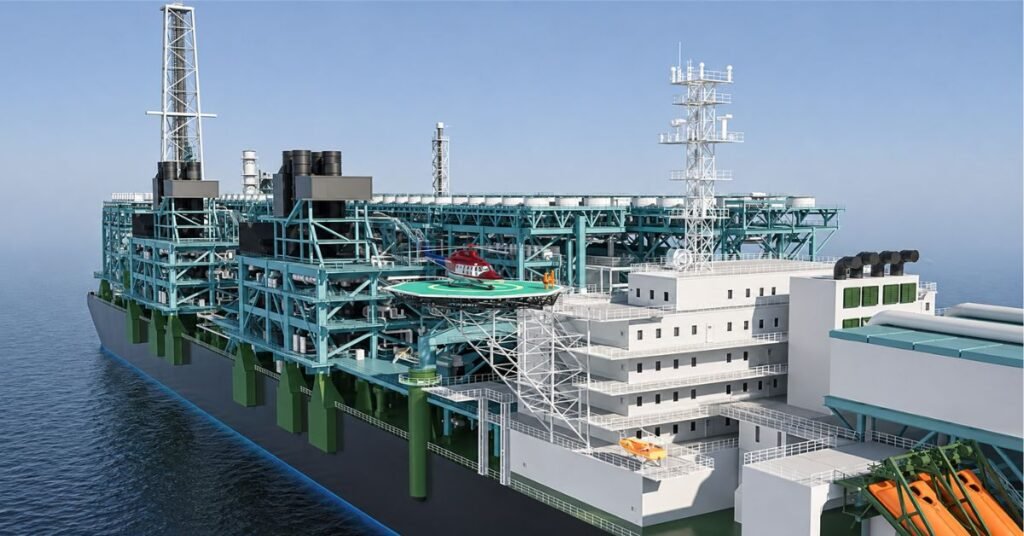
Wärtsilä has secured an order to supply dual-fuel engines and propulsion equipment for the first Floating Liquefied Natural Gas (FLNG) vessels being constructed by Samsung Heavy Industries (SHI) for the US-based Delfin LNG project. The equipment will support the vessels’ propulsion, operational reliability and emissions management. The order was booked in the second quarter of 2026.
The vessels will serve the Port Delfin LNG project, located approximately 40 nautical miles off the coast of Louisiana, North America. The offshore facility is designed to receive natural gas through existing onshore and offshore pipelines before processing, storing and exporting it as LNG.
Wärtsilä collaborated with the project partners during the front-end engineering (FEED) phase to develop a propulsion arrangement suited to the operational requirements of the FLNG vessels. A key consideration is the ability to disconnect the facility and move it to a safer location when a hurricane warning is issued.
“Being able to disconnect in case of a hurricane warning and sail to a safe location is essential for an FLNG Vessel off the coast of Louisiana. The chosen propulsion arrangement, including the ability to hoist the thrusters for inboard maintenance prior to the hurricane season, is part of the solution designed for reliable operations and to ensure the safety of crew and asset,” comments Björn Axfors, Lead Engineer Hull & Marine, Delfin.
The equipment package includes three Wärtsilä 46DF dual-fuel engines and an exhaust gas treatment system incorporating Selective Catalytic Reduction (SCR) and Oxicat technologies. The vessels will also feature three custom-designed, inboard-mountable thrusters.
According to Wärtsilä, the thrusters will be the largest units the company has manufactured and the largest of their type currently operating worldwide. Their patented inboard demountable design allows maintenance to be performed from inside the vessel, reducing the need for external intervention and minimising operational downtime.
“We are pleased to continue our collaboration with Wärtsilä on the Delfin LNG project. Wärtsilä’s proven dual-fuel engines and steerable thrusters, supported by close cooperation between our two companies throughout the project, have contributed to meeting the specific requirements of the project. We look forward to working together to deliver a successful FLNG project and to further strengthening our partnership as the FLNG market continues to grow,” adds Youngjin Jeong, Vice President of Offshore Procurement Team, SHI.
The propulsion arrangement is designed to support the vessel’s ability to relocate during severe weather conditions, while the inboard thruster configuration allows maintenance to be undertaken without requiring the equipment to be removed externally. The combination of dual-fuel engines and exhaust gas treatment technology is intended to support fuel efficiency and emissions control during operations.
“The growing interest in FLNG projects reflects the increasing need for flexible energy infrastructure that can be deployed quickly and operated efficiently. Success in these applications depends on optimising efficiency, reliability and environmental performance from the earliest design stages. By combining our expertise in propulsion, vessel integration and lifecycle support, we are helping customers develop solutions that meet both current operational needs and future expectations,” says Bernd Bertram, Vice President, Propulsion, Wärtsilä Marine.
Wärtsilä equipment deliveries are scheduled to begin in the third quarter of 2027. The FLNG vessel is expected to enter operation in early 2030.
Recent Posts
Marine
Petrobras advances Tupi Field redevelopment with LR approval for FPSO concept
Power & Propulsion
Wärtsilä secures engine and propulsion order for Delfin LNG’s first FLNG vessels
Marine
StormGeo and CCS link emissions platforms to support digital verification in China