
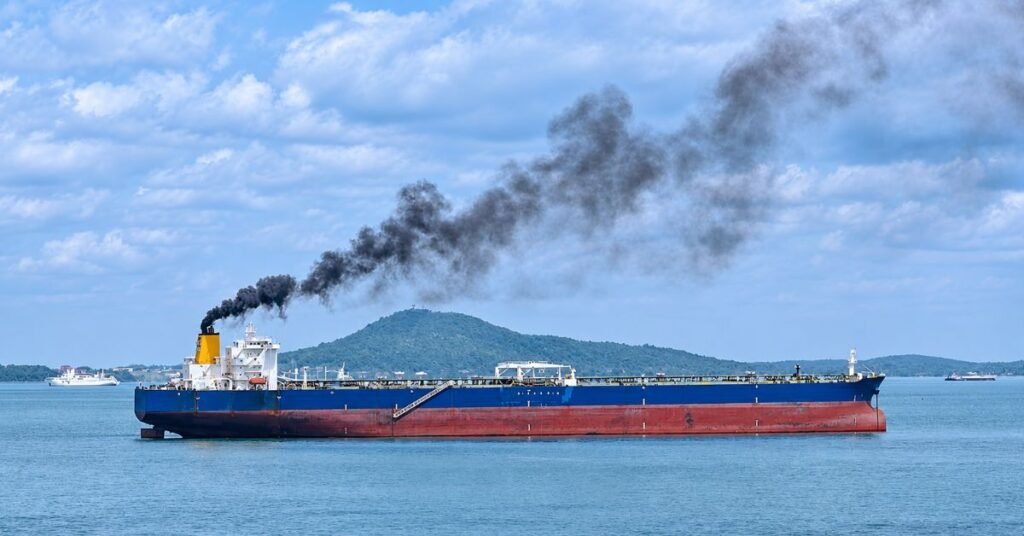
International shipping’s carbon dioxide emissions between 1990 and 2020 are associated with an estimated US$962.7 billion in global economic damage, according to an analysis published by Zero Carbon Analytics (ZCA) on 5 November 2026.
The study examines approximately 19.03 billion tonnes of cumulative emissions from international voyages. It applies a climate-damage model with a 2% discount rate to estimate their economic consequences. The findings add an assessment of historical climate costs to the debate over shipping’s transition to lower-emission fuels.
Which countries face the largest estimated impacts?
ZCA attributes US$280.7 billion in damage to the United States, US$113.5 billion to China and US$66.8 billion to Japan.
Relative impacts are higher in several Middle Eastern and African economies. Estimated losses correspond to 0.35% of the United Arab Emirates’ 2020 gross domestic product (GDP), 0.34% for Saudi Arabia, 0.32% for Mali and 0.30% for Burkina Faso.
The national estimates allocate shipping’s global damage total according to the geographical distribution of losses associated with global emissions. They therefore depend on an assumption that shipping emissions produce a similar country-by-country pattern of economic harm.
How does the economic damage model work?
The underlying research, led by Stanford University’s Marshall Burke and published in Nature in March 2026, connects emissions with warming and changes in economic output. Its framework allows researchers to estimate damage associated with emissions from particular countries, companies or activities.
An important feature is the treatment of delayed effects. A period of unusually high temperatures can affect economic performance beyond the year in which it occurs, allowing impacts on growth to accumulate.
Stanford’s researchers said their updated estimates were substantially higher than earlier results because they incorporated additional long-term effects of warming. Applying the framework also requires choices about discount rates and the period over which responsibility is assessed.
The estimates focus on economic output. They do not fully capture harms such as biodiversity loss, damage to cultural homelands or all consequences of sea-level rise and extreme weather. These boundaries are important when interpreting the shipping analysis as a modelled assessment of climate-related damage.
What benefits could shipping decarbonisation deliver?
ZCA estimates that a pathway resembling the IMO’s proposed Net-Zero Framework could avoid 14.2 billion tonnes of carbon dioxide-equivalent emissions during 2026–2050 and approximately 1.5 million temperature-related deaths by 2100.
Those projections use a policy scenario similar to the proposed framework and remain conditional on the assumed emissions reductions being achieved.
What would the IMO framework regulate?
The International Maritime Organization’s (IMO) proposed framework combines a global marine-fuel standard with a greenhouse gas emissions-pricing mechanism.
The fuel standard would progressively lower the emissions intensity of energy used onboard ships. Its lifecycle approach covers emissions from fuel production through to consumption, including carbon dioxide, methane and nitrous oxide.
The Marine Environment Protection Committee (MEPC) approved draft amendments in April 2025. Formal adoption remains outstanding following the adjournment of the extraordinary session in October 2025.
The distinction matters for shipowners and fuel suppliers assessing future compliance requirements. Approval of draft text forms one stage in the process towards legally binding international rules.
Further technical negotiations are scheduled for 23–27 November 2026, followed by MEPC 85 from 30 November to 3 December. The extraordinary session is scheduled to resume on 4 December, subject to confirmation by MEPC 85. The new analysis arrives ahead of these discussions over the design and implementation of shipping’s emissions measures.
Recent Posts
Marine
Petrobras advances Tupi Field redevelopment with LR approval for FPSO concept
Power & Propulsion
Wärtsilä secures engine and propulsion order for Delfin LNG’s first FLNG vessels
Marine
StormGeo and CCS link emissions platforms to support digital verification in China