
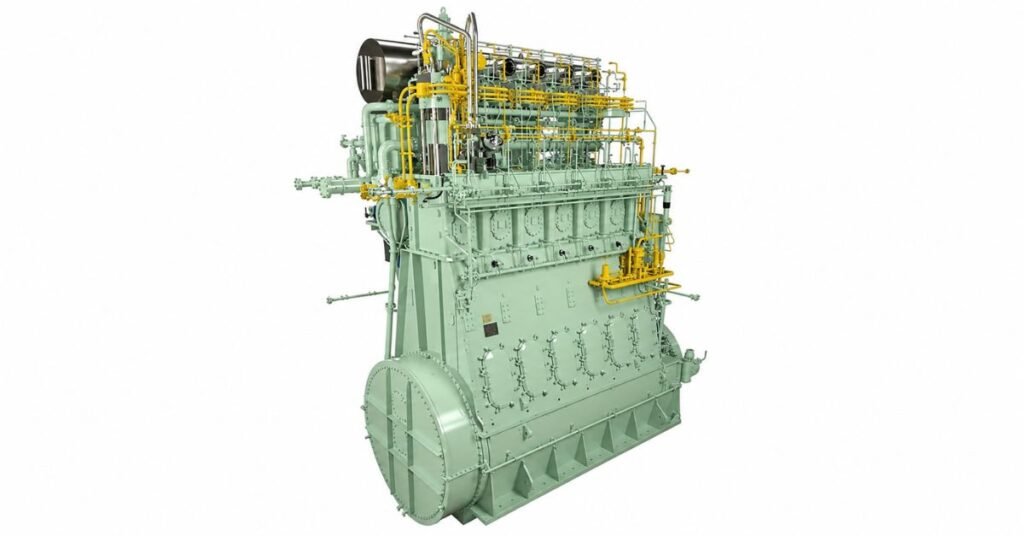
Everllence has secured more than 2,000 orders for small-bore generator-set engines in 2026 to date, the company announced on 10 November. The milestone reflects demand for marine auxiliary power equipment as shipowners balance operational reliability with preparations for alternative fuels.
The engines, designed and developed in Denmark, support onboard electricity generation and propulsion applications across several vessel categories. Everllence attributed the order intake to demand for reliable equipment, fuel efficiency and manageable maintenance costs.
What is driving demand for small-bore engines?
Rasmus Frimann Nielsen, Everllence’s head of small-bore four-stroke engineering, said customers were prioritising equipment that delivers operational benefits while retaining flexibility for future fuel choices.
The company is investing in dual-fuel auxiliary engines and designs intended to facilitate retrofits, including developments involving methanol and ammonia. Its global service network supports the small-bore portfolio throughout the equipment’s operating life.
Lars Zimmermann, head of small-bore four-stroke promotion, emphasised the importance of commercially deployable technology alongside longer-term development.
Everllence did not disclose the aggregate value of the orders, a comparable figure for 2025 or a breakdown between conventional and alternative-fuel engines. The announcement reports orders received, rather than engines delivered or installed.
How does the methanol portfolio support fuel flexibility?
Everllence’s small-bore methanol range includes the L21/31DF-M and L27/38DF-M. Both can operate on methanol or conventional liquid fuels and serve as generator sets or support diesel-electric propulsion.
The designs build on the conventional L21/31 and L27/38 platforms. Everllence reports more than 5,700 conventional engines from these families in service, with combined operating experience exceeding 290 million hours.
For merchant vessels, the methanol variants can provide auxiliary electricity on container ships, tankers, bulk carriers and vehicle carriers. Smaller vessels can use the engines within diesel-electric propulsion arrangements.
The L21/31DF-M uses port fuel injection, with the methanol injection nozzle positioned outside the combustion chamber. The larger L27/38DF-M uses a low-pressure methanol supply system and fuel oil for pilot ignition.
Everllence identifies e-methanol and biomethanol as compatible fuels. Their availability and production pathways remain relevant to the emissions performance achievable in individual vessel operations.
What output and integration options are available?
Everllence lists mechanical output of 1,000–1,980 kilowatts for the L21/31DF-M, operating at 900–1,000 revolutions per minute. Its corresponding electrical output range is 950–1,880 kilowatts.
The company positions the generator set as a companion to its ME-LGIM methanol-fuelled two-stroke main engine, allowing shipowners to select methanol-capable equipment for both propulsion and auxiliary power. The same published output range also applies to the conventional L21/31 Mk2 generator set.
Early commercial orders included six seven-cylinder L21/31DF-M units for China Merchants Heavy Industry. Those units were specified for two pure car and truck carriers equipped with ME-LGIM main engines, illustrating the integration of methanol technology across separate onboard power requirements.
What certification milestones underpin deployment?
China Classification Society (CCS) awarded an approval certificate for the L21/31DF-M methanol dual-fuel engine at a ceremony in Copenhagen on 10 June 2025.
CCS said the certification followed cooperation with Everllence throughout the approval process. It was also the first classification society approval certificate received by the company following its renaming from MAN Energy Solutions.
The approval provides a documented certification milestone for the methanol product within Everllence’s broader auxiliary-engine portfolio, whose latest order intake spans the small-bore range as a whole.
Recent Posts
Policy
Green port investment needs long-term finance and stable policies, Ningbo dialogue hears
Marine
Alpha Trading acquires Trieste fuel terminal, plans €20 million upgrade
Hydrogen
Hanwha Aerospace gains Korean Register approval for 200 kW marine hydrogen fuel cell