
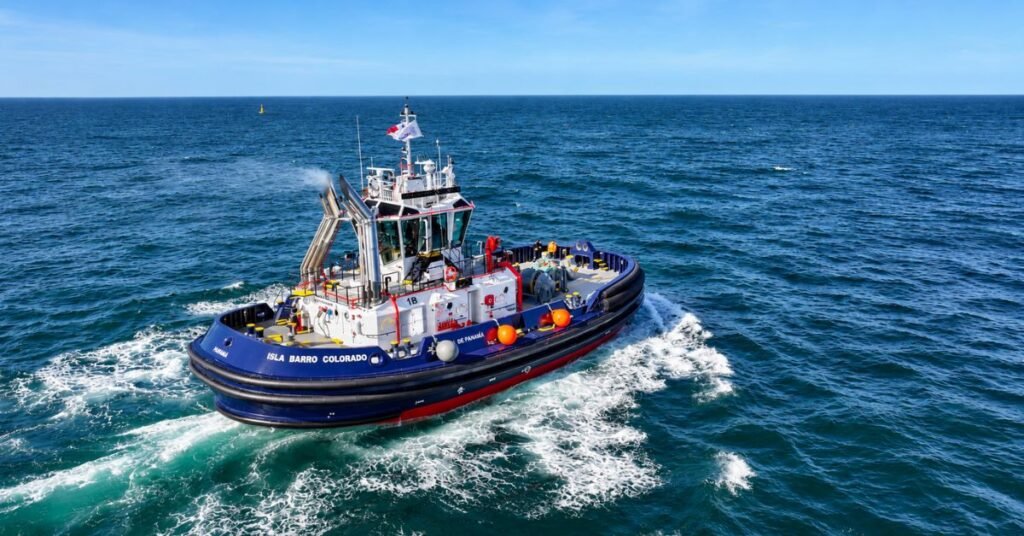
The Panama Canal Authority (ACP) has reached the halfway point in its 20-vessel hybrid-electric tug programme following delivery of Isla Otoque, the tenth tug built by Spain’s Astilleros Armón. The vessel was delivered in October 2026 and reached Panama by early November after crossing the Atlantic.
The approximately US$300 million programme supports fleet renewal and strengthens ship-handling operations along the waterway connecting the Caribbean and Pacific. ACP initially ordered ten tugs in 2023 and exercised an option for another ten in 2026.
Which vessels have been delivered?
Armón completed five vessels during 2026: Isla Coiba in February, Isla Farallón in April, Isla Galeta in June, Isla Jicarón in August and Isla Otoque in October.
They followed Isla Barro Colorado, Isla Bastimentos, Isla Boná, Isla Cañas and Isla Cébaco, delivered between April and December 2025. Construction is being undertaken at Armón’s Navia shipyard in Spain.
The tractor tugs combine diesel propulsion with battery-supported electric power for towing and manoeuvring vessels through canal operations.
What are the tugs’ principal specifications?
ACP’s specifications for the lead vessel, Isla Barro Colorado, give a length of 28.9 metres and a beam of 14 metres. The tug develops 80 tonnes of bollard pull, a measure of towing force, and has two engines rated at 2,331 kilowatts each.
Its hybrid installation includes a battery system rated at 445 kilowatts. The vessel also carries a Fire Fighting 1, or FiFi 1, system and incorporates accommodation and ergonomic features intended to improve working conditions for its crew.
The series uses Corvus Orca energy storage systems and azimuth thrusters. The tugs are classed by the American Bureau of Shipping (ABS) and have a reported maximum speed of 12.5 knots.
How does hybrid propulsion support canal operations?
ACP says the combination of diesel engines, electric motors and battery storage improves energy management while supporting reliable manoeuvring. The authority expects the arrangement to lower fuel consumption and emissions, reduce maintenance expenditure and extend equipment life.
The operational objective is to provide dependable ship-handling capacity while reducing the environmental impact of the supporting fleet. These vessels retain diesel engines, with batteries forming part of an integrated propulsion system.
At a ceremony marking the addition of five hybrid tugs, Canal administrator Ricaurte Vásquez Morales linked the investment to maintaining a cleaner and more efficient operation. Deputy administrator Ilya Espino de Marotta highlighted the role of captains, seafarers, pilots, mechanics, engineers and support personnel in operating the new technology.
Who supplies the engines and technical support?
Wabtec and its Latin American channel partner, Marinsa International, announced the engine contract for the initial ten vessels in November 2023. Each tug was specified with two Wabtec 8L250MDA marine engines.
Wabtec stated that the engines meet International Maritime Organization (IMO) Tier II emissions standards. It also specified approximately 60,000 operating hours before overhaul, subject to compliance with the prescribed maintenance schedule.
Marinsa’s responsibilities cover installation and commissioning support in Spain, followed by service support for the operating fleet in Panama. Wabtec identified its Grove City facility in Pennsylvania as the manufacturing location for the engines.
The programme builds on an established relationship between ACP and Armón. The Spanish shipbuilder previously constructed 14 tugs for the Canal between 2011 and 2015. The current series introduces battery-supported propulsion into that continuing fleet modernisation effort.
Recent Posts
Policy
Green port investment needs long-term finance and stable policies, Ningbo dialogue hears
Marine
Alpha Trading acquires Trieste fuel terminal, plans €20 million upgrade
Hydrogen
Hanwha Aerospace gains Korean Register approval for 200 kW marine hydrogen fuel cell