
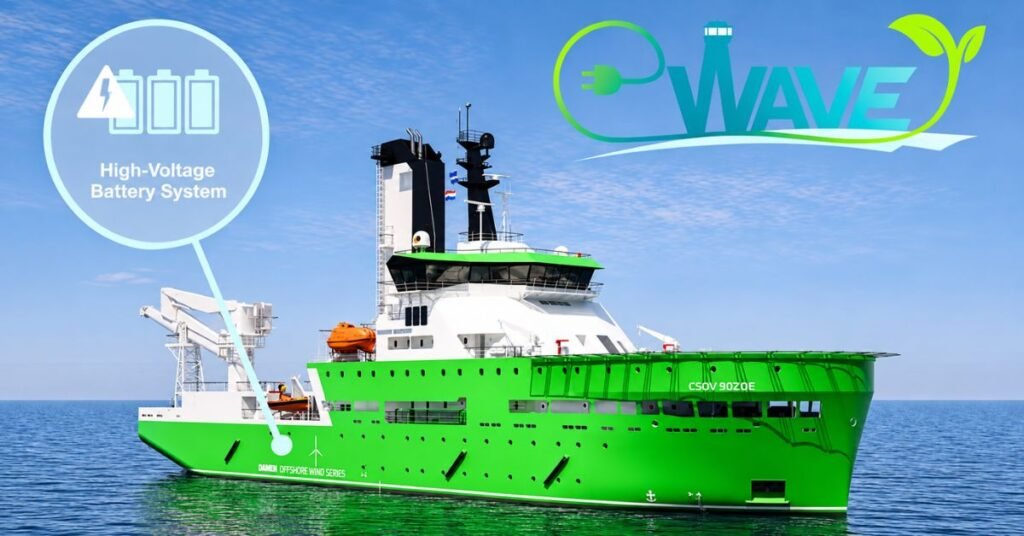
The European Union-funded eWAVE project is developing a modular high-voltage battery and power distribution system designed to support the electrification of vessels across multiple maritime segments. The initiative focuses on integrating battery storage, power electronics, monitoring and energy management into a scalable system for all-electric ships.
Launched in February 2025 under the Horizon Europe programme, eWAVE (Efficient HV Electric Modular Battery and Distribution Systems for Sustainable Waterborne Vessels) brings together 18 partners from nine countries. Coordinated by Austrian energy and innovation specialist i2m, the 48-month project aims to develop and demonstrate high-voltage battery technology for maritime applications.
The project has set a target system energy density of at least 185 Wh/dm³, a 20% reduction in battery module housing weight and the development of a scalable 1,500V DC battery system. Its modular architecture is intended to support future installations exceeding 1 MWh and operating at higher voltage levels.
Modular battery architecture for maritime electrification
The eWAVE system combines modular battery units with power electronics and integrated control mechanisms. Its architecture is based on modular base units (MBUs), which connect battery modules with bidirectional modular multilevel converters.
When connected in series, these units form battery strings operating at approximately 1.5 kV DC. A string master controller coordinates the operation of individual modular base units. The project is also examining conventional wired and wireless battery management approaches.
Alongside hardware development, the project is addressing battery monitoring, safety and performance management. This includes advanced estimation of state of charge (SoC), state of health (SoH) and state of safety (SoS), supported by real-time monitoring systems.
Other areas of investigation include battery sustainability and second-life applications, with the project considering how battery storage can be managed throughout its operational lifecycle.
Digital twins to assess applications across vessel types
The project combines physical demonstrations with digital modelling to evaluate the battery system across different maritime operating environments.
A prototype high-voltage battery system is planned for demonstration aboard a research vessel operated by the German Aerospace Center (DLR). Digital twins will complement the physical demonstration by assessing the system’s potential application to other vessel categories.
These include RoRo and RoPax ferries, inland waterway vessels, offshore supply vessels and harbour tugs. The digital models will help examine how the modular battery architecture can be adapted to different electrical configurations and operational requirements.
eWAVE establishes technical foundation for battery development
Now in its second project year, eWAVE has progressed from defining system requirements towards establishing the technical specifications for its battery architecture and demonstrators.
An important development has been the definition of a common technical framework covering battery modules, modular base units, integrated converters, string-level control, safety architecture, monitoring and data communication.
This framework will guide subsequent development and procurement activities.
The project also addresses the wider role of energy management in electrified vessels. Efficient operation requires battery condition, available storage capacity, power demand, vessel operating profiles and electrical network constraints to be considered together.
Forecast-based optimisation is one of the approaches being examined in this context. Similar methods are already used in stationary energy storage applications to predict energy consumption and storage conditions, helping optimise when electricity is generated, stored and used.
i2m also applies real-time optimisation of energy flows in stationary applications. The eWAVE project is investigating how related system-level principles can be applied to maritime environments, where operating conditions and electrical requirements differ.
Technical, economic and environmental evaluation planned
The next stages of eWAVE will focus on translating the established system architecture into hardware, software and demonstration units. The project will assess the performance of the technology through its planned onboard demonstration and digital-twin evaluations.
Technical, economic and ecological assessments will also form part of the project, examining the system’s suitability for different maritime applications.
By integrating high-voltage battery storage, power conversion, monitoring and digital energy management, eWAVE aims to establish a modular framework that can be adapted to different vessel types and support the wider development of battery-electric shipping.
FAQs
What is the eWAVE project?
eWAVE is an EU-funded Horizon Europe project developing modular high-voltage battery and power distribution systems for all-electric vessels.
How many partners are involved in the eWAVE project?
The project brings together 18 partners from nine countries and is coordinated by Austrian energy and innovation specialist i2m.
What are the main technical targets of eWAVE?
The project targets a system energy density of at least 185 Wh/dm³, a 20% reduction in battery module housing weight and a scalable 1,500V DC battery system.
Which vessels will be used to demonstrate the eWAVE technology?
The high-voltage battery system is planned for demonstration aboard a DLR research vessel. Digital-twin assessments will also examine its potential application to RoRo/RoPax ferries, inland vessels, offshore supply vessels and harbour tugs.
What technologies does the eWAVE project combine?
The project integrates modular battery units, bidirectional power converters, battery management systems, real-time monitoring, advanced battery state estimation and digital twins.
When will the eWAVE project be completed?
The 48-month project began in February 2025, with its planned duration extending to February 2029.
Recent Posts
Tugboats
Svitzer takes delivery of another TRAnsverse 2900 tug as newbuild pipeline reaches 27 vessels
Technology
Kongsberg Maritime inaugurates upgraded K-Sim Navigation simulator at IMTC Mumbai
Ammonia
Jordan Green Ammonia secures Aqaba plant site under 45-year lease