
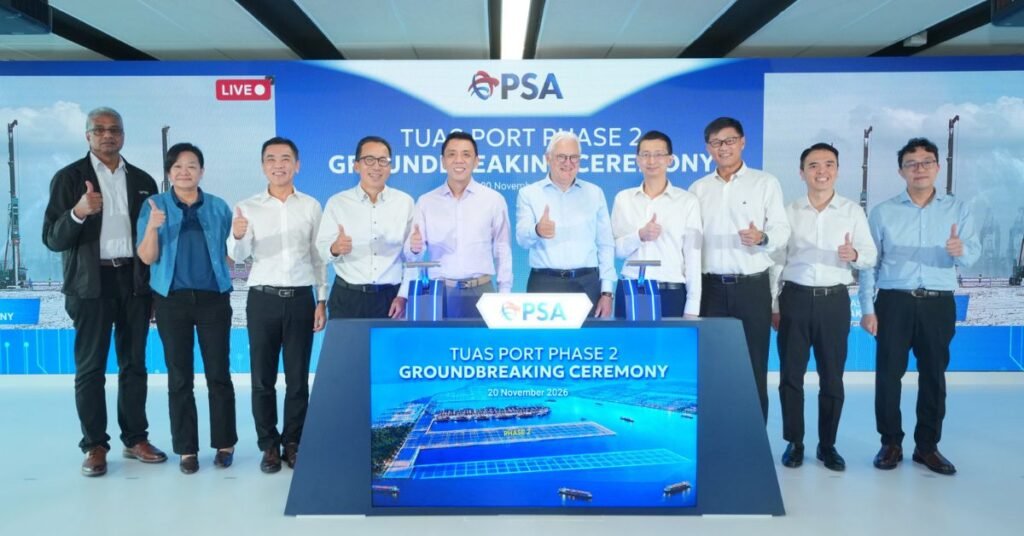
PSA Singapore has commenced construction of Tuas Port Phase Two, advancing the development of what is planned to become the world’s largest fully automated container terminal. The groundbreaking marks the start of the port’s second development stage, which will expand container-handling infrastructure and strengthen Singapore’s position as a major global transhipment hub.
Phase Two is the largest of the four planned development stages at Tuas Port in terms of wharf length. The expansion will include 21 mega berths, a water depth of 23 metres and 8.6 kilometres of wharf infrastructure. The facilities are designed to accommodate some of the world’s largest container vessels and support changing international trade patterns.
Operations at Phase Two are scheduled to commence progressively from 2028.
Tuas Port expansion to increase container-handling capacity
The latest development will add substantial berthing infrastructure to Tuas Port, enabling PSA Singapore to accommodate larger container ships and manage evolving cargo flows.
The port’s infrastructure development is centred on automation, advanced technologies and integrated terminal operations. The expansion is also intended to improve coordination between port facilities and wider supply chain networks as Singapore continues to develop its role in international maritime trade.
PSA International Group Chairman Peter Voser said, “Global trade continues to evolve amid shifting supply chains and changing market dynamics. PSA must continue to invest in the capabilities and connectivity needed to remain relevant and create value for decades to come. Tuas Port reflects our long-term commitment to strengthening Singapore’s position at the heart of global trade. As we break ground on Phase Two, we are not simply adding capacity, we are laying the foundations for a more integrated port ecosystem that delivers greater value for our customers, partners and the wider supply chain.”
Automation and network integration central to Phase Two
The expansion will incorporate automation and digital capabilities to support more coordinated terminal operations. PSA intends to use these technologies to improve operational efficiency and connect port facilities with other logistics and supply chain nodes.
PSA International Group CEO Ong Kim Pong said, “The development of Tuas Port reflects the collective commitment and contributions of our people, unions, management and stakeholders, whose partnership has been instrumental in bringing the port to where it is today. With Phase Two, we will continue to bring scale, automation and intelligence to enable more coordinated and efficient terminal operations. This is how we bring PSA’s Node to Network strategy to life – connecting ports, supply chain nodes and partners into an integrated network that supports the sustainable movement of global trade in an increasingly interconnected world.”
The company’s Node to Network strategy focuses on connecting ports, logistics facilities and supply chain partners through an integrated network to facilitate cargo movement and trade connectivity.
The development of Phase Two forms part of the wider four-phase construction programme at Tuas Port. Once completed, the port is expected to consolidate Singapore’s container terminal operations within a single location, supported by automated systems and large-scale infrastructure.
FAQs
What is PSA Singapore developing at Tuas Port?
PSA Singapore is developing Phase Two of Tuas Port, part of a four-phase project to establish the world’s largest fully automated container terminal.
What are the key features of Tuas Port Phase Two?
Phase Two will include 21 mega berths, 8.6 kilometres of wharf infrastructure and a water depth of 23 metres.
When will Tuas Port Phase Two begin operations?
Operations are scheduled to commence progressively from 2028.
How many development phases does Tuas Port have?
Tuas Port is being developed in four phases. Phase Two is the largest of these in terms of wharf length.
What is the objective of the Tuas Port expansion?
The expansion aims to increase container-handling capacity, accommodate the world’s largest container vessels, strengthen terminal automation and support Singapore’s position as a global transhipment hub.
What is PSA’s Node to Network strategy?
PSA’s Node to Network strategy focuses on connecting ports, supply chain facilities and industry partners into an integrated network to improve coordination and support global trade flows.
Recent Posts
Tugboats
Svitzer takes delivery of another TRAnsverse 2900 tug as newbuild pipeline reaches 27 vessels
Technology
Kongsberg Maritime inaugurates upgraded K-Sim Navigation simulator at IMTC Mumbai
Ammonia
Jordan Green Ammonia secures Aqaba plant site under 45-year lease