
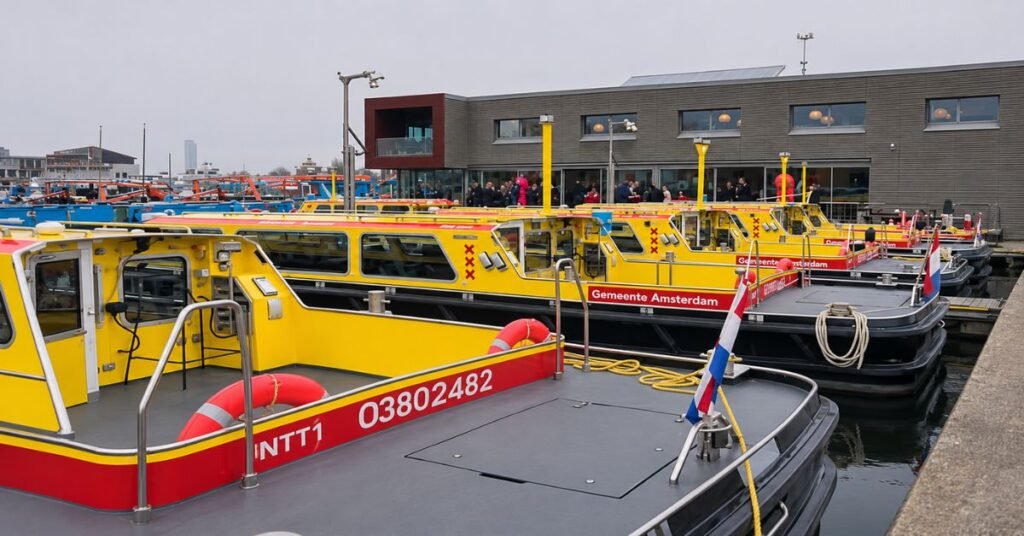
Damen Shipyards Group has delivered two battery-electric patrol vessels to the City of Amsterdam, completing the municipality’s third order for its Patrol Vessel 1304 Electric design. Named Waterbuffel and Waterrietzanger, the boats will support canal traffic enforcement while operating with low noise and no propulsion exhaust emissions.
Announcing the delivery on 9 November, Damen said the vessels were handed over on 7 September. Their naming ceremony took place at Amsterdam’s maritime museum, attended by Deputy Mayor Elise Moeskops. The contract was signed on 18 April following a competitive tender.
What will the electric patrol vessels do?
The vessels are operated by Toezicht en Handhaving Openbare Ruimte (THOR), Amsterdam’s public-space supervision and enforcement division. Their responsibilities include monitoring compliance with local navigation regulations, enforcing speed limits and checking permits for moored boats.
Each vessel measures 13.4 metres and has a single 130-kilowatt electric motor supplied by a 273-kilowatt-hour battery pack. Maximum speed is 16 kilometres per hour. According to Damen, the battery provides sufficient endurance for a full day of operation at average speed.
The additions follow Watersnip and Watertrapper, delivered to the city in 2023, and bring its fleet of this electric patrol design to six vessels.
How has Amsterdam’s patrol fleet evolved?
Amsterdam’s relationship with Damen predates its battery-electric orders. The builder supplied a conventionally powered Patrol Vessel 1304 in 2004, followed by a vessel featuring electric hybrid propulsion in 2013.
The city subsequently received Waterpieper and Waterhoen in 2021. Those vessels were equipped with 273-kilowatt-hour battery systems and 130-kilowatt motors, establishing the propulsion configuration used in the latest municipal deliveries.
A separate vessel, P55, was delivered to Amsterdam Police alongside the 2021 pair. It had a smaller, 136-kilowatt-hour battery package and a diesel generator to extend its range when required.
For the earlier vessels, hull construction took place at Damen Shipyards Kozle in Poland, followed by outfitting and delivery from Damen Shipyards Hardinxveld in the Netherlands. Their accommodation included an all-round-visibility wheelhouse, a galley and sanitary facilities.
How does the delivery fit Amsterdam’s clean-waterway policy?
The fleet expansion comes as Amsterdam tightens emissions requirements across its inland waterways.
An emission-free zone for pleasure craft took effect in the city centre, including the Singelgracht, on 1 April 2025. Electric, hydrogen-powered and manually propelled boats can operate within the zone, alongside hybrid vessels running without emissions.
Certain petrol- and diesel-powered boats retain temporary access under transitional arrangements. Eligibility depends on the type of permit and when it was purchased, with different deadlines applying.
Passenger and transport vessels have faced emission-free operating requirements on Amsterdam’s inland waters since 1 January 2025 through their operating licences. The municipality is developing separate policy for service vessels.
Amsterdam also intends to extend its emission-free approach across its inland waterways in 2030. The city identifies this as an ambition under its Clean Air Action Plan, with policy for the expansion still being developed.
What supporting infrastructure is being developed?
Alongside vessel requirements, Amsterdam is expanding public charging provision for electric pleasure boats. The municipality plans more than 300 additional charging points at 29 locations, with completion scheduled by the end of 2027.
These public facilities are specifically designated for pleasure craft. Boats must hold a valid permit, and mooring is permitted only while charging, for a maximum of 24 hours.
The recreational charging programme forms a separate part of Amsterdam’s wider waterway electrification effort. Damen’s latest announcement does not specify charging infrastructure or charging times for the two new patrol vessels.
Recent Posts
LNG
EU shipping emissions rules open new market for bio-LNG, says IEA
LNG
AxDo secures 11-year LNG supply deal for planned Bahamas bunkering hub
LNG
LNG bunkering fleet faces major expansion as DNV projects need for up to 208 vessels