
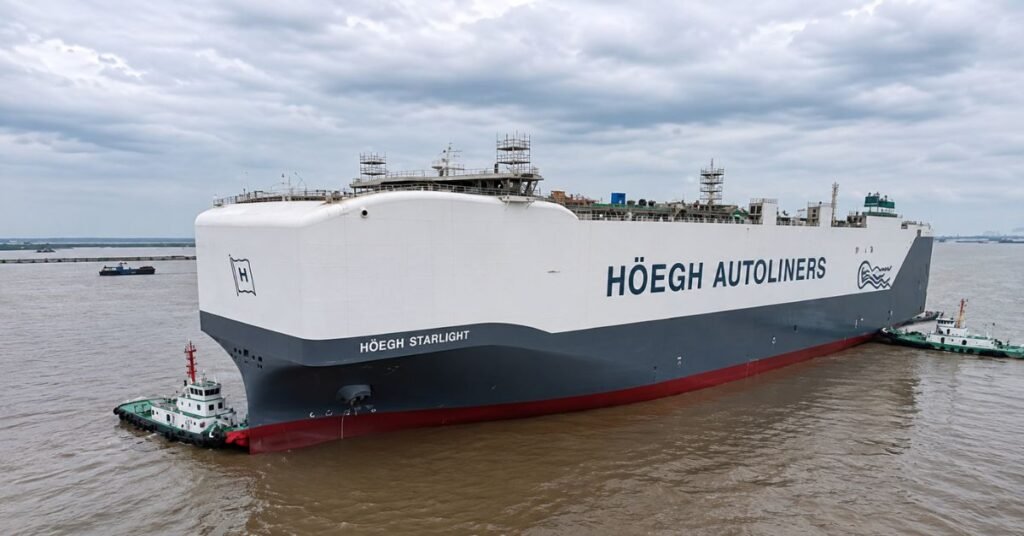
Höegh Autoliners has signed an agreement with Chinese battery manufacturer BYD to install a marine battery system on Aurora No. 12, a car carrier scheduled for delivery in May 2028. The vessel will combine battery storage, solar panels and a shaft generator with ammonia-capable propulsion to reduce fuel consumption and improve onboard energy management.
The agreement was signed on 9 November at the COP31 climate conference in Antalya, Türkiye. The vessel is expected to leave the shipyard equipped to operate on ammonia, placing it within the next phase of Höegh’s alternative-fuel fleet programme.
What will the BYD battery system deliver?
BYD’s battery installation will work with the vessel’s solar panels and shaft generator as an integrated energy system. Höegh estimates that the combination will reduce annual greenhouse gas emissions by approximately 1,000 tonnes of carbon dioxide equivalent while lowering fuel expenditure.
The operator describes the planned configuration as the first combination of these technologies on a deep-sea car carrier. The projected emissions savings remain a company estimate ahead of delivery and operational deployment.
Chief Operating Officer Sebjørn Dahl said the project would help the company understand how different technologies perform when combined. BYD sees the agreement as an opportunity to demonstrate its containerised battery technology in deep-sea shipping.
Where does Aurora No. 12 fit in the fleet programme?
Höegh’s ammonia propulsion plans cover vessels nine to 12 in its original Aurora-class programme. Its 2025 annual report identifies three ammonia dual-fuel deliveries scheduled for 2027, followed by the fourth in 2028.
The engines are being supplied by Everllence, formerly MAN Energy Solutions. This phase follows the introduction of earlier Aurora vessels with liquefied natural gas dual-fuel propulsion and provision for future fuel conversion. The distinction is significant: Aurora No. 12 is intended to have ammonia operating capability at delivery.
In August 2026, Höegh ordered six additional Aurora-class vessels from China Merchants Heavy Industry’s Jiangsu yard, taking the programme to 18 ships. Those additional vessels are scheduled for delivery between 2029 and 2031.
The latest six were ordered as liquefied natural gas dual-fuel vessels retaining future ammonia-conversion flexibility. The company also secured options for four further ships and reserved another four building slots, providing scope to expand the programme to 26 vessels.
Aurora-class ships can accommodate up to 9,100 cars. The additional newbuildings will carry DNV’s ammonia- and methanol-ready class notations, with Everllence main engines and Kongsberg Maritime bridge systems.
Why does ammonia’s production pathway matter?
Ammonia contains no carbon, but its use does not automatically make a voyage emissions-free. Its overall climate performance depends on production, transport and storage, as well as combustion performance and any pilot fuel used for ignition.
The International Energy Agency’s Advanced Motor Fuels programme identifies nitrogen oxides, nitrous oxide and unburned ammonia as emissions requiring attention. Nitrous oxide is a potent greenhouse gas, making engine performance and exhaust treatment important alongside the choice of fuel.
Fuel oil used to ignite ammonia in dual-fuel engines also contributes carbon dioxide emissions. Consequently, reducing energy demand through onboard efficiency measures remains relevant even when a ship is designed for alternative fuels.
What regulatory framework supports deployment?
The International Maritime Organization has issued interim safety guidelines for ships using ammonia as fuel, alongside separate guidance on seafarer training for ammonia operations.
These measures provide a framework for deploying the fuel as shipowners move from fuel-ready designs towards vessels equipped for ammonia service. Höegh’s battery project adds an energy-management component to that transition, with performance to be established once the vessel enters operation.
Recent Posts
LNG
EU shipping emissions rules open new market for bio-LNG, says IEA
LNG
AxDo secures 11-year LNG supply deal for planned Bahamas bunkering hub
LNG
LNG bunkering fleet faces major expansion as DNV projects need for up to 208 vessels