
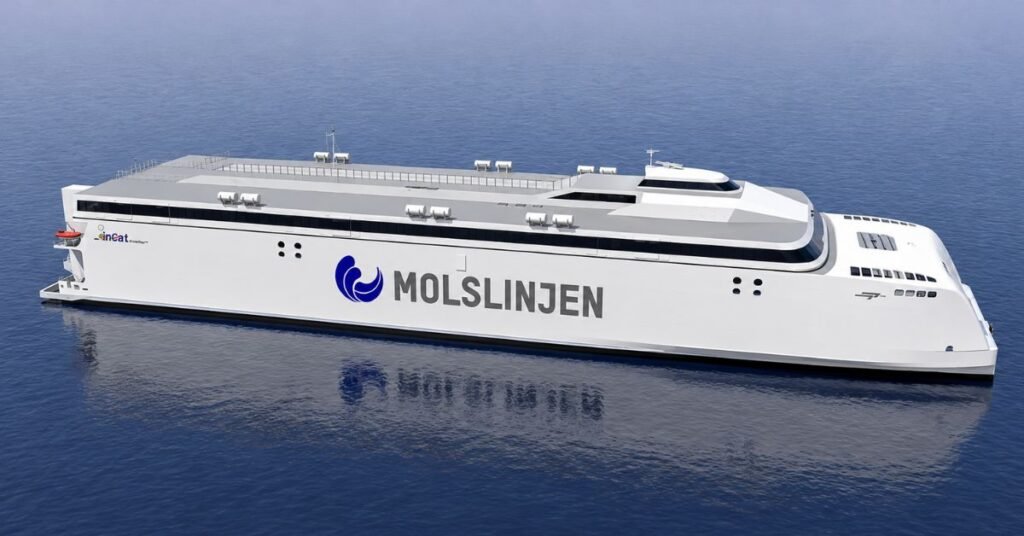
AYK Energy has secured a contract to supply 165MWh of marine battery systems for three new fully electric high-speed catamarans being built for Danish ferry operator Molslinjen. The agreement, signed with system integrator Wärtsilä, represents the largest marine battery order in the ferry sector to date, according to the companies.
The three vessels are under construction at Incat Tasmania in Australia and will each be equipped with AYK Energy’s DNV type-approved Polaris battery system, providing 55MWh of installed capacity per vessel.
The electric catamarans are designed to operate at speeds of up to 40 knots and will feature high-capacity charging systems capable of recharging the batteries in approximately 30 minutes. Each ferry will accommodate up to 1,500 passengers and 500 cars.
The vessels will serve routes between Jutland and Zealand across Denmark. Once delivered, they are expected to become the largest electric ferries operating in Europe.
The first catamaran is scheduled to arrive in Denmark in late 2027 and enter commercial service in the first quarter of 2028. The remaining two vessels are expected to arrive in 2028 and 2029.
Battery weight reduction influences contract award
A key factor in AYK Energy securing the contract was its reduction of the battery system’s weight while maintaining its energy capacity and power output.
According to the company, the initial battery configuration considered by Molslinjen nearly two years ago weighed more than 700 tonnes. Following a redesign, the battery system planned for installation on the first catamaran will weigh less than 400 tonnes.
AYK Energy founder Chris Kruger said the company revised the battery architecture to improve energy density and reduce overall weight.
“We decided to rethink the battery’s design from the ground up to reduce weight and improve performance,” he said. “With new battery cells, inspiration from manufacturing techniques in the automotive industry and a lighter, stronger aluminum structure, we can store more energy per kilogram and deliver more power. At the same time, we have adapted the technology to the specific requirements of the marine environment and integrated our patented solutions for fire suppression and limiting overheating within the battery modules.
The redesign incorporates new battery cells, manufacturing approaches influenced by the automotive industry and a lighter aluminium structure. AYK has also integrated fire suppression and overheating control technologies into the battery modules.
LFP battery technology and marine safety
The Polaris system uses lithium iron phosphate (LFP) battery chemistry, which AYK identifies as a key component of its marine battery safety approach. The company holds what it describes as the first type approval for LFP battery technology in the marine sector.
Chris Kruger said, “AYK is immensely proud to provide our new Polaris battery systems for these ferries,” he said. “This is genuinely an inflection moment for electric ships. It is also the result of enormous hard work over more than a decade by those of us who have believed in electric ships.
“AYK’s approach has always been led by safety first. There is massive pressure to improve energy density and raw power, but this cannot happen overnight, especially in the rugged conditions of the sea. This is not a car where the driver can simply step out onto the road if there is a fire. This is the reason AYK secured the first type approval of LFP battery technology, which is considerably safer than the previously used NMC chemistry.”
Molslinjen CEO Carsten Jensen said battery weight was a critical consideration in the vessel design, particularly given the speed requirements of the aluminium catamarans.
“We are pushing the boundaries of technology here, and the combined weight of the vessel and its batteries will be crucial to operating such large vessels at high speed across the Kattegat. So when AYK managed to significantly reduce the weight of its batteries without compromising power, that tipped the balance. This provides a proven level of safety that is on a par with, or probably even better than, what we have with diesel today. This was also a decisive factor in our choice of supplier.”
Dr Torsten Büssow, Director of Wärtsilä’s electrical integration business, said the battery configuration would need to balance charging power, energy capacity and vessel weight.
“The speed how AYK is bringing latest LFP technologies into the marine industry is impressive. For large ferries we have to find a balance between short high power charging and long high energy sailing times combined with a weight challenge on aluminum catamarans like these.”
Wärtsilä to integrate electric propulsion system
Under the agreement, AYK Energy will supply the battery systems, while Wärtsilä will provide the integrated electric propulsion system and waterjets.
The propulsion configuration will support the vessels’ high-speed operating requirements, while the 30-minute charging capability is intended to accommodate the turnaround requirements of the ferry routes.
The contract adds to AYK Energy’s portfolio of marine electrification projects across different vessel categories, including bulk carriers, cruise ships, icebreakers, ferries and workboats.
Recent projects include an agreement to supply batteries for Germany’s new polar research vessel Polarstern, the installation of two 12MWh Orion+ battery systems for Brittany Ferries’ hybrid-electric vessels Guillaume de Normandie and Saint-Malo, and the delivery of a 6MWh battery system for Svitzer’s battery-methanol tug.
FAQs
How much battery capacity will AYK Energy supply to Molslinjen?
AYK Energy will supply a combined 165MWh of battery capacity across three electric ferries, with each vessel receiving a 55MWh Polaris battery system.
Who is building the three electric ferries for Molslinjen?
The three high-speed electric catamarans are being built by Incat Tasmania in Australia.
What battery technology will the new ferries use?
The vessels will use AYK Energy’s Polaris battery system, based on lithium iron phosphate (LFP) chemistry and holding DNV type approval.
How much will each ferry weigh in terms of battery system capacity?
The battery system for the first catamaran is expected to weigh less than 400 tonnes, compared with an earlier configuration exceeding 700 tonnes.
What are the specifications of the new Molslinjen electric ferries?
Each catamaran will have 55MWh of battery capacity, reach speeds of up to 40 knots and accommodate up to 1,500 passengers and 500 cars. The vessels will support high-capacity charging in approximately 30 minutes.
When will the new electric ferries enter service?
The first vessel is expected to arrive in Denmark in late 2027 and enter service in the first quarter of 2028. The other two are scheduled to arrive in 2028 and 2029.
What role will Wärtsilä play in the project?
Wärtsilä will act as the system integrator, supplying the integrated electric propulsion system and waterjets, while AYK Energy will provide the battery systems.
Recent Posts
Tugboats
Svitzer takes delivery of another TRAnsverse 2900 tug as newbuild pipeline reaches 27 vessels
Technology
Kongsberg Maritime inaugurates upgraded K-Sim Navigation simulator at IMTC Mumbai
Ammonia
Jordan Green Ammonia secures Aqaba plant site under 45-year lease