
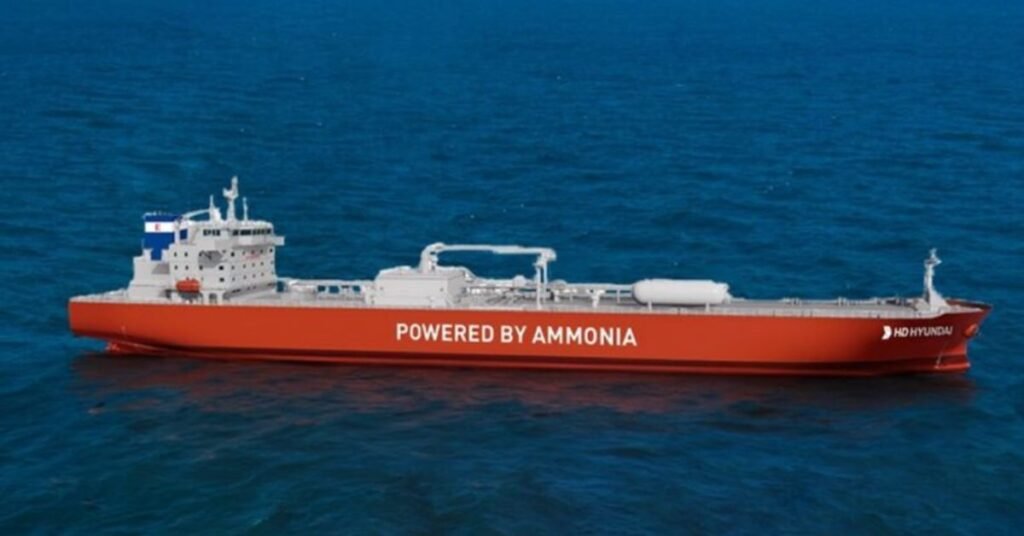
Close cooperation between the Belgian Federal Public Service Mobility and Transport (FPS Mobility), EXMAR and Lloyd’s Register turns real‑world experience into practical rules – contributing towards sustainability with the tightest possible safety framework.
At the current 111th session of the International Maritime Organization’s Maritime Safety Committee (MSC 111), the safety guidelines for ammonia as fuel on IGC ships have been approved. This marks an important milestone in the transition towards sustainable shipping.
The development of these guidelines is the result of close cooperation between the FPS Mobility, EXMAR and Lloyd’s Register.
“As a public authority, we want to facilitate the energy transition by ensuring that an appropriate regulatory framework is in place in good time. Thanks to close cooperation with the industry, this framework is also tailored to the realities on the ground,” noted Nathalie Deleuze, FPS Mobility’s Maritime Expert in Alternative fuels.
Celine Audenaerdt, KBRV’s Head of Environmental and Technical Affairs added: “Through intensive collaboration and the combination of strong in-house competence and hands-on experience, the partners have succeeded in developing robust and practical safety guidelines.”
Liam Blackmore, Global Head of Technology Adoption and Integration, Lloyd’s Register, said: “The approval of these guidelines provides a clear signal that ammonia is moving from concept to a fuel with an emerging international safety framework. It demonstrates how close collaboration between industry, flag administrations and technical organisations can accelerate the safe adoption of new fuels at scale. Being part of this collaboration reinforces our role as a trusted advisor helping to turn ambition into practical, scalable solutions for the maritime energy transition.”
These guidelines are not purely theoretical, but are firmly grounded in real operational knowledge and expertise from within the sector.
“Drawing on more than four decades of operational experience and the challenges encountered along the way, we jointly developed these guidelines through a strong partnership. We would like to thank the teams at FPS Mobility and Lloyd’s Register for their excellent cooperation and valuable contribution throughout the process,” concluded Kristof Coppé, Director Fleet Operations & Technical Business Development at EXMAR.
Building on EXMAR’s and Lloyd’s Register’s experience in midsize gas carriers shipbuilding, the Directorate-General Shipping of the FPS Mobility has taken the lead in the IMO to draft these guidelines. This guarantees that the regulatory framework reflects the real-world practice, enabling innovation while maintaining effective safeguards within a controlled environment.
Ammonia has the potential to play a significant role in decarbonising the maritime sector. The IMO had already adopted interim guidelines, supporting early movers and the first vessels designed to operate on ammonia. Once the first ammonia-fuelled ships enter into operation in the near future, these safety guidelines will demonstrate the acceptance of ammonia as a marine fuel and support its wider deployment, while experience gained will contribute to the development of a clear and robust international safety framework.
Recent Posts
HYBRID
GRSE Signs ₹1,032-Crore ONGC Contract for Four Hybrid Offshore Supply Vessels
EV
Energy In Motion Opens ₹500-Crore Electric Truck Plant in Pune
Fuels
Aegis Logistics Commissions 35,000-Tonne LPG Bottling Plant at JNPA