
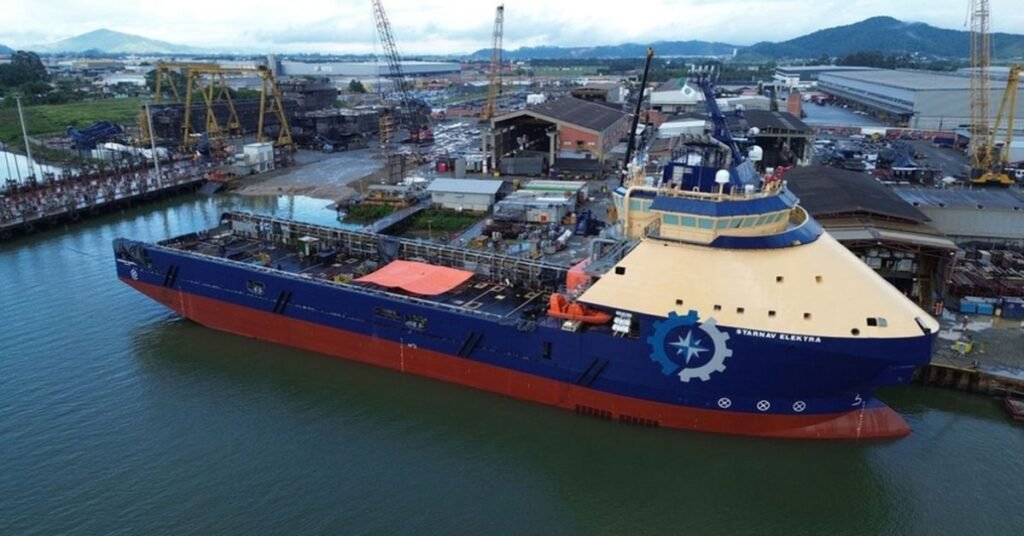
Brazil has taken delivery of its first domestically built offshore support vessel equipped with a hybrid power generation and propulsion system, with Starnav Elektra entering service under Petrobras’ offshore fleet renewal programme.
The 5,500-deadweight-tonne platform supply vessel (PSV) was named in Rio de Janeiro on September 17, 2026. Built by Detroit Shipyard in Itajaí, Santa Catarina, the vessel is owned by Starnav and chartered to Petrobras to support offshore oil and gas operations in Brazilian waters.
Starnav Elektra is the first vessel delivered under Petrobras’ Mar Aberto Programme, which is aimed at renewing and expanding the company’s marine fleet while supporting Brazil’s domestic shipbuilding and offshore sectors.
Battery System Enables Hybrid Operation
Launched in March 2026, the 92.1-metre PSV is the first Brazilian-built vessel of its type to feature a battery energy storage system.
Built to American Bureau of Shipping (ABS) class requirements, the vessel is equipped with a Dynamic Positioning Class 2 (DP2) system, allowing it to maintain its position during offshore operations even following a single failure within the positioning system.
Its ABS class notations include ESS-LiBATTERY and HYBRID, covering its lithium-ion battery installation and hybrid-electric power configuration. It also carries the SUSTAIN-1 notation, which addresses emissions, waste management, pollution prevention, energy efficiency, performance monitoring and ship recycling.
WEG Supplies 1,322-kWh Battery System
Brazilian electrical equipment manufacturer WEG supplied the vessel’s 1,322-kWh battery system, with its design and capacity developed in consultation with Petrobras.
The battery system supports peak shaving by supplying additional power when demand rises, allowing the vessel’s engines to operate closer to their efficient load range. It can also provide spinning reserve, enabling fewer generators to remain online while retaining the capacity to respond to sudden changes in electrical demand.
The hybrid arrangement is designed to lower fuel consumption, emissions, engine operating hours and maintenance requirements. Starnav Elektra has also been designed to accommodate potential future use of renewable fuels, including hydrotreated vegetable oil (HVO).
IMO Tier III Engines Reduce NOx Emissions
The vessel has four generator sets powered by mtu 16V 4000 M33S engines supplied by Rolls-Royce Power Systems. The engines are fitted with selective catalytic reduction (SCR) systems from Hug Engineering.
The SCR technology reduces nitrogen oxide emissions and allows the generator sets to meet International Maritime Organization (IMO) Tier III requirements.
Petrobras has also identified telemetry-based fuel monitoring, advanced hull coatings and anti-fouling systems as part of its approach to improving the efficiency of its new PSV projects. These systems are intended to improve energy performance and reduce resistance associated with marine growth.
First Vessel Under Petrobras’ Mar Aberto Programme
Petrobras has invested approximately R$450 million in Starnav Elektra, with the vessel delivered around two years ahead of its original contractual schedule.
The PSV travelled from Santa Catarina to Rio de Janeiro with an all-female crew. Led by Captain Isabela Teixeira Ponce de Leon, the 16-member team completed the delivery voyage before the vessel’s naming ceremony.
Petrobras expects to have 48 vessels under contract by the end of 2026 and 96 vessels, including barges and push boats, by the end of 2027.
Starnav Plans Ten-Vessel Newbuilding Programme
Starnav Elektra is the first vessel in a planned 10-vessel construction programme being undertaken by Starnav and Detroit Shipyard. The programme is expected to involve total investment of approximately US$700 million.
Long-term charter agreements with Petrobras provide the commercial framework for the construction programme, while Brazil’s Merchant Marine Fund and financing from the Brazilian Development Bank (BNDES) form part of the wider financing structure supporting domestic shipbuilding.
The delivery introduces hybrid propulsion and battery energy storage to Brazil’s domestically built PSV fleet and forms part of a broader programme to expand the country’s capacity to construct offshore support vessels for its energy sector.
Recent Posts
Ammonia
Aegis Tristar acquisition to expand Indian group’s global energy logistics reach
Power & Propulsion
Everllence and MITSUI E&S Mark 100 Years of Two-Stroke Engine Partnership
Ammonia
NTPC Targets Japan, South Korea and Germany for Green Ammonia Exports from Andhra Pradesh Hub