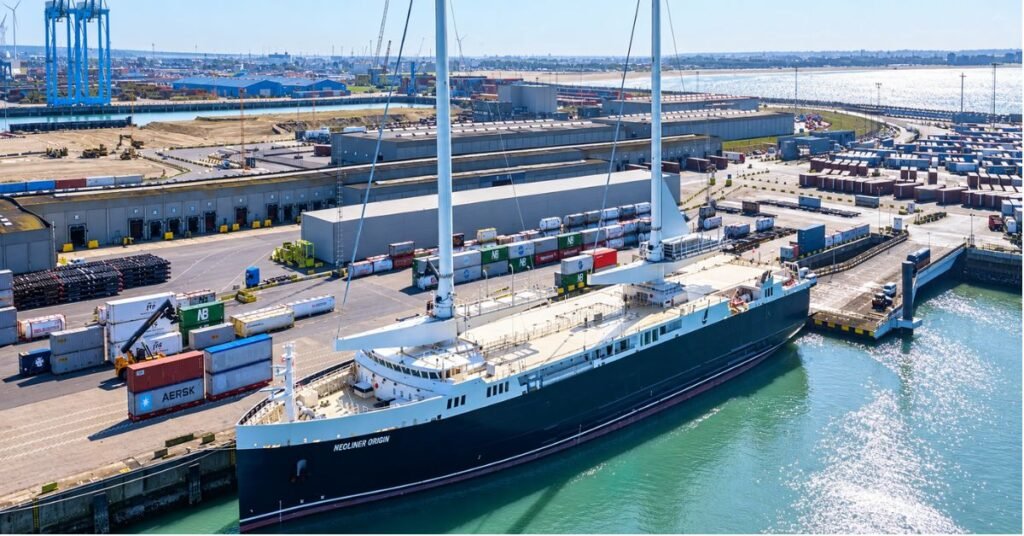
NEOLINE’s wind-powered Ro-Ro cargo vessel Neoliner Origin made its first call at PSA Zeebrugge in Belgium on September 21, 2026, marking the vessel’s first visit to the country and the addition of Zeebrugge to NEOLINE’s regular transatlantic service.
The 136-metre vessel is designed to use wind as its primary propulsion source, supported by an auxiliary diesel-electric system. Its two foldable SolidSail masts carry a total sail area of 3,000 square metres. On its North Atlantic route, Neoliner Origin is designed to reduce fuel consumption by more than 80% compared with a conventional vessel operating at 15 knots.
Zeebrugge Added to NEOLINE’s European Network
Zeebrugge, part of the Port of Antwerp-Bruges, is a major European hub for Ro-Ro, automotive and out-of-gauge cargo. Its inclusion in NEOLINE’s service provides shippers with direct access to the wind-powered transatlantic route from a logistics hub serving Belgium, the Netherlands, Germany and northern France.
Following the addition of Zeebrugge, the vessel’s rotation connects Zeebrugge, Montoir-de-Bretagne, Saint-Pierre-et-Miquelon, Baltimore and Halifax.
The rotation is expected to take five weeks during summer and six weeks in winter, with around 10 rotations planned annually. According to NEOLINE, the extension adds only a few days to the overall rotation while maintaining the transit-time commitments for existing customers using the Montoir-de-Bretagne service.
CMA CGM Supports Service Expansion
CMA CGM has been a partner in the development of NEOLINE’s wind-powered shipping concept and is offering the service to its customers and other shippers seeking to reduce emissions associated with transatlantic supply chains.
The Zeebrugge call expands the service’s access to the European freight market and provides additional opportunities to secure return cargo. The development could also support a potential future expansion of the NEOLINE fleet.
Recent Posts
Ammonia
Aegis Tristar acquisition to expand Indian group’s global energy logistics reach
Power & Propulsion
Everllence and MITSUI E&S Mark 100 Years of Two-Stroke Engine Partnership
Ammonia
NTPC Targets Japan, South Korea and Germany for Green Ammonia Exports from Andhra Pradesh Hub