
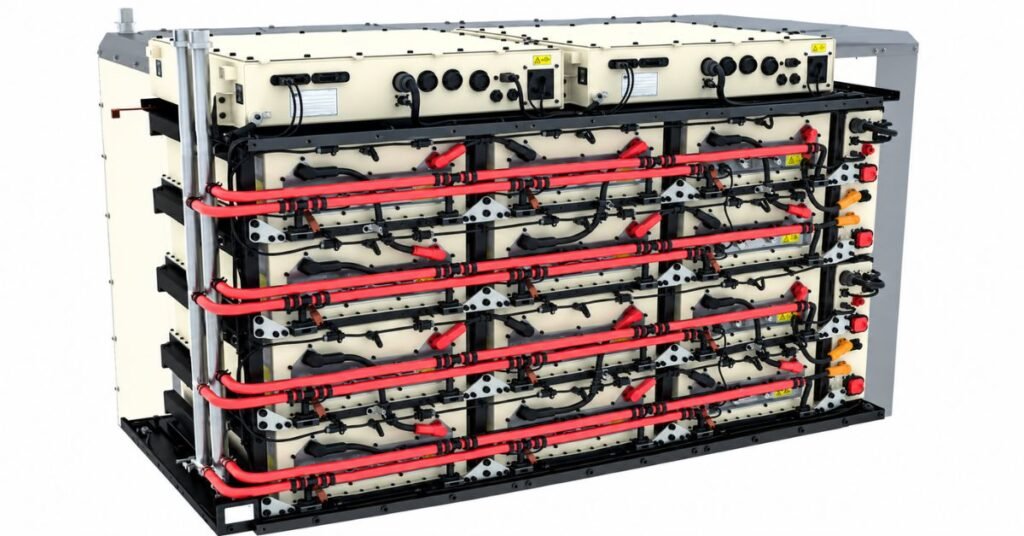
Caterpillar Marine is developing a production battery system for hybrid and fully electric vessels, targeting applications including harbour tugs, ferries and inland workboats.
The CAT marine battery system is designed to provide the primary propulsion energy in fully electric vessels, while hybrid configurations will combine batteries with Caterpillar engines, generators and other powertrain components.
LFP battery system targets marine applications
Caterpillar’s first production marine battery application uses lithium iron phosphate (LFP) chemistry. The liquid-cooled system has a 1C charge-and-discharge rate and operates at voltages of up to 1,420 VDC.
The battery modules can be arranged in multiple rack configurations, allowing the system to be adapted to the available space within a vessel’s battery room and its power requirements.
Will Watson, marine product director at Caterpillar, said the company is developing a range of battery modules covering chemistries adapted to most duty cycles, with LFP as its first marine production application.
The company expects tugs and ferries to be among the strongest candidates for battery-electric and hybrid propulsion because these vessels generally operate close to shore, have variable power requirements and may have regular access to charging infrastructure.
Watson said tugs that alternate between high-power ship-assist operations and periods of low-load operation or idling are among the earliest potential adopters. Pushboats and inland towboats, meanwhile, could transition more gradually because of their continuous power requirements and long operating lives.
He said the strongest adoption for fully electric energy rooms today is in the tug and ferry space, operations that stay close to shore and have variable power demands, noting that duty cycle is adopting hybrid at a higher rate than constant-load vessels.
Hybrid systems offer flexibility for workboats
Point-to-point vessels and inland vessels with shoreside charging access are also considered suitable for increased electrification.
Hybrid configurations may remain more practical for vessels operating at constant loads, over longer distances or in areas where charging infrastructure is limited.
Watson said power options that combine batteries with lower-carbon-intensity fuels can help operators modernise existing assets while avoiding heavy capital expenditure linked to uncertain fuel economics and availability. He also said engine and battery technologies can operate as mutually supportive systems.
Caterpillar describes the transition as a move from the conventional engine room to an “energy room”, where engines, batteries, generators, electric motors, power electronics and controls function as an integrated system.
The company can convert conventional engine rooms powered by CAT diesel marine engines into hybrid systems incorporating propulsion engines, electric motors, clutches, gensets, power electronics, controls and batteries. The battery system, however, is designed to work with CAT engines and not third-party engines.
Newbuilds have advantages for fully electric systems
Caterpillar sees fully electric propulsion as generally easier to integrate into newbuild vessels than existing boats because of the space, weight, cooling and electrical requirements associated with marine battery systems.
The company is advising operators to consider future propulsion requirements during the vessel design stage, even where a transition to fully electric propulsion is not an immediate objective.
A modest capital investment during newbuild construction could provide greater flexibility for future propulsion changes, according to Caterpillar.
Retrofit projects can still help operators reduce total cost of ownership and extend the useful life of existing vessels. However, each retrofit needs to be assessed against the vessel’s design, configuration and operating profile.
Battery system designed for rapid power response
The CAT marine battery system is designed to respond rapidly during towing, acceleration, dynamic positioning and other high-power operations.
In these applications, the battery can discharge energy quickly to provide instant torque and help stabilise the vessel’s power system.
In a hybrid installation, the battery can respond to sudden changes in load while the vessel’s engines increase their output. This is intended to eliminate response lag and allow the main engines to ramp up without creating a risk of blackout.
Each battery module is sealed, while its liquid-cooling circuit is isolated from the module interior. The system also incorporates leakage detection.
Caterpillar’s battery management system continuously monitors cell and module temperatures, charge levels and battery health. The rackable design allows the number and arrangement of modules to be tailored to the vessel’s power requirements and available space.
The 1C charge rate means that, in principle, a battery could be charged in about one hour, depending on the installation and the charging capacity available.
Modular servicing and battery replacement
Caterpillar is designing the battery systems around vessel drydock schedules. Initial battery replacement is targeted at intervals of approximately five years, with the company aiming to extend this to 10 years and eventually 15 years as the technology develops.
The system is serviceable at the module level. Fuses, contactors and electronic control modules can be serviced onboard by trained technicians.
The CAT Battery Management System and telematics are intended to support ongoing monitoring through alerts, fault identification and prognostics.
Caterpillar pursuing classification approvals
The CAT marine battery system is IEC compliant and CE certified. Caterpillar is also pursuing approvals from ABS, DNV, Bureau Veritas, RINA and Lloyd’s.
The company has not opened a public order book for the system. Operators interested in the technology are being directed to Caterpillar Marine account managers.
Multi-energy propulsion strategy
Caterpillar expects workboats to require multiple propulsion and energy solutions because operating conditions, fuel availability and operator objectives vary significantly between vessels.
Watson said Caterpillar anticipates a multi-energy future for workboats, with solutions ranging from combustion engines using lower-carbon fuels such as biofuels and methanol to hybrid powertrains and fully electric systems.
The company’s approach is based on selecting propulsion technology according to the vessel’s operating profile rather than applying a single energy solution across the workboat sector.
Recent Posts
Marine
82% of Maritime Professionals Say Current Training Falls Short of Operational Needs, Study Finds
Ammonia
Maersk Tankers Ammonia Retrofit Project Advances Towards EU Support
Policy
EU Maritime Innovation Projects Advance in €3.4-Billion Funding Selection