
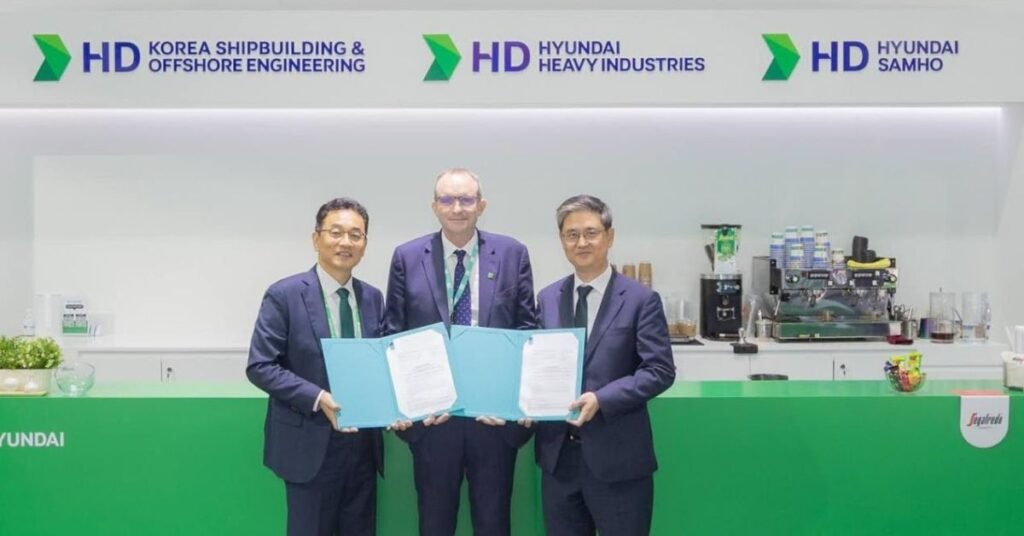
Lloyd’s Register (LR), HD Korea Shipbuilding & Offshore Engineering (KSOE) and HD Hyundai Heavy Industries (HHI) are collaborating on the development of a 185,000 cbm LNG carrier incorporating hybrid-electric propulsion.
The companies signed an Approval in Principle (AiP) for the vessel concept at Gastech 2026 in Bangkok. The project will focus on the development and safety verification of the hybrid-electric propulsion system and its application to large LNG carriers.
Hybrid-electric propulsion system under development
Under the AiP project, LR, KSOE and HHI will examine the architecture of the vessel’s hybrid-electric propulsion system, including redundancy requirements and battery integration.
The partners will also work on technical guidance and requirements for the emerging propulsion technology. The objective is to establish a technical framework that can support the broader application of hybrid-electric propulsion in the LNG carrier sector.
Hybrid-electric propulsion combines conventional power generation and propulsion equipment with electrical systems and energy storage. Depending on the vessel’s operating profile, such systems can help manage changes in power demand and improve overall propulsion efficiency.
For the 185,000 cbm LNG carrier design, the project will assess how battery systems can be integrated into the propulsion architecture while maintaining appropriate levels of safety and redundancy.
Focus on safety and technical requirements
The collaboration comes as shipowners and shipbuilders assess alternative propulsion configurations to improve vessel efficiency and reduce emissions.
LR’s involvement at the design stage is also intended to contribute to technical guidance for hybrid-electric propulsion systems, an area where formalised standards and requirements are still developing.
The partners expect the work to generate technical insights applicable beyond LNG carriers. These could inform future developments involving electric propulsion, fuel cell integration and other advanced vessel concepts.
Andy McKeran, Chief Growth Officer, Lloyd’s Register, said: “Hybrid electric propulsion has clear potential to support efficiency gains and emissions reduction, but its application at this scale requires a robust approach to design and safety. By working in partnership from the earliest stages, we can help shape practical, reliable solutions that support wider deployment across the industry.”
HHI evaluates advanced electric propulsion
The project also provides HHI and KSOE with an opportunity to evaluate the operational and technical implications of applying hybrid-electric propulsion to a large LNG carrier.
Hongryeul Ryu, Executive Vice President & CTO, HD Hyundai Heavy Industries, said: “HD HHI has proactively adopted eco-friendly technologies to comply with environmental regulations. Through this recent project, we were able to identify the various advantages and disadvantages of applying an advanced electric propulsion system. Building upon these insights, we expect this experience to serve as a valuable foundation for developing and implementing more efficient propulsion systems in the future.”
Kwang-Pil Chang, Senior Executive Vice President – Advanced Research Center, HD KSOE, said: “Electric propulsion is at the heart of the maritime industry’s transition toward more sustainable and efficient vessels. We are continuously advancing our electric propulsion technologies and solutions to lead this transition and enable their application across a broader range of vessel types. Through close collaboration with our partners, we will continue to strengthen our technological leadership and shape the future of electric shipping.”
Potential applications beyond LNG carriers
The technical work is expected to provide a reference point for the development of hybrid-electric propulsion across other vessel categories.
In addition to battery integration and propulsion-system architecture, the project’s findings could contribute to future work involving fuel cells and other electrical power technologies.
The collaboration between LR, HHI and KSOE therefore combines ship design, propulsion-system development and classification expertise to examine the requirements for applying hybrid-electric propulsion at the scale of a large LNG carrier.
Recent Posts
Marine
82% of Maritime Professionals Say Current Training Falls Short of Operational Needs, Study Finds
Ammonia
Maersk Tankers Ammonia Retrofit Project Advances Towards EU Support
Policy
EU Maritime Innovation Projects Advance in €3.4-Billion Funding Selection