
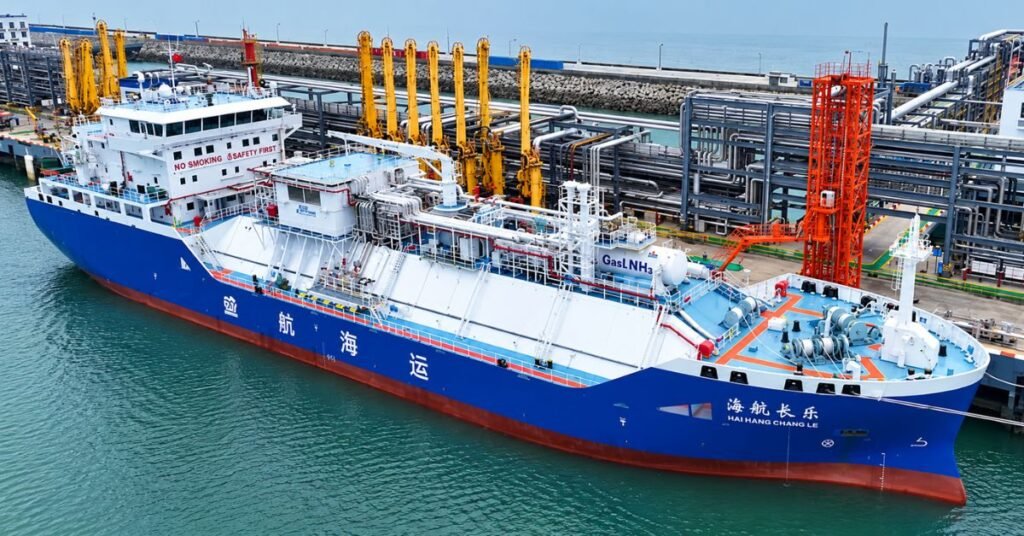
A 5,500 m³ semi-refrigerated and semi-pressurised liquefied gas carrier has been converted in China for ammonia transport and ship-to-ship (STS) ammonia fuel bunkering, according to the vessel’s designer FKAB.
The Chinese-flagged vessel, Shenghang Yongle, is based on FKAB Marine Design’s L21 ammonia carrier design. The conversion was led by Jiangsu Andefu Energy Development, with FKAB providing ship design services and Gloryholder supplying cargo-handling technology.
The vessel has received an ammonia bunkering class certificate from China Classification Society (CCS), enabling it to carry liquid ammonia and supply it to other vessels through STS bunkering operations.
Shenghang Yongle Converted for Ammonia Bunkering
Shenghang Yongle was originally designed as a flexible liquefied gas carrier. Following the conversion, the vessel can transport liquid ammonia while also functioning as a marine fuel bunkering vessel.
The approximately 100-metre vessel was built by China Merchants Shipbuilding Industry Dingheng shipyard and is managed by Shenghang Shipping. It is designed for unrestricted navigation and can carry several liquefied gas cargoes, including ammonia, liquefied petroleum gas (LPG) and vinyl chloride monomer.
Shenghang Yongle sailed in the East China Sea from Qinzhou to Caojing on September 6.
Existing Ammonia Carrier Design Adapted for Bunkering
The vessel’s existing cargo containment and handling systems provided the foundation for the conversion. Its cargo tanks have a minimum design temperature of -48°C, while ammonia becomes liquid at temperatures below -33.3°C at standard atmospheric pressure.
The ship is also equipped with two low-temperature reliquefaction systems. These capabilities allowed the existing gas-carrier systems to be adapted for the additional requirements involved in transferring ammonia as a marine fuel.
The conversion included modifications to the bunkering system, development of operating procedures and risk assessments, as well as the establishment of safety and emergency-response arrangements.
Specific ammonia-related risks considered during the conversion included toxicity, material compatibility, low-temperature operations and leak detection during bunkering.
CCS Issues Ammonia Bunkering Class Certificate
The vessel’s ammonia bunkering capability has been certified by China Classification Society. The certification covers its ability to conduct STS liquid ammonia fuel bunkering operations.
The conversion comes as shipping companies and maritime technology providers continue to develop infrastructure for the potential use of ammonia as a marine fuel. Several ammonia bunkering projects globally have progressed through design, feasibility and construction phases, while operational bunkering capability remains limited.
The conversion of an existing ammonia-capable gas carrier provides an alternative to developing a purpose-built bunkering vessel and demonstrates how existing liquefied gas carrier platforms can be adapted for marine fuel supply.
Ammonia Bunkering Infrastructure Remains a Challenge
Ammonia is being considered as a potential low- or zero-carbon marine fuel when produced using renewable energy. However, wider adoption depends on factors including the availability of low-carbon ammonia, regulatory frameworks and the development of a reliable supply chain.
The supply chain requires suitable infrastructure for ammonia production, storage, transportation and bunkering. Safety is also a key consideration because ammonia is toxic and requires specialised systems for containment, transfer, leak detection and emergency response.
The development of operational ammonia bunkering vessels is therefore an important component of establishing the infrastructure needed for ammonia-fuelled shipping.
Recent Posts
Marine
82% of Maritime Professionals Say Current Training Falls Short of Operational Needs, Study Finds
Ammonia
Maersk Tankers Ammonia Retrofit Project Advances Towards EU Support
Policy
EU Maritime Innovation Projects Advance in €3.4-Billion Funding Selection