
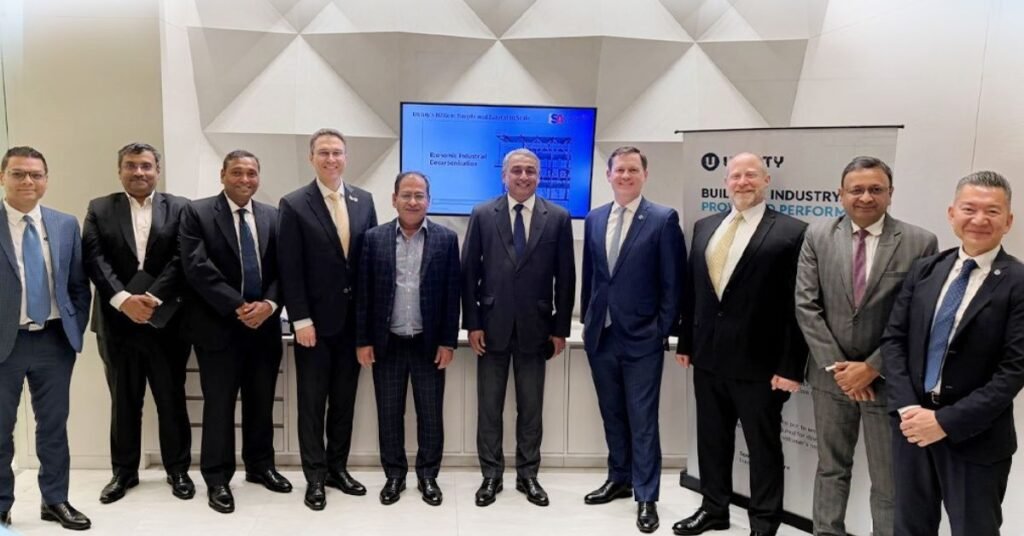
Tata Steel and Houston-based Utility Global will undertake engineering studies for a proposed hydrogen production facility at the Kalinganagar steelworks in Odisha. Announced on 18 November 2026, the project would use gases generated during steelmaking to produce up to 10 tonnes of high-purity hydrogen daily.
The companies will conduct front-end engineering and design (FEED) studies to support a final investment decision (FID) by Tata Steel’s board. Installation and operations would follow only after investment approval. Tata Steel describes the proposal as India’s first project to produce hydrogen using steel-plant off-gases.
How will the hydrogen production process work?
The proposed facility will deploy Utility Global’s proprietary H2Gen electrochemical technology, using a mixture of blast furnace gas and basic oxygen furnace gas.
According to Utility Global, the process draws on residual energy in these industrial gases to produce hydrogen from water without electricity driving the conversion. It also generates a separate, concentrated carbon dioxide stream, which the company says can simplify subsequent carbon capture.
At Kalinganagar, the hydrogen could be injected back into a blast furnace. The proposed configuration therefore links gas generated during steelmaking with hydrogen production and potential reuse within the same industrial complex.
What does the announcement establish about emissions?
The project is being developed as a potential route to reducing emissions from existing steelmaking assets. The announcements do not quantify the expected reduction in greenhouse gas emissions or specify the eventual treatment, utilisation or storage of the concentrated carbon dioxide.
The process also differs from renewable-electricity-based water electrolysis. Its use of steelmaking off-gases means the proposed hydrogen should not automatically be described as green hydrogen.
Utility Global’s stated advantage is integration with existing industrial processes. Chief Executive Officer Parker Meeks described Kalinganagar as the company’s largest announced commercial H2Gen deployment globally and its first announced project in India.
What remains before construction can proceed?
The immediate task is to establish the engineering basis for Tata Steel’s investment decision. Neither company has disclosed a project cost or commissioning date.
Subodh Pandey, Tata Steel’s Vice President for Technology, Research and Development, New Materials Business and Graphene, emphasised that decarbonisation technologies must function at the scale and complexity of an operating steel plant.
Tata Steel said H2Gen had previously been demonstrated using actual blast furnace gas at a steel producer’s facility in Canada. The proposed Odisha installation would take the technology into a new operating environment, subject to the engineering assessment and board approval.
How does it fit Tata Steel’s wider decarbonisation programme?
The proposal supports Tata Steel’s stated ambition to achieve net-zero emissions by 2045. Its earlier work includes trials involving hydrogen, coal-bed methane and biochar injection into blast furnaces.
In September 2021, the company commissioned a carbon capture facility at Jamshedpur with capacity to capture five tonnes of carbon dioxide daily from blast furnace gas. That project established an earlier application of gas treatment within its steelmaking operations.
More recently, Tata Steel announced the commissioning of a coke oven gas injection project at Blast Furnace 1 at Meramandali, Odisha, in September 2026. Developed with technology support from Paul Wurth-SMS and equipment supplied by Kobelco, it injects coke oven gas through furnace tuyeres to substitute part of the conventional fossil-fuel reductant requirement.
The Kalinganagar studies extend this programme by assessing whether hydrogen production from existing process gases can be integrated into a commercial steelworks.
Recent Posts
Power & Propulsion
Everllence 175D Marine Engine Targets 1,500 Hours of Unmanned USV Operation
Tugboats
Zhejiang’s First Fully Electric Tugboat Enters Service at Ningbo-Zhoushan Port
Marine
ABB to acquire Ziehl-Abegg for $2.65 billion, expanding HVAC and industrial cooling portfolio