
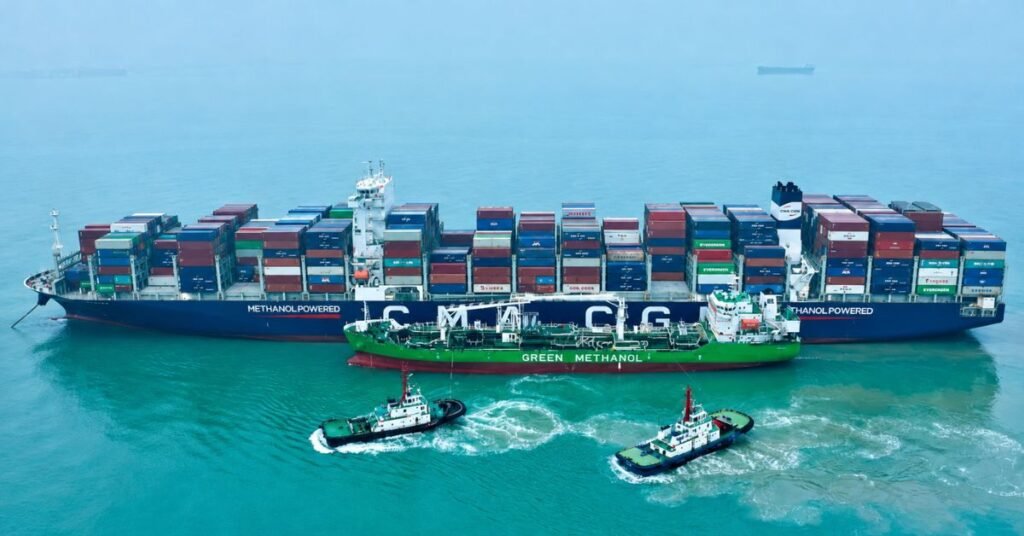
The same 13,000 TEU methanol dual-fuel containership, the same port, and another record just five months later. CMA CGM, SIPG Energy and Shanghai Electric have completed an 8,016-tonne biomethanol bunkering operation in Shanghai, more than doubling the previous record and marking another step in CMA CGM’s broader push to scale up low-carbon marine fuels.
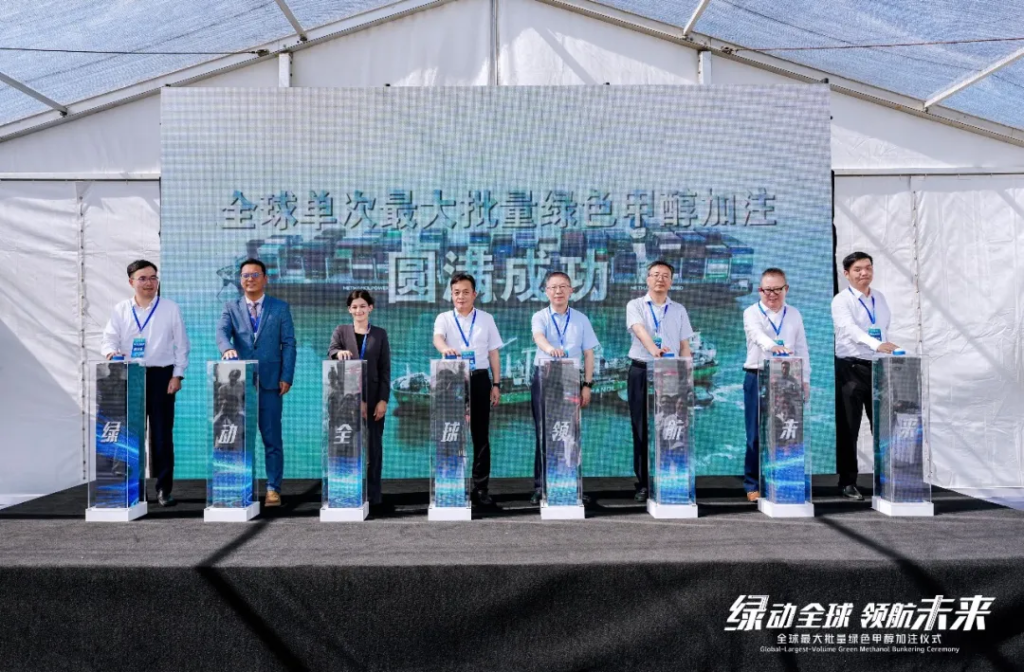
A new world record has been set for biomethanol bunkering.
On August 15-16, CMA CGM, together with SIPG Energy and Shanghai Electric Group, successfully supplied 8,016 tonnes of domestically produced biomethanol to the 13,000 TEU dual-fuel containership CMA CGM OSMIUM at Shanghai Port.
The operation set a new world record for the largest quantity of biomethanol supplied in a single ship bunkering operation, significantly surpassing the previous record of 3,643 tonnes, which had been established in Shanghai only five months earlier.
The bunkering was carried out by SIPG Energy’s bunker vessel Hai Gang Zhi Yuan.
CMA CGM OSMIUM is a 13,000 TEU biomethanol dual-fuel containership currently deployed on CMA CGM’s SEAS 2 service connecting Asia with the East Coast of South America.
A ceremony was held at Shanghai Yangshan Port on August 17, bringing together the partners involved in the project to mark the latest milestone in the development of low-carbon shipping.
From 3,643 tonnes to 8,016 tonnes in just five months, the amount supplied in a single operation increased by 4,373 tonnes, or around 120%.
The numbers illustrate how quickly biomethanol bunkering is moving from demonstration-scale operations towards much larger volumes.
Earlier this year, CMA CGM OSMIUM completed a 3,643-tonne biomethanol bunkering operation at Shanghai Yangshan Port. That operation represented CMA CGM’s first biomethanol bunkering globally and, at the time, established a new record in China.
Five months later, the same vessel has returned to Shanghai and more than doubled the scale of the operation.
For one of the world’s largest liner shipping groups, the development shows that biomethanol is moving beyond initial fuel trials and into larger-scale commercial deployment.
A Green Fuel Supply Chain from Jilin to Shanghai
Behind the 8,016-tonne bunkering record lies a much broader supply chain.
According to CMA CGM, most of the biomethanol used in the latest operation was produced at Shanghai Electric Group’s biomethanol project in Taonan, Jilin Province, in northeast China.
The fuel was transported from Taonan to Dalian Port, where it was consolidated, transferred and stored before being shipped south to Shanghai for final bunkering.
The operation therefore involved much more than a bunker vessel alongside a containership.
Upstream, it relied on biomass resources and biomethanol production capacity in northeast China.
In the middle of the chain came inland transportation, port consolidation, storage and coastal shipping.
At the final stage, SIPG Energy organised the bunkering operation in Shanghai, with the fuel ultimately entering CMA CGM’s global liner network.
The result is an increasingly visible value chain linking:
biomass resources → methanol production → logistics → port storage → marine bunkering → deep-sea shipping.
This supply chain was not created for a one-off operation.
On March 20, 2025, CMA CGM, SIPG Energy and Shanghai Electric formally signed a long-term biomethanol supply cooperation agreement aimed at developing an integrated biomethanol value chain.
Roughly a year later, the partnership delivered the first 3,643-tonne bunkering operation.
Five months after that, the single-operation volume had increased to 8,016 tonnes.
From a long-term supply agreement to first delivery and then to a world record, the cooperation is now moving along a clear path towards larger-scale commercialisation.
For Shanghai Port, the operation also strengthens its position in the emerging global market for low-carbon marine fuels.
The ability to supply large deep-sea vessels with alternative fuels on a reliable basis is becoming an increasingly important capability for major international maritime hubs.
CMA CGM and Shanghai: From LNG to Biomethanol
Shanghai has already played an important role in CMA CGM’s alternative-fuel journey.
In 2022, CMA CGM and Shanghai International Port Group completed China’s first bonded LNG SIMOPS operation at Yangshan Port, allowing LNG bunkering and container handling to take place simultaneously.
The vessel involved was the 15,000 TEU LNG-powered containership CMA CGM SYMI, while SIPG carried out the ship-to-ship bunkering operation using the LNG bunker vessel Hai Gang Wei Lai.
The two sides had also established a long-term arrangement under which Shanghai would provide LNG bunkering services for CMA CGM vessels calling at Yangshan.
A few years later, their cooperation has expanded from LNG to biomethanol.
The progression is clear:
LNG bunkering → 3,643 tonnes of biomethanol → 8,016 tonnes of biomethanol and a new world record.
It also reflects a broader shift in the relationship between major liner companies and global hub ports.
Ports are no longer being asked only to provide conventional marine fuels. They are increasingly expected to support LNG, methanol, biofuels and other alternative-energy pathways.
A Green Shipping Strategy Built Over Many Years
The latest record also fits into a much longer CMA CGM decarbonisation strategy.
CMA CGM began making major investments in LNG dual-fuel containerships as early as 2017.
The subsequent delivery of the 23,000 TEU CMA CGM JACQUES SAADE and its sister vessels placed CMA CGM among the first liner operators to deploy alternative-fuel technology at scale on major east-west container trades.
Those dual-fuel ships also created a technical platform that could later accommodate lower-carbon gaseous fuels, including biomethane and e-methane.
CMA CGM subsequently expanded its focus beyond vessels and into the fuels themselves.
In 2021, the Group launched a low-carbon shipping solution based on biomethane and began supporting the development of biomethane supply.
It also worked with energy companies on the industrial development of BioLNG, e-methane and other low-carbon fuel pathways.
The strategic direction was becoming increasingly clear: LNG infrastructure and dual-fuel vessel technology could provide an immediate operational platform, while progressively lower-carbon fuels could be introduced over time.
A $1.5 Billion Energy Fund Pushes the Strategy Further Upstream
In 2022, CMA CGM took another major step by creating a $1.5 billion energy fund to accelerate the energy transition across shipping, inland transport and logistics.
The investment scope covered the industrial production of renewable fuels including biofuels, biomethane, e-methane and low-carbon methanol, as well as ports, warehouses, vehicles and other low-emission technologies.
This widened CMA CGM’s approach from fleet investment towards the broader energy ecosystem.
Having ships capable of using alternative fuels is only part of the transition.
For large-scale maritime decarbonisation to become commercially viable, those fuels must also be available in sufficient quantities, at competitive prices, and at the ports where global shipping networks operate.
That is why CMA CGM has increasingly become involved in fuel production projects, long-term supply agreements, bunkering infrastructure and partnerships with energy companies.
According to its latest announcement, CMA CGM currently operates one of the world’s largest dual-fuel fleets and plans to deploy 200 vessels capable of using low-carbon fuels by 2031.
The scale of the fleet transition has therefore moved into the hundreds of ships.
Biomethane, Methanol and Bioethanol: A Multi-Fuel Approach
Another defining feature of CMA CGM’s green shipping strategy is its decision to maintain several fuel pathways in parallel.
The Group has not placed its future on a single marine fuel.
Instead, its portfolio increasingly covers LNG, biomethane, e-methane, biomethanol and other renewable fuels.
In July 2026, the strategy expanded further.
The 13,000 TEU CMA CGM IRON completed a bioethanol bunkering operation at Brazil’s Port of Santos, demonstrating the potential for another low-carbon alcohol fuel within CMA CGM’s fleet.
Looking at 2026 alone, the pace of activity has accelerated considerably:
March — Shanghai: CMA CGM OSMIUM completes CMA CGM’s first biomethanol bunkering, receiving 3,643 tonnes.
July — Santos: CMA CGM IRON completes a bioethanol bunkering operation in Brazil.
August — Shanghai: CMA CGM OSMIUM receives 8,016 tonnes of biomethanol, setting a new world record.
The sequence shows a clear progression from technical validation towards regular operations and increasingly large fuel volumes.
China Is Becoming an Important Part of CMA CGM’s Global Green Fuel Network
The 8,016-tonne record also highlights another important feature of CMA CGM’s decarbonisation strategy: working with partners in different regions according to their industrial and energy strengths.
In Europe, CMA CGM has developed experience in LNG, biomethane and synthetic methane.
In Brazil, it is exploring the potential of a well-established bioenergy industry through bioethanol.
In China, biomethanol is becoming an increasingly important area of cooperation.
China combines large-scale renewable-energy industries, biomass resources, manufacturing capabilities, major ports and the world’s largest shipbuilding base.
In the latest project, Shanghai Electric provides upstream biomethanol production, SIPG Energy provides port-side fuel organisation and bunkering capability, and CMA CGM connects those resources directly with the global liner shipping network.
CMA CGM OSMIUM’s deployment on the SEAS 2 service between Asia and the East Coast of South America also gives the latest operation a clear long-haul commercial dimension.
Biomethanol produced through a Chinese supply chain is now being supplied at scale to a vessel operating on an intercontinental liner route.
Christine Cabau, Executive Vice President of the CMA CGM Group, described the operation as a major milestone in the Group’s decarbonisation journey, saying that close cooperation across the value chain is helping make the large-scale adoption of alternative marine fuels a reality.
SIPG Energy General Manager Zhang Da said the company is working to move domestically produced biomethanol bunkering from one-off demonstration projects towards regular, large-scale green fuel services.
The industry context is also changing rapidly.
As more alternative-fuel ships enter service, competition will increasingly extend beyond ship technology itself towards fuel production, certification, storage, logistics and the ability of major ports to provide reliable supplies.
From early investment in LNG dual-fuel mega-containerships to biomethane, methanol and now bioethanol; from ship investment to energy funds, fuel production and long-term supply chains, CMA CGM has been steadily expanding the scope of its green shipping strategy.
Shanghai’s latest 8,016-tonne biomethanol bunkering record is one of the clearest demonstrations yet of how those investments are beginning to translate into operational scale.
A new world record has been set. More importantly, large-scale low-carbon marine fuel use is moving another step closer to becoming part of everyday deep-sea shipping.
Recent Posts
Biofuels
WinGD Ethanol-Fuelled Engine Completes First In-Service Voyage on Maersk Vessel
Power & Propulsion
Norsepower Rotor Sails Installed on Airbus Cargo Ship Spirit of Toulouse
EV
Estonia Electric Ferry to Combine Steerprop Propulsion with Battery Power