
Summary
CMA CGM is exploring an ethanol bunkering trial in Singapore and working with the Maritime and Port Authority of Singapore (MPA) and industry partners on a potential liquefied biomethane (bio-LNG) trial. The proposed initiatives will examine fuel handling, marine engine compatibility, bunkering safety and the accounting of greenhouse gas emissions savings. The companies are also planning a digital port clearance pilot in the first quarter of 2027, alongside initiatives covering maritime training and start-up collaboration.
Article
CMA CGM is evaluating the use of ethanol and liquefied biomethane as alternative marine fuels through proposed bunkering trials in Singapore, as the shipping group expands its collaboration with the Maritime and Port Authority of Singapore (MPA) on maritime decarbonisation.
In a joint update issued on 26 November 2026, CMA CGM and MPA outlined plans to assess the operational requirements of ethanol bunkering and explore a potential liquefied biomethane trial. The initiatives will address fuel safety, engine operations and the verification of emissions savings. No timelines have been announced for either bunkering trial.
What will CMA CGM’s proposed ethanol and bio-LNG trials examine?
The proposed ethanol trial will assess the fuel’s suitability for marine engine applications, including bunkering procedures, safety requirements and operational considerations.
The separate liquefied biomethane trial will focus on establishing how the fuel’s sustainability credentials and greenhouse gas emissions reductions can be documented and recognised under regulatory and voluntary frameworks.
Liquefied biomethane, commonly known as bio-LNG, can use existing LNG bunkering infrastructure in Singapore. CMA CGM already regularly uses the port’s LNG bunkering facilities, providing an established infrastructure base for exploring the alternative fuel.
The proposed work follows an October 2026 memorandum of understanding between MPA, CMA CGM and Singapore LNG Corporation. The agreement covers the certification, supply and use of liquefied biomethane as a marine fuel.
It also addresses the tracking and verification of sustainability attributes when biomethane is mixed with conventional natural gas within shared infrastructure. Establishing reliable accounting mechanisms is important for shipping companies seeking to demonstrate the emissions reductions associated with the fuels they procure.
When will CMA CGM and MPA launch the digital port clearance pilot?
CMA CGM and MPA are planning a digital port clearance pilot in the first quarter of 2027 to improve data exchange between ships and port authorities.
The initiative builds on earlier trials conducted aboard APL Singapura in 2025 and CMA CGM Grand Palais in 2026. These trials examined how electronic data exchanges could simplify port clearance procedures and reduce manual administrative work during vessel calls.
The findings from both vessel trials will contribute to the development of the planned pilot.
Separately, CMA CGM’s innovation accelerator ZEBOX and Singapore’s PIER71 signed an agreement on 18 November 2026 to support maritime start-ups in entering new markets and developing industry partnerships. The collaboration follows ZEBOX’s participation in Singapore’s Smart Port Challenge in 2025 and 2026.
How is CMA CGM supporting maritime training in Singapore?
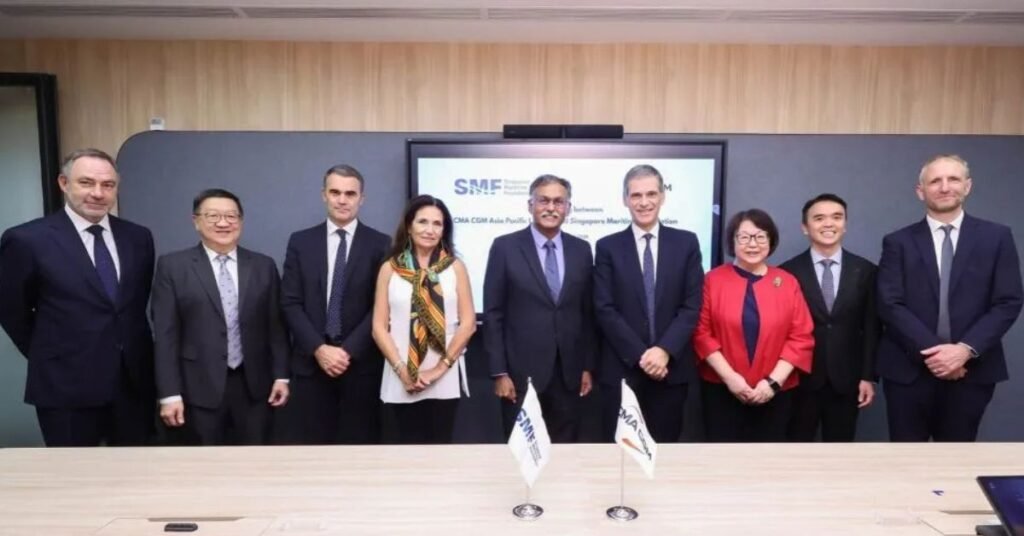
CMA CGM and the Singapore Maritime Foundation signed a memorandum of understanding on 25 November 2026 to support MaritimeONE scholarships and internship opportunities.
Since 2019, CMA CGM has supported 11 students through MPA’s Global Internship Award, providing placement opportunities in Singapore and overseas.
The company and MPA are also exploring potential collaboration on the authority’s Maritime Leadership Programme in 2027.
These initiatives form part of a broader maritime partnership first established between CMA CGM and MPA in 2022 and renewed in March 2025. The renewed agreement covers cooperation in decarbonisation, digitalisation and maritime innovation.
It also included plans to add four LNG-powered vessels, each with a capacity of 23,000 twenty-foot equivalent units (TEU), to the Singapore Registry of Ships.
In 2026, CMA CGM’s intra-Asia shipping subsidiary CNC also introduced or enhanced services connecting Singapore with Malaysia, Indonesia and Myanmar.
FAQs
Has CMA CGM confirmed dates for ethanol and bio-LNG bunkering trials in Singapore?
No. Both trials remain under consideration, and the joint update issued on 26 November 2026 did not specify commencement dates or fuel volumes.
What will the proposed bio-LNG bunkering trial examine?
The trial will examine how the sustainability attributes and greenhouse gas emissions savings associated with liquefied biomethane can be documented and recognised under regulatory and voluntary frameworks.
Can bio-LNG use Singapore’s existing LNG bunkering infrastructure?
Yes. Liquefied biomethane can utilise existing LNG bunkering infrastructure, including facilities already used by CMA CGM in Singapore.
When is the digital port clearance pilot expected to begin?
CMA CGM and MPA plan to launch the digital port clearance pilot in the first quarter of 2027, building on earlier trials aboard APL Singapura and CMA CGM Grand Palais.
Which organisations are involved in CMA CGM’s biomethane initiative?
CMA CGM, the Maritime and Port Authority of Singapore and Singapore LNG Corporation are involved in the collaboration covering the certification, supply and use of liquefied biomethane as a marine fuel.
Recent Posts
Bunkering
CMA CGM considers ethanol and bio-LNG bunkering trials in Singapore
Policy
Odisha outlines plans for new port, shipbuilding cluster and green fuel infrastructure
Power & Propulsion Methanol
Greenpeace launches 75-metre sailing flagship at Spain’s Freire Shipyard