
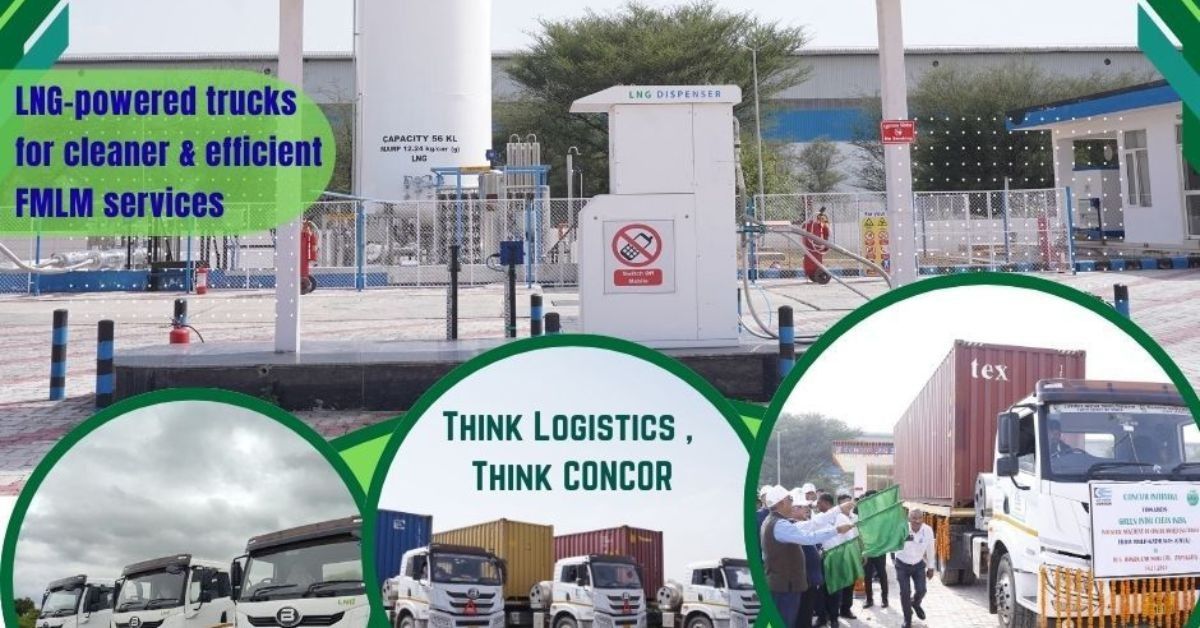
Container Corporation of India Ltd (CONCOR) has deployed a fleet of 230 LNG-powered trucks to strengthen its First and Last Mile Logistics (FMLM) services, marking a significant step toward cleaner and more cost-efficient freight movement in India.
The introduction of LNG trucks is aligned with CONCOR’s broader sustainability agenda and India’s push to reduce emissions from road transport. Compared with conventional diesel vehicles, LNG-powered trucks offer substantially lower carbon emissions, reduced particulate matter, and significantly lower noise levels, making them better suited for urban and peri-urban logistics operations. The switch is also expected to bring down fuel costs over the vehicle lifecycle, improving operating economics for both CONCOR and its customers.
To support the new fleet, CONCOR has commissioned its first LNG fuel station at the Multi-Modal Logistics Park (MMLP) in Kathuwas, Haryana. A second LNG fuel station is set to become operational soon at the MMLP Dadri in Uttar Pradesh, further strengthening the refuelling ecosystem along key freight corridors in northern India. These facilities are expected to ensure reliable fuel availability and enable seamless operations of LNG-powered vehicles across CONCOR’s network.
The LNG trucks will be used for first and last-mile connectivity between ports, inland container depots (ICDs), container freight stations (CFSs), and customer locations. By reducing the environmental footprint of short-haul and feeder movements, CONCOR aims to complement its rail-based container operations with greener road logistics.
Industry observers see the initiative as an important move toward building a sustainable, multimodal logistics system that balances efficiency, cost competitiveness, and environmental responsibility.
Recent Posts
Biofuels
WinGD Ethanol-Fuelled Engine Completes First In-Service Voyage on Maersk Vessel
Power & Propulsion
Norsepower Rotor Sails Installed on Airbus Cargo Ship Spirit of Toulouse
EV
Estonia Electric Ferry to Combine Steerprop Propulsion with Battery Power