
Europe could produce enough e-fuels to meet 14% of the shipping sector’s fuel demand by 2033, but slow project deployment risks allowing China to take the lead in the emerging market for zero-emission marine fuels, according to a new analysis by Transport & Environment (T&E).
The report highlights that while Europe has a growing pipeline of e-fuel projects, only a small number have reached commercial operation, underlining the need for stronger policy support and investment.
Large Pipeline, Limited Deployment
T&E’s updated e-fuels tracker identifies 69 e-fuel projects across Europe that could supply the maritime sector.
However, only six projects are currently operational, illustrating the challenges developers face in bringing large-scale facilities online.
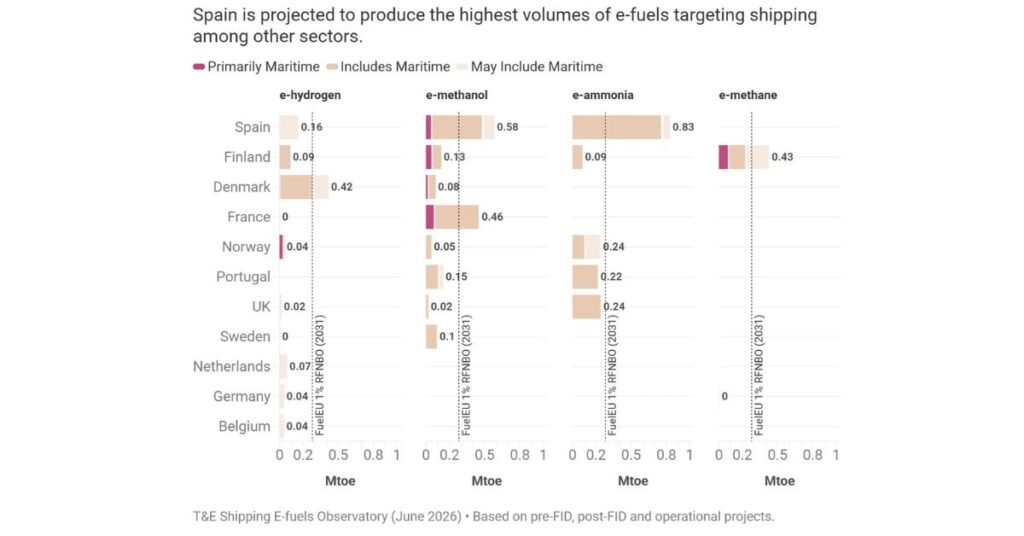
If all announced projects proceed as planned, they could collectively produce up to 4.09 million tonnes of oil equivalent (Mtoe) of e-fuels by 2033, enough to meet approximately 14% of European shipping’s fuel demand.
Among the most advanced developments is Spain’s Andalusian Green Hydrogen Valley, which reached Final Investment Decision (FID) in February. The project is expected to produce around 474,000 tonnes of oil equivalent per year of e-ammonia and e-methanol.
Spain Leads European Development
According to the analysis, Spain has the largest pipeline of maritime e-fuel projects, followed by:
- Denmark
- Finland
- France
The expansion of these projects has been supported by the introduction of FuelEU Maritime, which established the EU’s first dedicated target for renewable fuels in shipping.
China Scaling Up Faster
While Europe has a larger number of announced projects, T&E found that China’s three operational e-fuel plants currently produce around ten times more fuel than Europe’s six operating facilities.
The report warns that China’s ability to commercialise projects more rapidly could allow it to dominate future e-fuel exports unless Europe accelerates domestic production.
Without stronger European investment, imported Chinese e-fuels could increasingly supply the European market.
Policy Support Needed
T&E argues that additional financial incentives and regulatory measures are required to close the cost gap between renewable e-fuels and conventional fossil fuels.
The organisation also believes stronger demand-side measures will encourage shipping companies to adopt e-fuels rather than relying on imported LNG or biofuels to meet decarbonisation targets.
Constance Dijkstra, Maritime Policy Manager at T&E, said Europe risks falling behind if it does not accelerate commercial deployment.
She said the EU must bridge the price gap between European-produced e-fuels and fossil fuels while encouraging greater uptake of renewable fuels across the shipping industry.
Recent Posts
Marine
Singapore Unveils Ammonia Bunkering Standard, First Ethanol Bunkering and LNG Storage Plans
Ammonia
Singapore Launches TR 148 Ammonia Bunkering Standard and Model Contract to Prepare for Ammonia-Fuelled Ships
Policy
China Targets Doubling New Energy Inland Vessels by 2028 Under 2026-2030 Action Plan