
Summary
Finnlines and Stora Enso have expanded their cooperation to reduce emissions from transporting packaging board and wood-based products. Stora Enso will use the Finnlines Green Lane service, which replaces an equivalent amount of fossil-fuel energy with renewable alternatives within the shipping company’s network and provides verified emissions-reduction documentation.
Industrial cargo partnership adopts lower-carbon transport
Finnlines Green Lane will support Stora Enso’s efforts to reduce the environmental footprint of its European maritime logistics, under an expanded partnership announced on 15 October 2026.
The arrangement brings the service into an established industrial supply chain, combining scheduled sea transport with customer-supported renewable-energy use.
Finnlines says its biofuel option can reduce well-to-wake greenhouse-gas emissions by up to 90% compared with conventional fossil fuels. This describes potential lifecycle performance, rather than an achieved reduction across Stora Enso’s entire logistics operation.
The announcement does not quantify the cargo volumes covered, contract duration or expected annual emissions savings.
Customers receive certificates documenting reported reductions, which Finnlines says are independently verified annually. The company identifies EU MRV, FuelEU Maritime, ISO 14064 and EN 16258 among the frameworks and standards supporting verification.
Energy replacement operates across the fleet
Green Lane uses an energy-equivalence approach. For covered transport, Finnlines commits to replacing the fossil-fuel energy needed to carry a customer’s cargo with an equivalent amount of alternative energy.
The replacement fuel is consumed within the same calendar year as the shipment, although it need not be used on the vessel or voyage carrying that particular consignment.
This distinction explains how the product operates across a shipping network: the customer’s purchase supports alternative-energy consumption, while the physical shipment continues through the liner service.
Finnlines identifies waste-based fatty acid methyl ester, or FAME, as a biofuel currently used. It may also use certified hydrotreated vegetable oil, or HVO.
The company says its biofuel carries International Sustainability and Carbon Certification and batch-level sustainability documentation. For customers, the accounting method, fuel certification and verified reduction records are therefore central parts of the service.
Service builds on its 2025 introduction
The Stora Enso agreement extends a product Finnlines introduced on 22 May 2025, offering electricity and biofuel pathways for lower-emission transport.
At launch, the electricity option focused on the Naantali–Kapellskär route between Finland and Sweden, served by the hybrid roll-on/roll-off passenger vessels Finnsirius and Finncanopus.
Their five-megawatt-hour batteries are charged from shore while the ships are berthed. Stored electricity is then used at sea to replace fossil-fuel consumption for an allocated number of freight units.
Battery capacity limits the availability of that option. It does not mean the ships complete every crossing entirely on electricity.
Finnlines has also distinguished between the emissions boundaries of its offerings: the electricity claim concerns tank-to-wake performance, while the biofuel reduction is assessed well-to-wake. These measures cover different stages of energy use and should be read accordingly.
Fleet investment provides an earlier foundation
The customer service follows earlier investment in more efficient vessels.
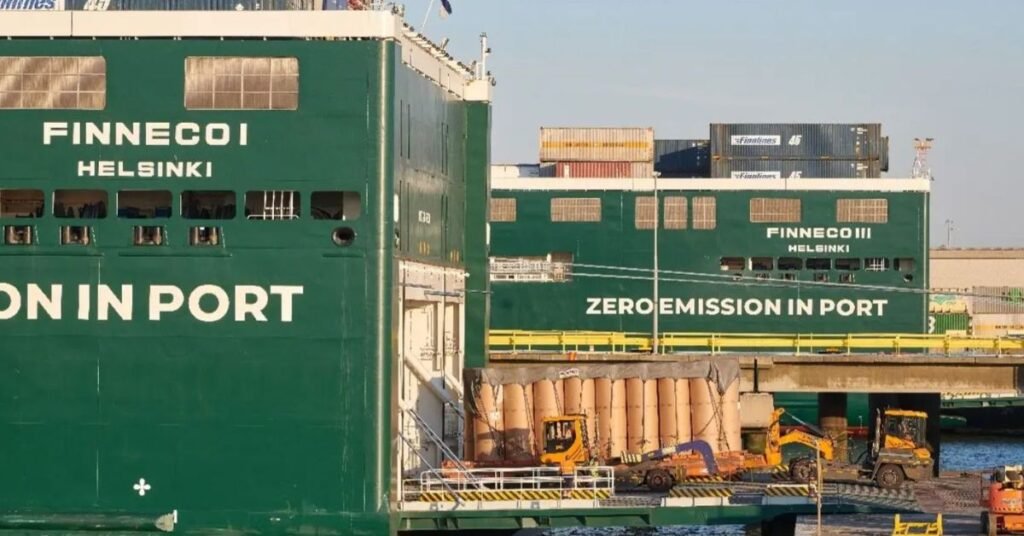
Finnlines’ three Finneco-class hybrid freight ships were delivered in 2022. Each measures 238 metres in length and provides 5,800 lane metres of cargo capacity.
Their equipment includes batteries, solar panels, waste-heat recovery and air lubrication. The latter introduces air beneath the hull to reduce resistance through the water, lowering the propulsion energy required.
These investments address vessel efficiency, while Green Lane gives customers a mechanism to support alternative-energy consumption.
The distinction is commercially relevant: fleet improvements change the transport platform itself, whereas the customer programme adds an energy-purchasing and emissions-documentation arrangement to freight services.
Stora Enso targets emissions beyond its factories
The partnership also fits Stora Enso’s broader climate commitments.
The company targets a 50% reduction in absolute Scope 1 and 2 emissions by 2030 against a 2019 baseline, alongside a separate 50% reduction in Scope 3 value-chain emissions. It has additionally committed to net-zero carbon emissions by 2040 through The Climate Pledge.
Transporting raw materials and finished products is among the activities addressed through its value-chain work. Cooperation with logistics providers is consequently relevant alongside changes within production facilities.
The Finnlines arrangement provides one transport-specific action within that wider programme. Its eventual contribution will depend on the shipments covered and the reductions documented through the service, rather than the maximum percentage reduction available from an individual fuel pathway.
FAQs
What does the partnership cover?
Stora Enso will use Green Lane for maritime transport of packaging board and wood-based products.
Must the alternative fuel power the ship carrying the cargo?
No. Finnlines can consume the equivalent alternative energy elsewhere in its fleet during the same calendar year.
What does the “up to 90%” reduction mean?
It is the stated potential lifecycle greenhouse-gas reduction for the biofuel option compared with conventional fossil fuels.
How are reductions documented?
Customers receive certificates, with reported reductions independently verified annually.
When was Green Lane introduced?
Finnlines launched the service on 22 May 2025.
Recent Posts
Biofuels
WinGD Ethanol-Fuelled Engine Completes First In-Service Voyage on Maersk Vessel
Power & Propulsion
Norsepower Rotor Sails Installed on Airbus Cargo Ship Spirit of Toulouse
EV
Estonia Electric Ferry to Combine Steerprop Propulsion with Battery Power