
Summary
Construction has begun on Cap Morgiou, the first of two Sogestran bunker vessels intended to serve Petroineos in southern France. The ships will handle conventional fuels, biofuels and e-methanol, expanding delivery flexibility across the Marseille, Fos and Toulon areas. The first vessel is expected to arrive in early 2028.
First vessel moves into construction
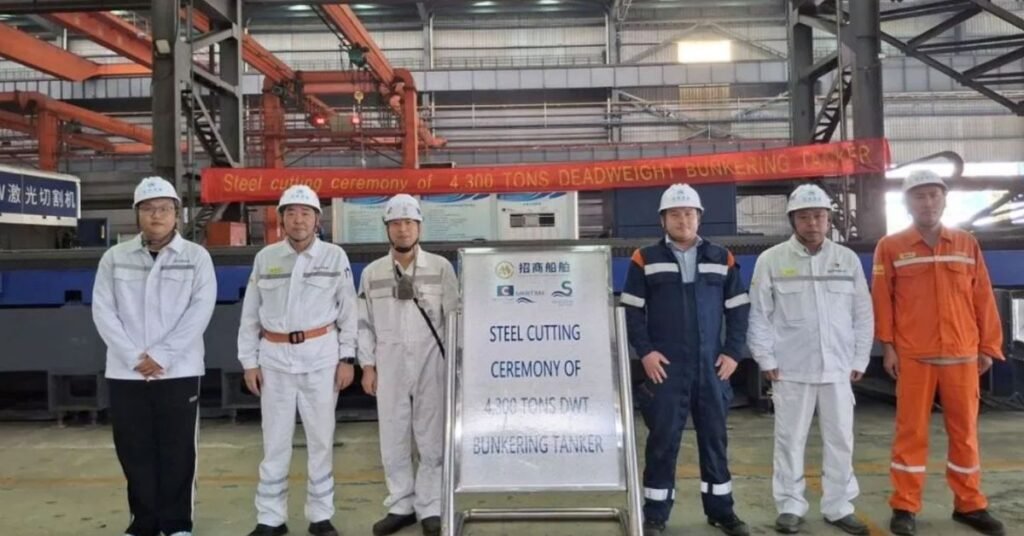
The Sogestran bunker vessels programme reached a construction milestone with the first steel cutting for Cap Morgiou at China Merchants Industry Yangzhou Dingheng Shipyard on 8 October 2026.
The project is being developed through Sogestran subsidiary Maritima for its customer Petroineos Lavéra. It follows the two-vessel programme announced in October 2025.
Cap Morgiou is scheduled for launch in 2027 and delivery in early 2028. Construction of the second vessel, Cap Janet, is expected to begin approximately six months after the first.
The vessels will have dual qualification for oil and chemical products and will be capable of carrying three different products simultaneously. Their intended cargo range includes marine diesel, fuel oils, HVO, B24, B100 and e-methanol.
Earlier order established the technical specification
The original project announcement identified a cargo capacity of 4,500 cubic metres for each ship. Their design was developed specifically to improve access to the Petroineos refinery jetties at Lavéra.
Deltamarin’s Shanghai office undertook the design work. The newbuildings are intended to replace the existing vessels Florence B, Tatiana B and Cap Pinede.
The programme extends a relationship between Petroineos and Maritima that had lasted more than 34 years when the order was announced.
This makes the investment both a renewal of established delivery capacity and preparation for a wider range of marine fuels. The ships are being designed around the operating requirements of an existing regional supply network.
Diesel-electric machinery supports short-distance operations
The specified propulsion arrangement combines three electronically managed generator sets with electric propulsion. Generator output is intended to adjust to the vessels’ operating requirements.
Two electric azimuth thrusters at the stern, supported by a bow tunnel thruster, will provide manoeuvrability. The design also includes shore-power connections and mass flow meters for monitoring delivered fuel quantities.
These features address different aspects of bunker-vessel operation: propulsion and positioning, energy use alongside, and measurement during deliveries.
The diesel-electric arrangement should be distinguished from the cargo capability. Being able to transport e-methanol does not establish that the bunker vessels themselves will use methanol for propulsion. The published machinery specification describes a diesel-electric system.
Carrying several fuels creates commercial flexibility
The ability to carry three products simultaneously is central to the planned service offering. It gives the operator scope to accommodate different fuel requirements within the same vessel’s cargo configuration.
For suppliers, this could help manage a transition in which conventional fuels remain part of the market while customers introduce alternative products at different speeds.
The commercial value lies in that flexibility. A vessel designed around several compatible cargo categories can support a broader delivery portfolio than one restricted to a single fuel.
However, carrying capability alone does not determine which products will be available on a particular date. Actual supply will also depend on procurement, customer orders and operating arrangements.
The steel-cutting announcement therefore marks progress in delivery infrastructure rather than the start of a new alternative-fuel supply service.
Lavéra provides the industrial connection
The refinery connection is an important part of the project’s geography. Petroineos describes Lavéra, near Marseille on France’s Mediterranean coast, as a major refining site with crude-processing capacity of approximately 210,000 barrels per day.
Its activities include marketing and trading refined products, alongside direct marine bunkering supply to shipping operators.
Designing the vessels around access to the refinery jetties links their cargo capabilities with the physical infrastructure from which deliveries will be organised. That relationship helps explain why vessel dimensions, manoeuvrability and cargo arrangements matter alongside the selection of fuels.
The newbuildings are thus part of a wider chain connecting product supply, loading facilities and ships requiring bunkers.
Delivery will determine the next operational step
For Maritima and Petroineos, the immediate task is completing the two-vessel construction programme. Launch, outfitting, testing and delivery remain ahead.
For the regional bunker market, the project signals investment in equipment intended to serve both established demand and changing fuel preferences. Its operational contribution will become clearer as the ships approach service and their delivery portfolios are confirmed.
FAQs
Which vessel has reached steel cutting?
Cap Morgiou, the first of two vessels being built for Maritima’s Petroineos business.
Where are the ships being built?
At China Merchants Industry Yangzhou Dingheng Shipyard in China.
What will each vessel carry?
Each will have 4,500 cubic metres of cargo capacity and the capability to transport three different products simultaneously.
When is the first delivery expected?
Cap Morgiou is scheduled for delivery in early 2028.
Will the ships themselves run on methanol?
The announced propulsion arrangement is diesel-electric. Methanol is among the fuels they will be capable of carrying and supplying.
Recent Posts
Biofuels
WinGD Ethanol-Fuelled Engine Completes First In-Service Voyage on Maersk Vessel
Power & Propulsion
Norsepower Rotor Sails Installed on Airbus Cargo Ship Spirit of Toulouse
EV
Estonia Electric Ferry to Combine Steerprop Propulsion with Battery Power