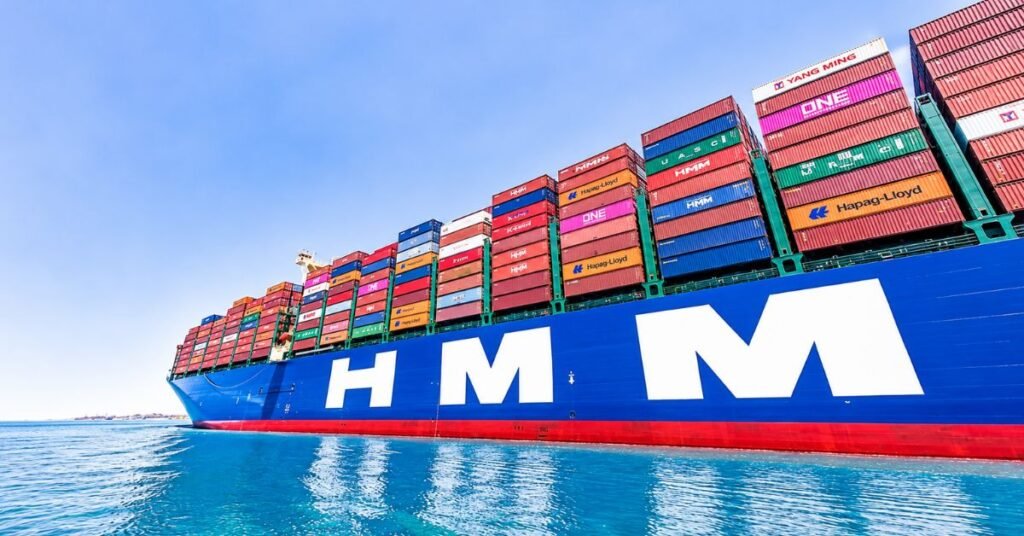
South Korean container shipping company HMM has entered into a Green Sailing Service agreement with US renewable energy company Nextpower, allowing the latter to account for verified greenhouse gas (GHG) emissions reductions from lower-carbon marine fuels in its supply-chain emissions reporting.
Announced on 23 November 2026, the agreement enables Nextpower to use the allocated emissions reductions towards its Scope 3 reporting, which covers indirect emissions generated across a company’s value chain, including purchased transportation and logistics services. The arrangement also provides HMM with a mechanism to recover part of the additional costs associated with adopting lower-carbon marine fuels.
How does HMM’s Green Sailing Service operate?
HMM’s Green Sailing Service uses a book-and-claim approach to allocate emissions reductions from lower-carbon fuel consumption to participating cargo customers.
Under the programme, customers specify their targeted greenhouse gas emissions reductions. HMM evaluates the feasibility of the request and submits a commercial proposal outlining the required fuel, anticipated emissions reductions, implementation arrangements and commercial terms.
Following implementation, HMM issues a declaration allocating the achieved reductions to the customer, supported by certified documentation. The allocation is independent of the vessel or shipping service physically transporting the customer’s cargo.
This approach separates the allocation of environmental benefits from the physical movement of goods. Consequently, a customer’s allocated emissions reductions do not necessarily mean that its cargo was transported on a vessel using the corresponding lower-carbon fuel.
What emissions reductions are eligible under the agreement?
HMM has stated that the reductions allocated to Nextpower will come from voluntary measures exceeding existing regulatory requirements. Emissions reductions used to meet mandatory obligations, including those under European Union environmental regulations, will not be included in the allocation.
The carrier also uses independent third-party verification to substantiate emissions reductions and prevent the same environmental benefit from being claimed by multiple customers.
The agreement’s financial terms and the total volume of emissions reductions covered have not been disclosed.
The distinction between voluntary and mandatory reductions is relevant to the principle of additionality, which requires environmental benefits claimed through voluntary programmes to go beyond existing regulatory obligations.
A November 2024 position paper from the Global Maritime Forum recommends that voluntary book-and-claim systems demonstrate additional environmental benefits. It also outlines principles covering transparent information sharing, consistent emissions accounting, fair commercial practices and verifiable records.
These principles provide an industry framework for evaluating voluntary emissions reduction claims, although they do not constitute regulatory approval of individual commercial agreements.
Which companies have previously joined HMM’s Green Sailing Service?
Nextpower joins a group of companies that have previously entered into similar arrangements with HMM, including Hellmann Worldwide Logistics, IKEA and Nike.
HMM identifies the partnerships as having commenced in 2023, 2024 and 2025, respectively.
In March 2024, Hellmann Worldwide Logistics disclosed that its participation involved the use of second-generation marine biofuel within HMM’s fleet. The resulting emissions reductions were allocated to Hellmann, which could subsequently make them available to its customers to support their supply-chain emissions targets.
The arrangement demonstrated how freight forwarders could participate in book-and-claim programmes alongside cargo owners, extending the application of emissions reduction accounting across the logistics value chain.
What lower-carbon fuel trials has HMM conducted?
HMM has previously conducted marine biofuel trials aboard its operating container vessels.
In September 2023, the carrier reported bunkering its 6,400 TEU container ship HMM Tacoma with a biofuel blend supplied by GS Caltex at Busan, South Korea.
The fuel consisted of 30% biodiesel produced from used cooking oil and 70% high-sulphur fuel oil. At the time, HMM Tacoma was operating on a trade route connecting the Far East, India and Latin America.
The latest agreement with Nextpower does not identify a specific fuel blend, vessel or shipping route. Instead, its scope focuses on allocating independently verified emissions reductions to support corporate supply-chain reporting, while providing HMM with a commercial mechanism to offset part of the additional expenditure associated with lower-carbon fuel adoption.
FAQs
What is HMM’s Green Sailing Service?
HMM’s Green Sailing Service is a book-and-claim programme that allows cargo customers to receive verified greenhouse gas emissions reductions generated through the carrier’s use of lower-carbon marine fuels.
Why has HMM partnered with Nextpower?
The partnership enables Nextpower to account for allocated emissions reductions in its Scope 3 supply-chain reporting, while helping HMM recover part of the additional costs of adopting lower-carbon marine fuels.
Does Nextpower’s cargo need to travel on a vessel using lower-carbon fuel?
No. Under HMM’s book-and-claim approach, emissions reductions can be allocated independently of the vessel or shipping service physically transporting the customer’s cargo.
How does HMM verify emissions reductions?
HMM uses independent third-party verification and certified documentation to substantiate the reductions and prevent duplicate allocation of the same environmental benefit.
Which companies have previously participated in HMM’s Green Sailing Service?
Previous participants include Hellmann Worldwide Logistics, IKEA and Nike, with partnerships commencing in 2023, 2024 and 2025, respectively.
What marine biofuel has HMM tested?
In September 2023, HMM bunkered its 6,400 TEU vessel HMM Tacoma with a blend containing 30% biodiesel derived from used cooking oil and 70% high-sulphur fuel oil.
Recent Posts
LNG
Samsung Heavy Industries partners with Tesser Atomics on nuclear-powered LNG carrier project
Marine
HMM and Nextpower partner on lower-carbon marine fuels and emissions reporting
Power & Propulsion
Everllence 175D Marine Engine Targets 1,500 Hours of Unmanned USV Operation