
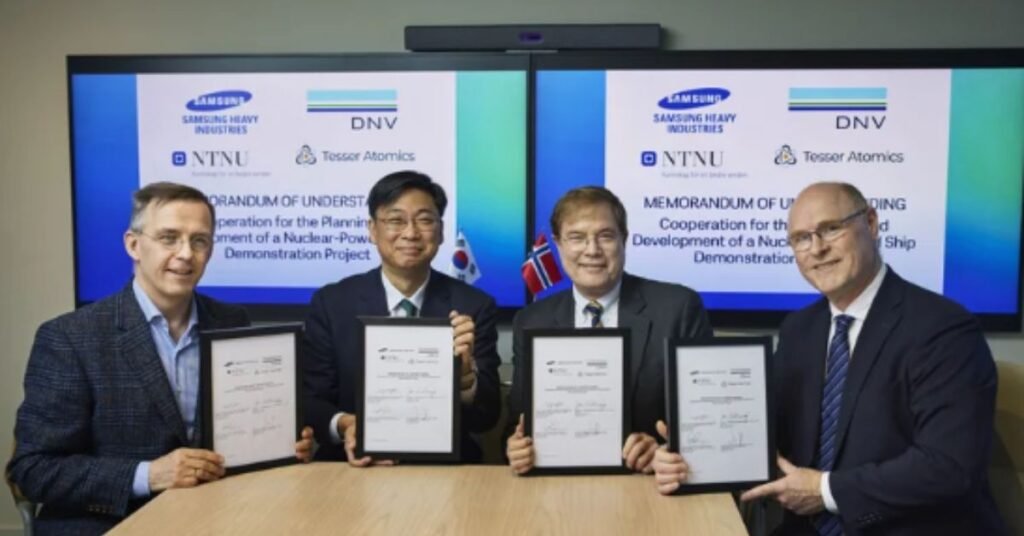
Samsung Heavy Industries (SHI) has entered into an exclusive development partnership with US-based reactor developer Tesser Atomics to advance plans for a nuclear-powered liquefied natural gas (LNG) carrier designed for commercial operations between the United States and Europe.
The memorandum of understanding (MoU), signed on 19 November 2026, establishes a framework for developing and demonstrating nuclear propulsion technology in ocean-going commercial shipping. Classification society DNV and the Norwegian University of Science and Technology (NTNU) are also participating in the initiative.
On 23 November, DNV announced a separate four-party agreement involving SHI, Tesser Atomics, DNV and NTNU. The collaboration will cover vessel concept development, safety assessments and the regulatory approval pathway for the proposed LNG carrier.
What does the Samsung Heavy Industries–Tesser Atomics agreement cover?
Under the agreement, SHI will serve as Tesser Atomics’ exclusive shipbuilding partner for the demonstration project, while Tesser will exclusively supply its proposed reactor technology for the vessel.
The collaboration will bring together SHI’s ship design and construction capabilities with Tesser’s nuclear reactor development and licensing expertise. The objective is to assess the technical and regulatory feasibility of operating a nuclear-powered LNG carrier on an established transatlantic commercial route.
The project is currently at the development stage. The partners have not announced a firm shipbuilding contract, construction schedule, project cost, financing arrangements or vessel capacity. Delivery specifications also remain undisclosed.
Which nuclear reactor will power the LNG carrier?
The proposed vessel will be designed around Tesser Atomics’ Triton reactor, a compact fluoride-salt-cooled high-temperature reactor developed for marine applications.
According to Tesser, the reactor concept combines tri-structural isotropic (TRISO) nuclear fuel with a low-pressure molten salt cooling system. The design also incorporates online refuelling, which is intended to allow fuel replacement while the reactor remains operational.
These features represent the developer’s proposed design capabilities and have not yet been demonstrated aboard the planned commercial vessel.
The project involves using nuclear energy for vessel propulsion, with LNG remaining the cargo transported by the carrier. It therefore represents a proposed application of nuclear power to commercial shipping rather than an LNG-fuelled propulsion system.
What are the responsibilities of SHI, Tesser Atomics, DNV and NTNU?
The four organisations will undertake different technical and research responsibilities as the project progresses.
Samsung Heavy Industries will lead vessel concept development, marine integration and construction feasibility, including the integration of the nuclear propulsion system into the ship’s design.
Tesser Atomics will be responsible for reactor technology development and nuclear plant-related safety and licensing activities.
DNV will contribute classification expertise, maritime risk assessment and verification. Its responsibilities will include hazard identification and the development of a safety assessment framework for the proposed vessel.
NTNU will coordinate research activities, funding proposals and consortium development. Its work will also cover feasibility studies, technical modelling, simulations and testing.
The initial phase will focus on establishing a development pathway covering the vessel concept, safety assessments and regulatory approvals before construction and commissioning can be considered.
How does the project connect with Norway’s maritime nuclear research?
The nuclear-powered LNG carrier initiative originated within Norway’s NuProShip research programme and is continuing under the NTNU-led SFI SAINT maritime nuclear research centre.
The proposed LNG carrier is intended to serve as a demonstration project within the broader research programme, which is examining the potential application of nuclear technology in maritime transport.
Beyond LNG carriers, the participating organisations are also considering the possibility of extending the technology to other commercial vessel categories, including container ships.
The research is expected to examine the technical, operational and regulatory requirements associated with integrating nuclear propulsion into different vessel designs.
What regulatory approvals are required for nuclear-powered ships?
The proposed LNG carrier will need to address several regulatory and technical requirements before commercial deployment can proceed. These include nuclear reactor licensing, maritime safety assessments, classification requirements, insurance arrangements and the legal framework governing nuclear-powered vessels.
At the international level, the International Maritime Organization (IMO) is working on updated safety provisions for nuclear-powered ships.
Its published workplan identifies 2030 as the target year for adopting a revised Code of Safety for Nuclear Ships and amendments to Chapter VIII of the International Convention for the Safety of Life at Sea (SOLAS).
The IMO’s regulatory timeline does not represent approval of the Samsung Heavy Industries–Tesser Atomics project. The proposed vessel must undergo its own technical assessments and approval procedures.
The immediate priorities for the consortium are to establish the vessel concept, complete the initial safety assessment framework and define the regulatory approval pathway. Decisions on financing, construction and commissioning will follow as the project advances.
FAQs
What is Samsung Heavy Industries developing with Tesser Atomics?
Samsung Heavy Industries and Tesser Atomics are developing a concept for a nuclear-powered LNG carrier intended for commercial operations between the United States and Europe.
Which reactor will be used in the proposed nuclear-powered LNG carrier?
The vessel concept will use Tesser Atomics’ Triton reactor, a compact fluoride-salt-cooled high-temperature reactor designed for marine applications.
What roles will DNV and NTNU play in the project?
DNV will contribute classification, maritime risk assessment and safety verification expertise. NTNU will coordinate research, feasibility studies, modelling, simulation, testing and consortium development.
Has Samsung Heavy Industries placed an order to build the nuclear-powered LNG carrier?
No firm shipbuilding contract has been announced. The current agreement establishes an exclusive development partnership, with construction timelines, financing, project costs and vessel specifications yet to be disclosed.
When will the IMO introduce updated regulations for nuclear-powered ships?
The IMO’s published workplan targets 2030 for the adoption of a revised Code of Safety for Nuclear Ships and amendments to Chapter VIII of SOLAS.
Could nuclear propulsion be extended to other commercial vessels?
The partners are considering potential applications beyond LNG carriers, including container ships and other vessel types. Further technical and regulatory assessments will be required before such applications can be pursued.
Recent Posts
LNG
Samsung Heavy Industries partners with Tesser Atomics on nuclear-powered LNG carrier project
Marine
HMM and Nextpower partner on lower-carbon marine fuels and emissions reporting
Power & Propulsion
Everllence 175D Marine Engine Targets 1,500 Hours of Unmanned USV Operation