
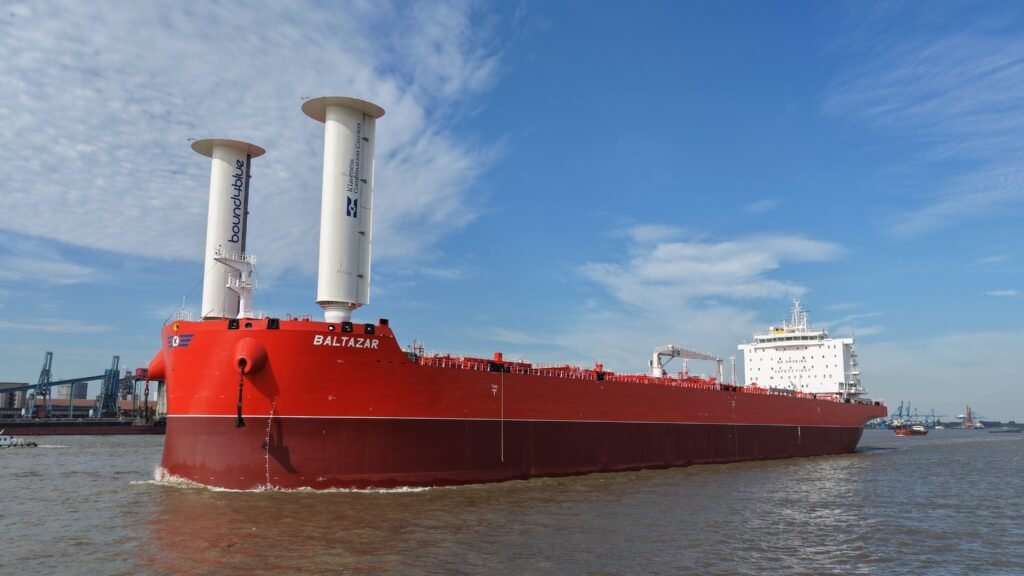
Klaveness Combination Carriers ASA (KCC) has named its 83,300 DWT combination carrier MV Baltazar in Fremantle, Western Australia, completing the company’s third-generation CABU newbuilding programme.
Built by New Yangzi Shipyard in China, MV Baltazar was recently delivered and entered service after completing her maiden voyage to Australia. The naming ceremony brought together KCC customers, business partners, industry stakeholders, government representatives and maritime media.
The Hon. Rita Saffioti MLA, Deputy Premier of Western Australia, served as Lady Sponsor and formally named the vessel.
MV Baltazar to serve Australian combination trades
MV Baltazar is designed to transport liquid cargoes on inbound voyages to Australia and dry bulk commodities on outbound voyages. The vessel is expected to operate primarily on Australian inbound and outbound trades.
Inbound cargoes are expected to include caustic soda solution and fertiliser products such as urea ammonium nitrate (UAN). Outbound cargoes will include alumina, iron ore, grain, salt and other dry bulk commodities.
The vessel measures 228.4 metres in length overall and has a beam of 34.8 metres. It has a deadweight capacity of approximately 83,300 tonnes, is registered with the Norwegian International Ship Register (NIS) and is classed by DNV.
Wind-assisted propulsion and efficiency technologies
MV Baltazar is fitted with two 27-metre bound4blue eSAIL® suction sails, making it the first KCC vessel to incorporate wind-assisted propulsion.
The vessel also features an air lubrication system, shaft generator, EcoEGR fuel-optimised main engine and Mewis duct. It has been prepared for a potential future retrofit to zero- or near-zero-emission fuels.
KCC said the vessel’s combination of trading pattern, size and energy-efficiency technologies results in the lowest carbon footprint among vessels operating in these trades.
Compared with KCC’s oldest CABU vessels, MV Baltazar offers up to 15% greater cargo-carrying capacity.
Third-generation CABU programme completed
MV Baltazar is the third and final vessel delivered under KCC’s third-generation CABU newbuilding programme, completing the company’s current contracted newbuilding series.
Commenting on the milestone, Engebret Dahm, CEO of KCC, said: “Today marks an important milestone for the company as we celebrate the naming of MV Baltazar following her maiden voyage into Australia. Australia has been a core pillar of KCC’s combination carrier business for decades, and our third-generation CABUs represent a new era in our service to and from Australia, continuing to support efficient and reliable transportation for Australian customers across some of the country’s most important industrial supply chains.”
KCC has operated combination carriers serving Australian trades for several decades. The latest CABU vessels add increased cargo capacity and additional energy-efficiency technologies to the company’s fleet serving these trades.
What is MV Baltazar?
MV Baltazar is an 83,300 DWT CABU combination carrier owned by KCC Shipowning AS, a wholly owned subsidiary of Klaveness Combination Carriers ASA. The vessel is designed to carry liquid cargoes on inbound Australian voyages and dry bulk commodities on outbound voyages.
MV Baltazar key specifications
| Specification | Details |
|---|---|
| Vessel type | CABU combination carrier |
| Deadweight | Approximately 83,300 DWT |
| Length overall | 228.4 metres |
| Beam | 34.8 metres |
| Flag | Norwegian International Ship Register (NIS) |
| Classification | DNV |
| Owner | KCC Shipowning AS |
| Primary trades | Australia inbound and outbound |
| Shipyard | New Yangzi Shipyard, China |
| Wind-assisted propulsion | Two 27-metre bound4blue eSAIL® suction sails |
Recent Posts
Ammonia
Aegis Tristar acquisition to expand Indian group’s global energy logistics reach
Power & Propulsion
Everllence and MITSUI E&S Mark 100 Years of Two-Stroke Engine Partnership
Ammonia
NTPC Targets Japan, South Korea and Germany for Green Ammonia Exports from Andhra Pradesh Hub