
Shipowners engine decisions over the next decade could have a significant bearing on the maritime fuel mix through 2050, but the ability of vessels to use alternative fuels will not necessarily translate into actual consumption, according to a new analysis by the Global Centre for Maritime Decarbonisation (GCMD) and Boston Consulting Group (BCG).
The study, Navigating the maritime fuel transition: How fuel economics, regulations, and fleet decisions shape the future bunkering landscape, examines how engine choices, fuel costs, carbon pricing and regulatory measures could influence shipping’s transition to lower-carbon fuels.
Ships typically remain in service for 25–30 years, while only about 4% of the global fleet is renewed each year. As a result, more than half of the vessels operating in 2050 are expected to have been ordered before 2035, making engine selection decisions during the coming decade important to the future fuel landscape.
Engine capacity may not translate into alternative fuel consumption
Dual-fuel engines give shipowners the flexibility to operate vessels on conventional fuels as well as alternative fuels. However, the analysis indicates that this flexibility does not guarantee that the alternative fuel will be used once the vessel enters service.
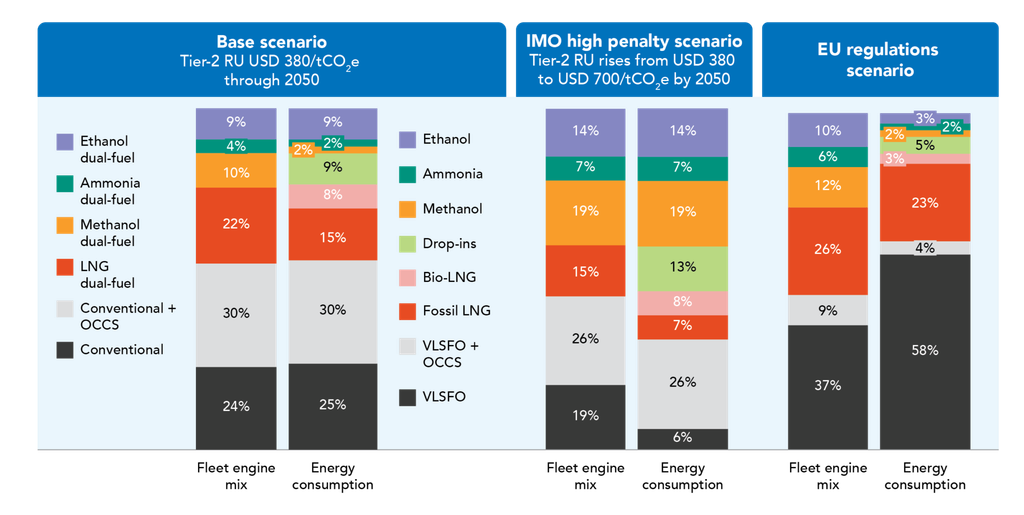
Under the study’s base scenario, the Tier-2 penalty under the IMO Net-Zero Framework remains at USD 380 per tonne of CO2 equivalent through 2050. In this scenario, methanol dual-fuel engines account for about 10% of fleet engine capacity by 2050, while methanol represents only around 2% of total fleet energy consumption.
The difference reflects the role of fuel economics. Where conventional fuels remain cheaper than methanol, vessels equipped with methanol-capable engines could continue operating primarily on conventional fuels.
Higher carbon pricing could accelerate new-fuel uptake
The model shows a substantially different outcome when the IMO Tier-2 penalty increases to USD 700/tCO2e by 2050.
Under that scenario, new fuels, including drop-in fuels, could account for approximately 61% of global fleet energy consumption. The analysis therefore highlights carbon pricing as a major factor in determining whether alternative-fuel capability results in actual fuel switching.
The study also finds that EU regulations alone are unlikely to trigger a comparable global shift because the measures cover only about 20% of international shipping’s energy demand.
E-methanol and e-ammonia costs remain broadly comparable
The analysis does not identify a clear cost advantage between e-methanol and e-ammonia through 2050.
Although e-ammonia can benefit from lower production costs, the advantage is partly offset by higher logistics and handling expenses. These include specialised crew training, larger exclusion zones and more complex bunkering requirements associated with ammonia’s toxicity.
Consequently, the overall levelised cost of using e-ammonia and e-methanol remains near parity through 2050.
Hydrogen and carbon costs could alter fuel competitiveness
The study identifies several variables that could materially change the relative competitiveness of alternative fuel pathways, particularly ethanol, methanol and ammonia.
For both e-methanol and e-ammonia, the levelised cost of hydrogen (LCOH) is a significant factor. E-methanol is also sensitive to the cost of biogenic CO2, linking its economics to feedstock availability and pricing.
The cost trajectory of bio-methanol could influence the near-term adoption of methanol dual-fuel engines and, in turn, affect longer-term technology choices. Ethanol uptake is also sensitive to how regulations treat biofuels derived from food crops.
The model estimates that if LCOH reaches USD 2/kg H2 by 2050, methanol and ammonia together could account for 36% of global fleet energy demand. This is 32 percentage points higher than the modelled share under an LCOH of USD 3/kg H2.
Biogenic CO2 costs could also affect the balance between methanol and ammonia. At an LCOH of USD 2/kg H2, increasing the cost of biogenic CO2 from USD 50/t to USD 150/t reduces methanol’s modelled share from 23% to 14%, while ammonia’s share rises from 14% to 22%.
Alternative fuels could reshape global bunkering hubs
The implications extend beyond vessel fuel consumption to the location and structure of future bunkering infrastructure.
Liquid fuels such as methanol and ethanol are comparatively straightforward to transport and bunker, which could allow established bunkering centres to retain their role as demand for these fuels grows.
Ammonia could lead to a different bunkering model because of its handling requirements and higher transport costs. The study identifies two potential hub types: production-linked hubs that benefit from access to low-cost ammonia, and import-aggregation hubs that achieve scale by serving maritime demand alongside industrial and power-sector consumption.
For ports and bunkering operators, the analysis suggests that future competitiveness will depend on a combination of fuel costs and availability, vessel traffic and the ability to aggregate demand.
What does the study mean for shipowners?
The central implication is that engine-selection decisions and future fuel economics need to be considered together. A vessel ordered today may remain in operation when the cost, availability and regulatory treatment of alternative fuels are significantly different from current conditions.
Professor Lynn Loo, CEO, GCMD, said:
Many vessels ordered over the coming decade will still be operating in 2050. Shipowners are therefore making long-lived engine choices before the relative economics of future fuels are clear. Our modelling puts into perspective just how difficult closing the cost gap between new and conventional fuels will be. The carbon price required to close this gap is substantial. And achieving it will be particularly challenging in today’s geopolitical environment. Understanding the signposts that could change these economics will be critical to the decisions the industry makes today.
Anand Veeraraghavan, Managing Director & Senior Partner, BCG, said:
The maritime fuel transition is being shaped as much by policy and cost uncertainty as by technology readiness. Rather than offer a single prediction, our approach with GCMD maps how sensitive each fuel pathway’s competitive position is to a handful of critical variables — policy scenarios, key cost drivers, and potential restrictions. Our hope is that this gives shipowners, fuel suppliers, port operators, and infrastructure investors a practical tool to stress-test their own fuel strategies as conditions change.
To access the report, please click here.
SOURCE : GCMD
Recent Posts
Ammonia
Aegis Tristar acquisition to expand Indian group’s global energy logistics reach
Power & Propulsion
Everllence and MITSUI E&S Mark 100 Years of Two-Stroke Engine Partnership
Ammonia
NTPC Targets Japan, South Korea and Germany for Green Ammonia Exports from Andhra Pradesh Hub