
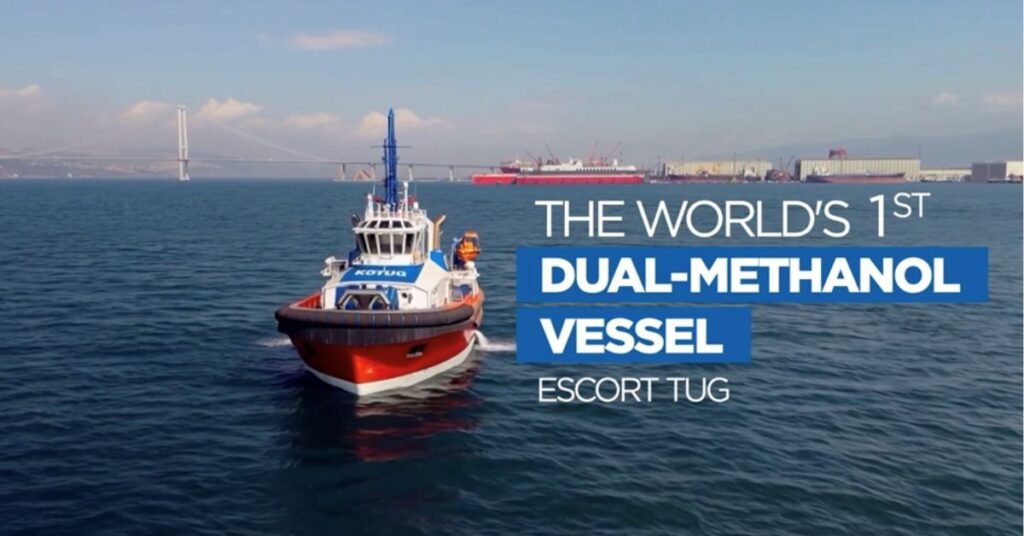
New escort tug fleet combines methanol propulsion, emission reduction technologies and First Nations partnership
KOTUG International has launched two dual-fuel methanol-powered escort tugs for operations in British Columbia, marking what the company says is the world’s first deployment of large purpose-built methanol escort tugs.
The vessels — SD AISEMAHT and SD QWIY AANITSA SARAH — were designed by Robert Allan Ltd. and built by Sanmar Shipyards to support operations linked to the Trans Mountain expansion project in Canada.
The launch represents a significant development in low-emission towage and alternative-fuel adoption within the escort tug segment.
Methanol propulsion targets lower-emission marine operations
The 44-metre escort tugs are equipped with dual-fuel engines capable of operating on both diesel and methanol, allowing operators to reduce greenhouse gas emissions when renewable methanol is available.
The vessels comply with IMO Tier III emissions standards and incorporate emission reduction technologies, shaft alternators and energy management systems aimed at improving fuel efficiency and operational performance.
KOTUG said a mechanical cross-link system enables one engine to power both azimuth thrusters during transit operations, reducing fuel consumption and engine running hours during lower-load sailing conditions.
The vessels are designed to deliver between 115 and 120 tonnes of bollard pull, positioning them among the most powerful escort tugs operating in Canadian waters.
Escort tug design integrates sustainability and operational safety
Beyond alternative fuel capability, the vessels include additional environmental and safety-focused technologies.
Advanced hull coatings have been applied to reduce underwater radiated noise, supporting protection of sensitive marine habitats along Canada’s West Coast, including whale migration areas.
The tugs are also fitted with onboard oil spill response systems, recovered oil storage capacity and firefighting systems to support emergency response operations in the Salish Sea region.
Purpose-built alternative fuel escort vessels
KOTUG said the project focused on designing purpose-built vessels rather than retrofitting existing tug tonnage.
The vessels feature:
- Dual-fuel methanol propulsion systems
- Full escort notation for tanker operations
- Cross-link thruster capability
- Integrated onboard power generation architecture
- High bollard pull for demanding escort operations
The company said the design approach was intended to balance operational performance, fuel flexibility and future environmental compliance requirements.
Partnership with First Nations communities
The project also includes collaboration with the Sc’ianew First Nation, with the vessels named in recognition of the partnership.
KOTUG said the initiative reflects broader goals around environmental stewardship, local engagement and community participation in marine operations.
The company added that the collaboration supports employment opportunities, knowledge exchange and long-term engagement with local communities connected to the operating region.
Methanol adoption continues expanding in maritime sector
Methanol is increasingly gaining traction as an alternative marine fuel across shipping sectors including container vessels, tankers, offshore vessels and harbour operations.
The fuel is viewed as one of the more commercially scalable pathways for reducing shipping emissions due to expanding engine availability, improving bunkering infrastructure and the future potential for renewable methanol production. Projects involving methanol-fuelled tugboats and harbour craft are also increasing as ports and operators seek lower-emission solutions for nearshore operations.
Recent Posts
HYBRID
GRSE Signs ₹1,032-Crore ONGC Contract for Four Hybrid Offshore Supply Vessels
EV
Energy In Motion Opens ₹500-Crore Electric Truck Plant in Pune
Fuels
Aegis Logistics Commissions 35,000-Tonne LPG Bottling Plant at JNPA