
Summary
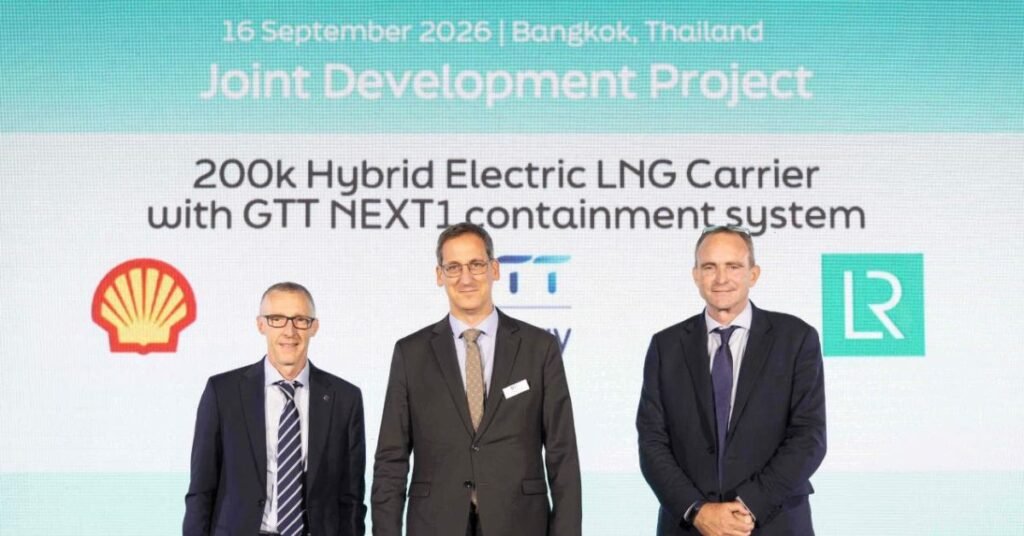
Lloyd’s Register (LR), Shell and GTT have launched a Joint Development Project (JDP) to develop a conceptual 200,000 m³ liquefied natural gas (LNG) carrier featuring hybrid-electric propulsion and GTT NEXT1® cargo containment technology. The project will assess propulsion system architecture, safety, redundancy, battery integration and total cost of ownership (TCO), alongside the integration of the cargo containment system, to evaluate the technical and commercial potential of the vessel concept.
Article
Lloyd’s Register (LR), Shell and GTT have initiated a Joint Development Project to assess the design and technical feasibility of a 200,000 m³ LNG carrier combining hybrid-electric propulsion with GTT NEXT1® cargo containment technology.
The proposed vessel concept will examine how a larger cargo capacity and hybrid-electric propulsion could influence LNG transportation efficiency, operational flexibility and overall vessel performance. The initiative will also assess the integration of the cargo containment system within the broader ship design.
Under the project, the three partners will focus on the development and safety verification of the hybrid-electric propulsion system. Key areas of assessment include system architecture, redundancy requirements and battery integration, with the aim of establishing the technical considerations involved in applying hybrid-electric propulsion to large LNG carriers.
The partners will also examine the concept’s commercial viability through a total cost of ownership (TCO) model. This assessment is intended to evaluate the economic implications of the proposed design alongside its technical requirements.
In parallel, the integration of GTT NEXT1® cargo containment technology will be evaluated as part of the vessel concept. The project will establish technical requirements and guidance for hybrid-electric propulsion in LNG carrier applications, contributing to the assessment of this configuration for future vessel designs.
Commenting on the project, Constantinos Chaelis, Global Gas Segment Director at Lloyd’s Register, said: “The industry is under increasing pressure to move more energy with lower emissions and greater operational flexibility. Larger vessel concepts are being assessed for their potential, and this project will explore how hybrid-electric propulsion and cargo containment technology can support their technical and operational performance from a TCO perspective.
“By bringing together expertise from across the LNG value chain, we’re helping to develop technical foundations that could support further assessment of future LNG carrier concepts.”
The project will provide a basis for evaluating the technical, safety and commercial considerations associated with combining hybrid-electric propulsion and advanced cargo containment technology in a large-capacity LNG carrier.
FAQs
1. What is the Lloyd’s Register, Shell and GTT LNG carrier project?
It is a Joint Development Project to develop and assess a conceptual 200,000 m³ LNG carrier combining hybrid-electric propulsion with GTT NEXT1® cargo containment technology.
2. What is the proposed LNG carrier’s cargo capacity?
The conceptual vessel is designed around a cargo capacity of 200,000 cubic metres (m³).
3. What technologies will the project assess?
The project will examine hybrid-electric propulsion, battery integration, propulsion system architecture, redundancy and GTT NEXT1® cargo containment technology.
4. How will the project evaluate the vessel’s commercial viability?
The partners will use a total cost of ownership (TCO) model to assess the commercial considerations associated with the proposed vessel concept.
5. What is the objective of the hybrid-electric propulsion assessment?
The assessment aims to establish technical requirements and guidance for applying hybrid-electric propulsion to LNG carriers, including system safety, architecture, redundancy and battery integration.
6. Who are the partners involved in the project?
The Joint Development Project brings together Lloyd’s Register, Shell and GTT to assess the technical and commercial potential of the proposed LNG carrier design.
Recent Posts
Ammonia
Aegis Tristar acquisition to expand Indian group’s global energy logistics reach
Power & Propulsion
Everllence and MITSUI E&S Mark 100 Years of Two-Stroke Engine Partnership
Ammonia
NTPC Targets Japan, South Korea and Germany for Green Ammonia Exports from Andhra Pradesh Hub