
Summary
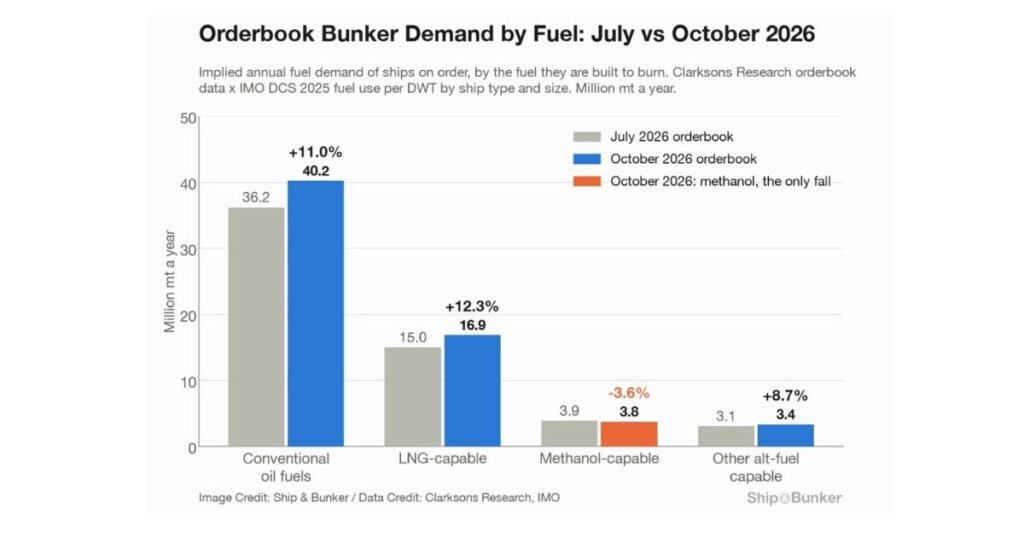
Estimated annual fuel requirements from ships on order have increased 10.3% since July, reaching 64.2 million tonnes of oil equivalent. Conventional oil remains the largest category, while LNG continues to expand. Methanol’s estimated requirement has declined despite an increase in vessel numbers, highlighting the importance of ship size and type.
Newbuilding pipeline points to higher fuel requirements
Orderbook bunker demand reached an estimated 64.2 million tonnes of oil equivalent annually at the start of October 2026, compared with 58.2 million in July.
The global orderbook comprised 7,305 ships, including 1,186 LNG-capable and 274 methanol-capable vessels. Conventional oil accounted for approximately 40.2 million tonnes of annual implied demand, up 11.1%, while LNG increased 12.3% to 16.9 million tonnes of oil equivalent.
Methanol moved in the opposite direction. Its estimated annual requirement fell 3.6% to 3.8 million tonnes of oil equivalent, although methanol-capable ships on order increased from 264 to 274. Methanol-capable containerships declined from 129 to 113, while LNG-capable containerships increased from 470 to 531.
Estimates measure potential consumption after delivery
The calculation combines Clarksons Research orderbook information with 2025 fuel-consumption data reported to the International Maritime Organization, differentiated by vessel type and size.
It estimates requirements once ships are delivered, rather than recording current bunker sales. Tonnes of oil equivalent provide a common energy basis for comparing fuels with different energy content.
The figures therefore indicate the direction of prospective fuel demand, rather than guaranteed purchases of particular products.
September ordering supports LNG momentum
Separate DNV Alternative Fuels Insight data provides context for the growing LNG pipeline. The platform recorded 69 alternative-fuelled vessel orders in September, its strongest monthly result since October 2024.
Those orders brought the third-quarter total to 168, the highest quarterly figure since the third quarter of 2024. Across January–September 2026, alternative-fuelled orders reached 311 vessels, up 53% against the corresponding period last year.
LNG accounted for 48 September orders, including 26 containerships and 18 car carriers. Its year-to-date total reached 200, increasing 52%.
September also included 12 ethanol-fuelled bulk carriers, showing activity beyond the established LNG and methanol pathways. These figures describe new orders placed during specific periods; they should be distinguished from the entire outstanding orderbook used in the fuel-demand estimate.
Earlier slowdown affected fuel choices unevenly
The latest developments follow a weaker overall newbuilding market in 2025. DNV recorded 275 alternative-fuelled vessel orders that year, a decline of 47%, alongside a fall in total newbuilding orders from 4,405 to 2,403.
Despite the reduction in vessel numbers, alternative fuels retained a 38% share of ordered gross tonnage. Large ships can therefore sustain a substantial tonnage share even when fewer units are contracted.
LNG led alternative-fuel ordering with 188 vessels in 2025. Methanol orders fell to 61 from 149 in 2024.
Within containership contracting, LNG represented approximately 58% of tonnage, conventional fuels 36% and methanol 6%. The earlier results show that fuel choices were already diverging before the latest July–October comparison.
They also reinforce a central point for bunker-market planning: counting vessels alone gives an incomplete picture of future energy requirements. Vessel size and operating profile materially influence the potential consumption associated with each fuel category.
Bunkering infrastructure must follow fleet development
The expanding LNG-capable fleet places greater attention on the infrastructure needed to supply it.
A DNV white paper published in September estimated that 165–208 LNG bunker vessels could be required globally by 2030. It warned that fuel demand may grow faster than delivery infrastructure, creating a potential constraint on further adoption.
The assessment identified opportunities to convert suitable small-scale LNG carriers into bunker vessels, alongside investment in purpose-built capacity.
It also emphasised operational readiness, safety management and workforce competence. More bunker vessels alone will not resolve every supply constraint if terminals, fuel logistics and trained personnel fail to develop alongside them.
For bunker suppliers and port investors, the combined evidence supports planning for conventional fuels alongside expanding alternative-fuel services. The investment task is matching infrastructure with vessel deliveries, trading patterns and customers’ actual fuel choices.
FAQs
What does orderbook bunker demand measure?
Estimated annual fuel requirements of ships currently on order once they enter service.
Does the increase mean current bunker sales rose?
No. It concerns prospective consumption from the newbuilding pipeline.
Which fuel category remains largest?
Conventional oil remains the dominant category.
Why can vessel numbers rise while estimated fuel demand falls?
The fleet’s size and vessel-type mix can change, affecting consumption even when more ships are counted.
What does “tonnes of oil equivalent” mean?
An energy-based unit that allows comparison between fuels with different energy content.
Recent Posts
Ammonia
Aegis Tristar acquisition to expand Indian group’s global energy logistics reach
Power & Propulsion
Everllence and MITSUI E&S Mark 100 Years of Two-Stroke Engine Partnership
Ammonia
NTPC Targets Japan, South Korea and Germany for Green Ammonia Exports from Andhra Pradesh Hub