
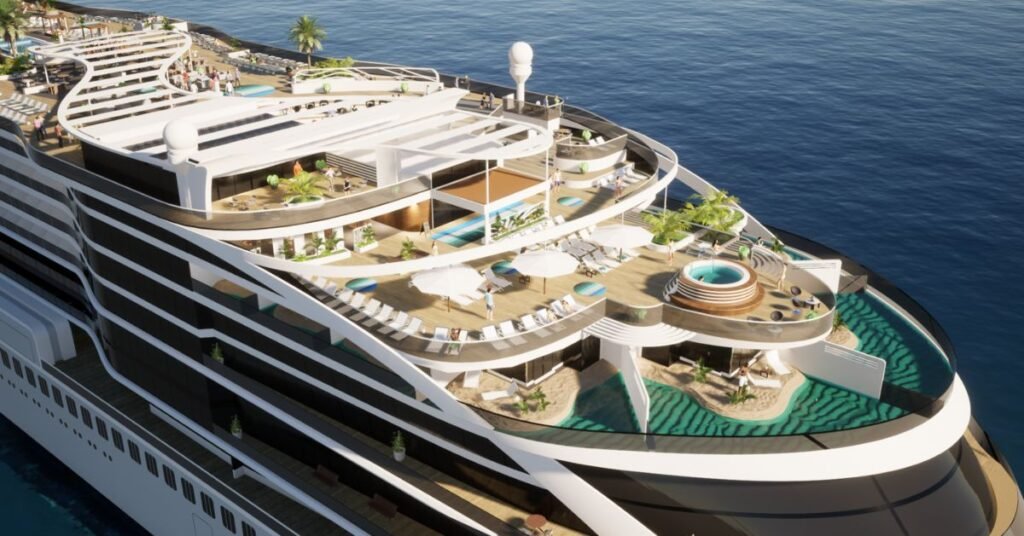
German shipbuilder MEYER WERFT has introduced a concept for a fully battery-electric cruise ship at Seatrade Cruise Global in Miami, outlining a potential pathway toward low-emission cruise operations.
The concept, named “Vision,” is designed as a vessel exceeding 80,000 gross tonnage (GT) and represents an exploration of large-scale electrification in the cruise segment. According to the company, the design could reduce greenhouse gas emissions by up to 95% compared to conventional cruise ships.
“We asked ourselves how we can use innovation to reduce CO₂ and contribute to decarbonization — not in 50 years, but much sooner. We enable a reduction in greenhouse gas emissions of up to 95%,” said Tim Krug from the MEYER WERFT Concept Development Group.
The proposed vessel would measure approximately 275 metres in length, accommodate up to 1,856 passengers, and feature a total size of around 82,000 GT. The battery system is planned to be supplied by Norway-based Corvus Energy.
“With battery-electric cruise ships, we offer a competitive product that relies on existing technologies. We are opening up entirely new opportunities for our customers to operate sustainably and profitably in the long term,” said Johannes Bade, who oversees the development programme behind the concept.
Thomas Weigend, Chief Sales Officer at MEYER WERFT, added: “We are pleased to have Corvus Energy — the pioneer in safe and reliable battery systems for ships, having equipped more than half of the world’s hybrid and fully electric seagoing vessels — at our side. The technology is available today. If ordered this year, we could already deliver the first ship in 2031.”
Corvus Energy CEO Fredrik Witte commented: “Our close collaboration with MEYER WERFT and the combination of our capabilities demonstrated with the ‘Vision’ is the natural evolution of battery technology — and a defining moment for the cruise industry. Scaling to fully electric cruise ships shows the world that the technology is safe, mature and ready to change the game.”
The concept is designed to operate on selected regional cruise routes using battery power, including itineraries such as Barcelona to Civitavecchia. The shipbuilder noted that the availability of charging infrastructure is expected to expand, with around 100 European ports projected to support such capabilities by 2030.
For extended voyages, the design can be adapted into a hybrid configuration with auxiliary generators, enabling operations such as transatlantic crossings.
In addition to propulsion, the concept introduces changes to vessel architecture. The absence of conventional engines and exhaust systems removes the need for funnel structures, allowing for redesigned upper deck layouts. The ship also incorporates enclosed, weather-protected recreational spaces, including an indoor aqua park, enabling year-round use.
The electric propulsion system is expected to reduce onboard noise and vibration levels, contributing to changes in passenger comfort compared to conventional engine-driven vessels.
Recent Posts
HYBRID
GRSE Signs ₹1,032-Crore ONGC Contract for Four Hybrid Offshore Supply Vessels
EV
Energy In Motion Opens ₹500-Crore Electric Truck Plant in Pune
Fuels
Aegis Logistics Commissions 35,000-Tonne LPG Bottling Plant at JNPA