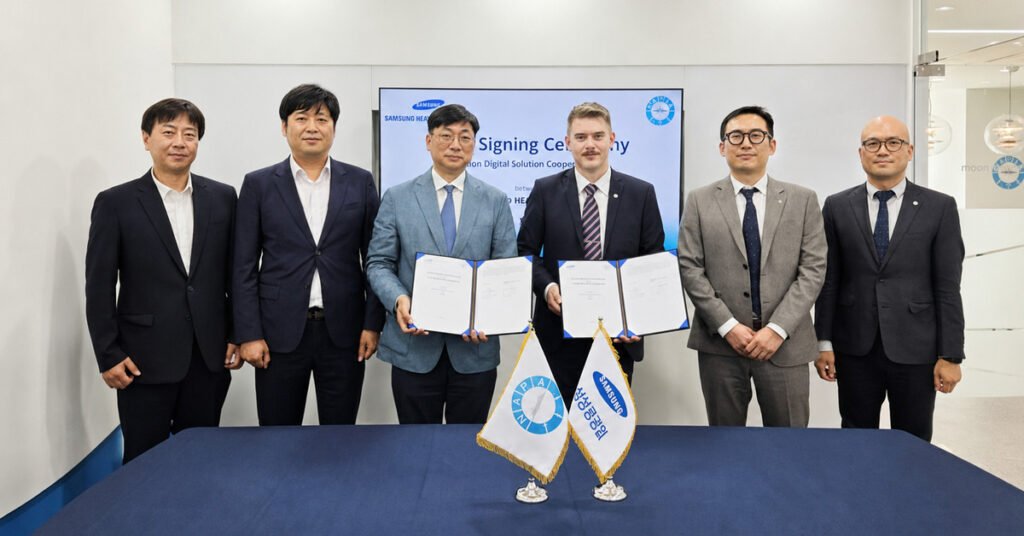
NAPA has signed a Memorandum of Understanding (MoU) with Samsung Heavy Industries (SHI) to collaborate on improving vessel performance through wind-assisted propulsion, digital twin technology and voyage optimisation, supporting shipowners’ decarbonisation strategies.
The partnership will focus on analysing operational data from vessels equipped with SHI’s SAVER Wing wind-assisted propulsion system and integrating NAPA’s digital solutions into the shipbuilder’s autonomous vessel platform.
Collaboration to Validate SAVER Wing Performance
As part of the agreement, the two companies will jointly assess the real-world performance of SHI’s SAVER Wing, a rigid two-element wing sail that generates additional thrust using wind energy.
Installed on the vessel’s deck, the system applies aerodynamic principles similar to aircraft wings to convert wind into forward propulsion, reducing engine load, fuel consumption and carbon emissions.
Using actual operational data alongside voyage and weather modelling, NAPA will help SHI provide shipowners with more accurate estimates of fuel savings and vessel efficiency than conventional design-stage calculations.
The companies said this approach is intended to support investment decisions by providing performance projections tailored to expected operating conditions.
Voyage Optimisation to Support Autonomous Shipping
The MoU also outlines plans to integrate NAPA Voyage Optimization into SHI’s Samsung Autonomous Ship (SAS) platform.
The voyage optimisation solution enables operators to evaluate routes, weather conditions and speed profiles to improve fuel efficiency, enhance safety and support regulatory compliance. Integrated with the SAS platform, it would allow vessels to dynamically adjust routes to maximise the benefits of favourable wind conditions while reducing fuel consumption and emissions.
In addition, SHI plans to deploy NAPA’s Operational Simulation technology to create digital twins of onboard equipment, enabling performance verification during the vessel design phase and supporting lifecycle efficiency improvements.
Building on Existing Collaboration
The agreement expands on a joint project launched by NAPA and SHI in May 2026 to evaluate the performance of SAVER Wing-equipped vessel designs.
According to the companies, the initial collaboration demonstrated the value of combining operational data with vessel modelling to improve design accuracy and operational efficiency.
Hyun Joe Kim, Executive Vice President at Samsung Heavy Industries, said: “Our customers are under more pressure than at any point in my career. They need vessels that will remain competitive and compliant for the next 25 years, and they need confidence in the efficiency data before they sign the contract. Being able to model a specific design against real operating conditions, early in the process, is a genuine advantage. We chose NAPA because they have the tools, design expertise and data legacy to do this well.”
Pekka Pakkanen, Executive Vice President, Shipping Solutions, at NAPA, said: “Shipowners are being asked to make multi-million, multi-year capital commitments without enough information on what this investment actually looks like. With this partnership, SHI will be able to answer shipowners’ questions and show exactly how their SAVER Wing solution will perform at sea. That bridge between design and operations is what shipowners have needed, and working with SHI gives us the best possible platform to provide that.”
“NAPA has done a lot of work in quantifying and modelling the benefits of combining voyage optimization with wind-assisted propulsion. What we are doing differently with SHI is outlining those benefits much earlier at the design stage.”
Recent Posts
HYBRID
GRSE Signs ₹1,032-Crore ONGC Contract for Four Hybrid Offshore Supply Vessels
EV
Energy In Motion Opens ₹500-Crore Electric Truck Plant in Pune
Fuels
Aegis Logistics Commissions 35,000-Tonne LPG Bottling Plant at JNPA