
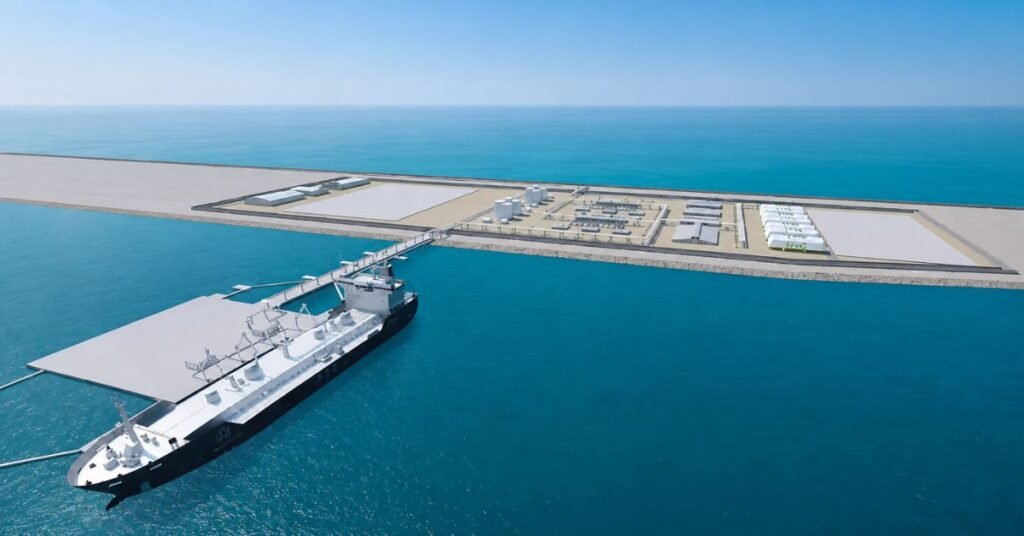
A new H2Global Foundation report has highlighted Oman’s approach to developing green hydrogen exports, in which the government coordinates land allocation and plans shared infrastructure for multiple producers. The study, published on 10 November 2026, examines how Oman is linking project development at Duqm and Salalah with the pipelines, utilities and port facilities needed to bring hydrogen derivatives to overseas markets.
How does Oman’s shared hydrogen infrastructure model work?
Hydrogen Oman (Hydrom), the government-owned entity set up in 2022 to coordinate the sector, allocates development land through competitive auctions and plans infrastructure across project clusters. Under its common-user model, multiple producers would share hydrogen pipelines, electricity networks, desalination facilities and water pipelines. Plans for Duqm include about 200 kilometres of hydrogen pipelines.
Pooling demand can reduce duplication and spread infrastructure costs across more users. The report points to questions over how those costs will be recovered, who will own the assets and how developers and infrastructure operators will share risk. It also notes that export terminals, storage tanks and ship-loading facilities may be developed separately from the shared utility networks.
What will Duqm and Salalah need to export hydrogen derivatives?
The two hubs have different starting points. H2Global identifies about 4 million tonnes a year of announced hydrogen-equivalent capacity across the remaining projects it assessed in Duqm, where substantial new export infrastructure would be required. Salalah, with about 900,000 tonnes a year of planned hydrogen-equivalent capacity, can build on existing chemical-handling facilities, although these would still need significant expansion. The figures describe announced projects and give an indication of the infrastructure each hub could need.
The study puts Oman’s plans in a wider market context. Of nearly 12 million tonnes a year of hydrogen-equivalent export capacity announced globally for 2030, less than 8% was associated with projects already operating, under construction or at final investment decision. That gap matters to ports and terminal operators, which need enough committed cargo to justify investment in storage and loading capacity.
What do the latest Duqm awards add?
Oman announced two Duqm project awards at the United Nations climate conference, COP31, under Hydrom’s third auction round. The projects are designed to produce a combined 121,000 tonnes of green hydrogen annually by 2032, with planned downstream production of green ammonia and green ammonium nitrate.
One consortium brings together Oman’s Petrogas E&P and Italy’s Bio3Energy. The other comprises PLN Indonesia Power Renewables, Oman’s Alawi Enterprises and Singapore’s HBA Offshore International. Hydrom also launched a fourth auction round linking renewable power and green hydrogen production with electricity demand from data centres.
FAQs
Why is green ammonia important to Oman’s export plans?
Ammonia is one way to transport hydrogen-derived products by sea. It accounts for around three-quarters of announced hydrogen-equivalent exports globally in H2Global’s assessment and is among the products planned under the latest Duqm awards.
What is Oman’s national green hydrogen production target?
Hydrom’s December 2024 strategy set out ambitions of 1 million to 1.5 million tonnes a year by 2030 and 3.25 million to 3.75 million tonnes by 2040. The figures are national production targets covering domestic use and exports.
Recent Posts
Power & Propulsion
Everllence wins engine order for 5,000 m³ hybrid live-fish carrier
Policy
CIMAC urges global IMO emissions rules to unlock investment in cleaner shipping
LNG
Samsung Heavy Industries wins US$257 million LNG carrier order for 2029 delivery