
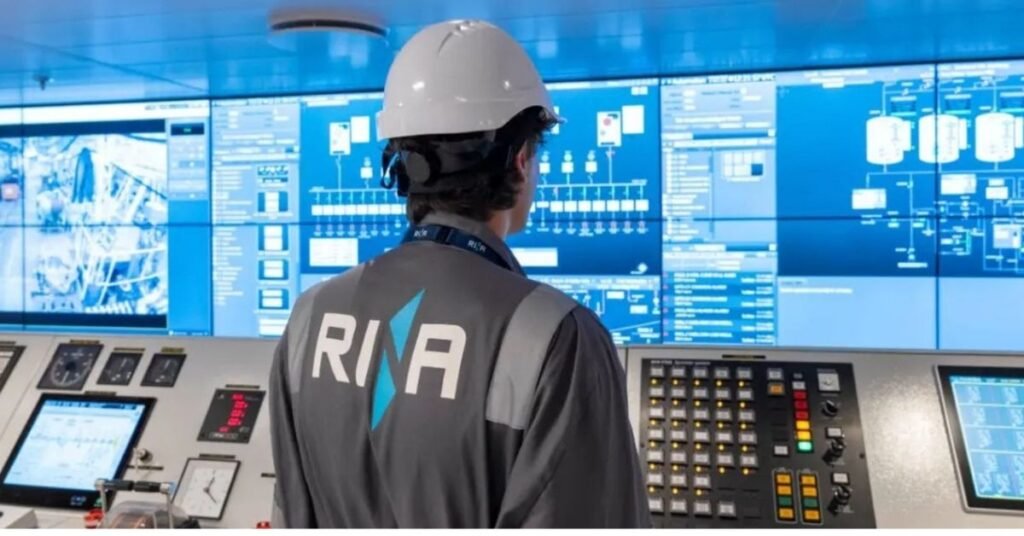
Classification society RINA has unveiled Mermaid, a new ship propulsion concept designed to help shipowners cut fuel consumption, lower emissions, improve operational resilience, and protect long-term asset value, all while staying flexible as the shipping industry’s decarbonisation pathway continues to evolve.
What does the Mermaid concept actually do?
Mermaid expands the role of a vessel’s highly efficient two-stroke main engine well beyond propulsion, turning it into the primary source of onboard power and reducing a ship’s dependence on less efficient auxiliary engines. The concept combines a shaft generator, a propeller shaft clutch, and battery energy storage into a new propulsion architecture, one that improves efficiency without locking owners into a specific fuel pathway.
The mechanics are straightforward. When a vessel arrives in port, the propeller is disconnected while the main engine keeps running to generate electrical power. Instead of switching to auxiliary engines to meet onboard power demand, as is standard practice today, Mermaid lets the main engine supply electricity directly or charge onboard batteries. Once charged, those batteries take over onboard power needs, freeing the main engine to run at its most efficient operating point while cutting fuel consumption, emissions, and operating costs.
The system also addresses a growing mismatch in the industry: slow steaming. As more vessels spend much of their operating life running well below their originally designed speeds, engines often end up oversized for real-world conditions. By combining auxiliary engines with battery storage in a hybrid propulsion scheme, Mermaid better matches propulsion power to actual operating conditions, reducing the need for excess installed engine capacity while adding a resilience layer during critical operations.
How much fuel can shipowners actually save?
According to RINA’s analysis, Mermaid can cut fuel consumption by more than 1,000 tonnes per year in some applications. Beyond the direct fuel savings, lower fuel use translates into lower future compliance costs under tightening emissions regulations, while the fuel-agnostic design gives owners room to adapt as new fuels and rules emerge. The battery-backed architecture also brings a safety dimension, reducing the risk of power loss during critical propulsion and electrical operations.
Why build a ship design around uncertainty instead of a specific fuel?
Antonios Trakakis, Energy Transition Solutions Technical Director at RINA, framed the thinking behind Mermaid around a central problem facing owners today, the absence of a clear fuel winner. He noted that the real challenge is not simply picking a fuel, since technically and commercially sound solutions may still emerge that the industry has not yet considered, and that a vessel ordered today needs to remain viable well into the 2050s.
Trakakis added that owners are currently being presented with multiple possible decarbonisation pathways, each carrying its own risks, and that Mermaid was built to hold up regardless of which pathway ultimately wins out, delivering value whether the fuel landscape shifts dramatically or stays largely unchanged.
Rather than optimising a vessel for one specific decarbonisation scenario, Mermaid offers a flexible platform designed to adapt as technologies, fuels, and regulations continue to shift, reducing the likelihood of costly retrofits down the line.
Where is Mermaid headed next?
The concept is applicable across a broad range of vessel types, including tankers, bulk carriers, and container ships. Following what RINA describes as encouraging feedback from both shipowners and shipyards, Mermaid is now being developed into a fully detailed design.
By prioritising adaptability over commitment to a single fuel pathway, Mermaid reflects a broader shift in ship design thinking, one that treats regulatory and fuel uncertainty not as a barrier to decarbonisation investment, but as a design constraint to be engineered around.
Recent Posts
Ammonia
Singapore Launches TR 148 Ammonia Bunkering Standard and Model Contract to Prepare for Ammonia-Fuelled Ships
Policy
China Targets Doubling New Energy Inland Vessels by 2028 Under 2026-2030 Action Plan
EV
Singapore Offers Up to S$250,000 per Vessel to Spur Electric Harbour Craft Adoption