
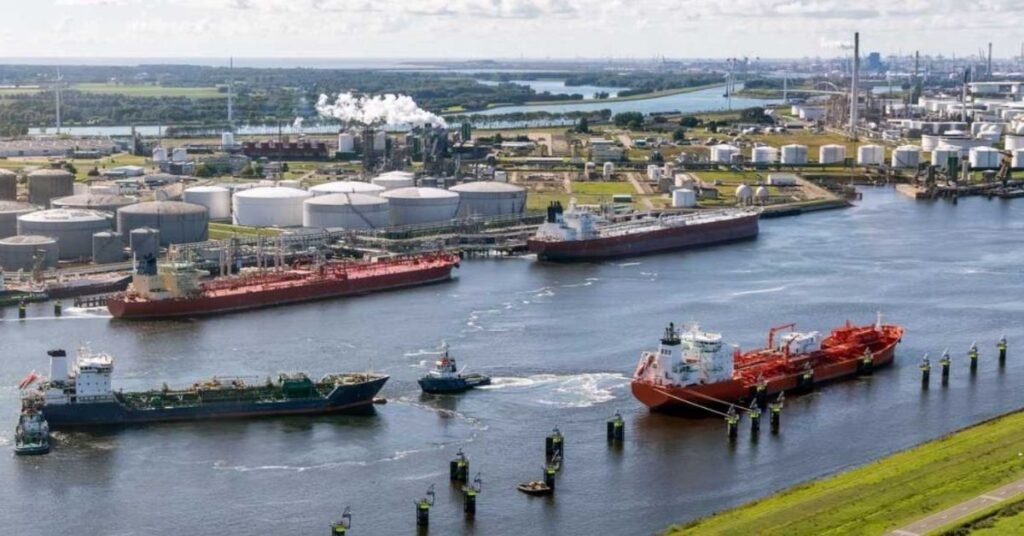
Major and secondary ports across Europe are ramping up investment in biofuel, methanol, and ammonia bunkering infrastructure, as volatile oil prices and tightening EU regulations push shipowners toward alternative fuels faster than many terminals can keep pace with.
Why is oil price volatility driving the shift to biofuels?
According to John Bassadone, founder and chief executive of biofuels supplier Peninsula, which has signed deals with the Port of Algeciras, biofuel adoption is picking up speed due to price volatility of conventional fuels and regulatory measures such as FuelEU and EU ETS. He noted that these regulations are designed to tighten progressively, making biofuels the most versatile decarbonisation option currently available at scale.
A regional survey of major seagoing hubs found ports concentrating first on securing adequate methanol supplies, with ammonia and other biofuels expected to follow once available at scale.
Which ports are leading on methanol bunkering?
Rotterdam, Amsterdam, and Antwerp-Bruges currently lead the region with established methanol bunkering operations. Algeciras, Bremerhaven, Marseille Fos, Barcelona, and Le Havre are following close behind, while North Sea Port in the Benelux region and the Port of London remain in preparatory stages.
Recent activity underscores the pace of adoption. Maersk’s dual-fuel container ship Antonia Maersk was refuelled with 2,800 tonnes of renewable biofuel by the bunker vessel Bahía Candela at APM Terminals in the Port of Barcelona in July, while Spanish energy major Repsol has signed supply agreements for renewable methanol deliveries beginning in 2029.
Barcelona’s port president, José Alberto Carbonell, positioned the port as central to scaling low-carbon fuel bunkering under its energy transition plan, describing Barcelona’s ambition to serve as the Mediterranean’s leading logistics and energy hub for the sector.
Algeciras, in the Bay of Gibraltar, is installing dedicated bunker vessels and bulk storage for methanol and ammonia, targeting operations by late 2027. The port aims to become the Mediterranean’s chief alternative fuels node, with proposed green corridors linking it to Rotterdam as well as Colombia and Panama. A 7,500 m3 ammonia bunker vessel will form part of the buildout, alongside a recent MoU between Peninsula and storage firm Evos to develop up to 60,000 m3 of low-carbon marine fuel storage capacity.
How are German ports positioning themselves?
Bremerhaven, which primarily bunkers LNG-fuelled container ships and car carriers, considers itself methanol-ready and has set 2030 as its target for becoming a full multi-fuel port. Bremen senator Kristina Vogt, who heads the port’s transformation efforts, pointed to existing methanol-capable storage on the Weser river and said the region has the best structural prerequisites for the transition, now that regulatory clarity has arrived.
Hamburg is close behind, having already approved both ship-to-ship and truck-to-ship methanol operations.
What about smaller ports and emerging fuels?
North Sea Port, located on the Dutch-Belgian border at the mouth of the River Scheldt, is developing what is expected to become the largest hydrogen network in the Benelux region. Chief executive Cas Konig said the port intends to become a major operating base for large-scale hydrogen import and onward transfer to the European hinterland.
Haropa in Le Havre, Europe’s leading river port, is advancing plans to bunker both methanol and ammonia. Its €500 million Methavert project targets initial production of 200,000 tonnes of e-methanol, while US-based Air Products is developing a €1.1 billion hydrogen and ammonia import terminal at the site. Haropa has also signed a green shipping corridor agreement with China.
Marseille Fos is emerging as another future hub, with CMA CGM backing large-scale e-methanol and green hydrogen production infrastructure slated for commissioning in 2028.
Why is methanol leading the alternative fuels race?
Bremerhaven managing director Robert Howe framed alternative-fuel readiness as both a climate imperative and a competitive advantage, saying the goal is for ports to offer universal bunkering regardless of whether vessels run on methanol, LNG, ammonia, or eventually green hydrogen.
Methanol’s early lead largely comes down to practicality. Risk assessments at major ports show that bunkering methanol closely resembles handling conventional fuel oil, requiring only limited modifications to existing bunker barges, and the fuel faces comparatively little resistance from port workers, terminals, and public authorities.
Industry analysis published by Marine Inspection in June 2026 noted that methanol’s advantage lies in being liquid at ambient temperature and pressure, making it easier to store and bunker than cryogenic or gaseous alternatives, while working with dual-fuel engines already available today.
Is ammonia still years away from scale?
Ammonia remains earlier in its development curve, though the first ammonia-fuelled ships are due to launch through 2026 as the IMO continues refining rules around its use. Experts expect ammonia to become the most cost-competitive alternative fuel within roughly a decade.
Rotterdam conducted an ammonia bunkering operation between two vessels in early 2025, and Antwerp-Bruges is now developing its own ammonia bunkering capability, building on methanol infrastructure both ports already operate.
A study by the Global Maritime Forum identified bunkering as the weakest link in the ammonia value chain, noting that knowledge levels and risk appetite vary significantly across ports and terminals, meaning successful rollout will depend on close coordination between operators, port authorities, and local communities.
Is fuel supply keeping pace with methanol-ready ships?
A supply gap is emerging as a key concern. Around 60 methanol-capable ships are already operating, but more than 300 additional methanol-ready vessels are on order, and retrofit activity is accelerating following early pioneering projects.
Marine Inspection cautioned that the real challenge in 2026 is the gap between methanol-capable ships and consistent low-emission methanol supply, since the fuel’s carbon benefit depends entirely on whether operators can reliably source bio- or e-methanol on their routes, rather than defaulting to fossil-derived methanol. The risk, industry observers warn, is that fleet readiness may outpace fuel availability.
Recent Posts
Ammonia
Singapore Launches TR 148 Ammonia Bunkering Standard and Model Contract to Prepare for Ammonia-Fuelled Ships
Policy
China Targets Doubling New Energy Inland Vessels by 2028 Under 2026-2030 Action Plan
EV
Singapore Offers Up to S$250,000 per Vessel to Spur Electric Harbour Craft Adoption