
Summary
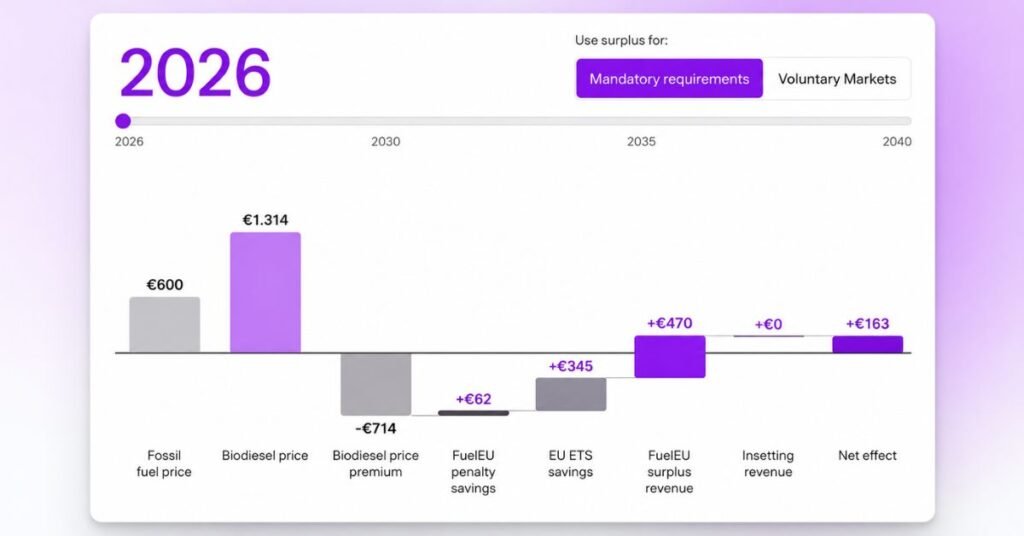
ZERO44 has released a free online calculator comparing fossil marine fuels with biodiesel after accounting for emissions costs and potential compliance benefits. Its default example indicates a €163 net benefit for a 2026 intra-European voyage, but the result depends on assumed fuel prices, carbon values and revenue from over-compliance.
Tool broadens the fuel-cost comparison
The ZERO44 biofuel calculator allows shipping operators to examine how the economics of replacing fossil fuel with biodiesel change when regulatory costs enter the calculation.
The interactive tool brings together fuel expenditure, EU Emissions Trading System costs, FuelEU Maritime penalties and potential value from compliance surpluses or carbon insetting.
Users can change fuel prices, select a voyage category and move between years to explore different outcomes. The company positions the calculator as an illustration of the commercial mechanisms involved, rather than a complete fleet-level procurement tool.
The launch addresses a practical question for shipowners and charterers: whether a more expensive bunker fuel can become competitive once its emissions performance and associated compliance value are considered.
Default example produces a conditional benefit
Under ZERO44’s published default assumptions, replacing the energy supplied by one tonne of conventional fuel with biodiesel produces a net benefit of approximately €163 in 2026 for voyages within Europe.
The calculator compares one tonne of heavy fuel oil with approximately 1.09 tonnes of biodiesel, reflecting an energy-equivalent comparison rather than equal fuel weights.
Its assumptions include biodiesel lifecycle greenhouse gas intensity of 12 gCO₂-equivalent per megajoule and a FuelEU surplus value of €100 per tonne of CO₂-equivalent.
The result is therefore a modelled scenario. It does not establish that every biofuel purchase produces a saving, or that every operator can realise the assumed surplus value.
For users, the important exercise is to replace illustrative inputs with commercially relevant figures and examine how sensitive the outcome is to changes.
FuelEU pooling creates a potential value stream
FuelEU Maritime and the EU ETS address different aspects of shipping emissions.
FuelEU sets limits on the greenhouse gas intensity of energy used onboard, while the ETS places a price on covered emissions. The European Commission describes them as complementary frameworks.
FuelEU also permits pooling, allowing an over-performing ship’s compliance surplus to compensate for another ship’s deficit, provided the pool meets the applicable conditions.
This flexibility helps explain why fuel economics can extend beyond avoided penalties. A vessel using lower-intensity fuel may create compliance value that can be allocated through an eligible pool.
However, creating a surplus and monetising it are separate steps. Commercial arrangements and the value agreed between participants influence the revenue ultimately received.
Voyage geography affects regulatory exposure
The calculator distinguishes between voyages within Europe, voyages to or from Europe and voyages outside Europe.
That distinction reflects the geographical scope of emissions regulation. Under the maritime EU ETS, voyages within the European Economic Area and emissions at berth are generally fully covered, while voyages between EEA and non-EEA ports generally have 50% coverage.
The phase-in reaches 100% of the applicable emissions obligation for the 2026 reporting year.
For operators, this means an identical fuel purchase can have different compliance economics depending on where the vessel trades.
A useful comparison therefore requires both a fuel-price assessment and an understanding of which parts of the operation fall within the relevant rules.
Future-year results rely on forecasts
The calculator holds entered fuel prices constant while applying forecast carbon-price paths.
It also assumes that the IMO Net-Zero Framework enters into force in 2029, using targets approved in draft form at MEPC 83. That is a modelling assumption, rather than confirmation of an implementation date.
Future results should consequently be read as scenarios illustrating the interaction of policy and prices.
Fleet decisions require additional checks
ZERO44 says actual decisions involve a wider fuel mix, vessel compatibility and changing trading patterns. Its commercial software offers more extensive fleet-specific analysis.
For shipping businesses, the free tool provides an accessible starting point for discussions between procurement, operations and compliance teams.
Its principal contribution is making the cost components visible. Whether a particular biofuel stem offers a commercial advantage still depends on the vessel, fuel documentation, regulatory treatment and the revenues that can actually be secured.
FAQs
What does the calculator compare?
Fossil marine fuel and biodiesel costs, including regulatory costs and potential compliance benefits.
Is it free to use?
Yes. It is available through ZERO44’s website.
Does it guarantee a €163 saving?
No. That is an illustrative result based on default assumptions.
Why does it compare different fuel weights?
It compares equivalent energy, using approximately 1.09 tonnes of biodiesel against one tonne of heavy fuel oil.
Is the assumed 2029 IMO start date confirmed?
No. It is a scenario assumption used by the calculator.
Recent Posts
Power & Propulsion
WinGD Signs First Engine Licensing Agreement with HD Hyundai Marine Engine
LNG
LNG Carrier Surplus Forecast Raises Questions Over New Ship Orders
Policy
UK ETS Site Visits: DNV Urges Early Action Before First Reporting Deadline