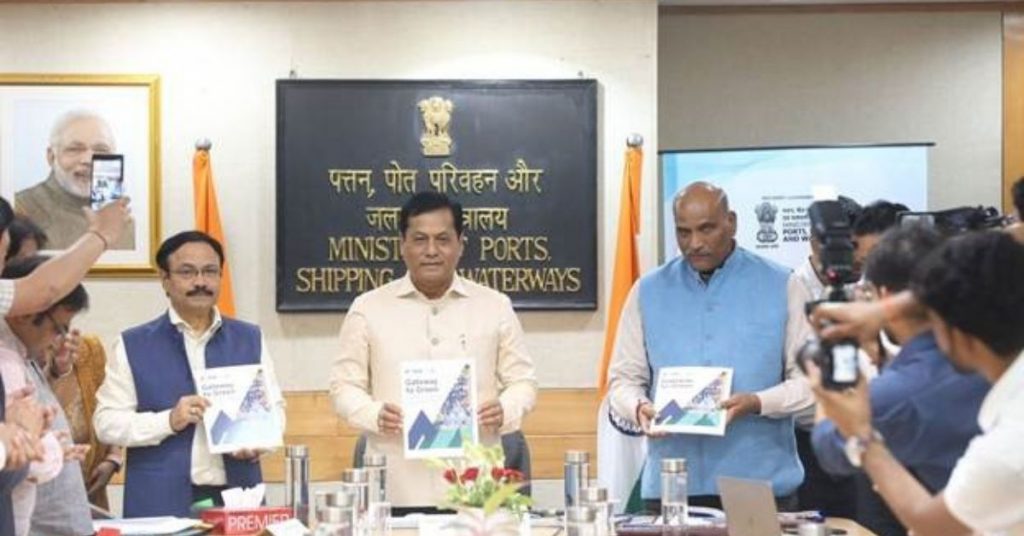
India’s Ministry of Ports, Shipping and Waterways (MoPSW) unveiled a bold push toward environmental sustainability with new initiatives aimed at transforming Indian ports into future-ready green energy hubs. Central to this vision is the launch of a strategic report titled “Gateway to Green: Assessing Port Readiness for Green Hydrogen Transition in India”, alongside a broader push for digital solutions that support sustainable port operations.
The report, developed in collaboration with the Indian Ports Association (IPA), outlines a roadmap to prepare India’s port infrastructure for the production, storage, and export of green hydrogen, marking a significant step in the country’s efforts to lead the global clean energy transition.
Green Hydrogen Roadmap: Ports as Energy Catalysts
The “Gateway to Green” report identifies strategic areas of action, including:
Allocating port land for green hydrogen production and allied industries
Creating shared infrastructure to reduce project costs and encourage investment
Stimulating domestic and international demand
Building international partnerships to enable green hydrogen exports
Encouraging Indian ports to play an active role in co-investing and enabling project ecosystems
Ports such as V.O. Chidambaranar, Paradip, Deendayal, JNPT, Mumbai, and Cochin are highlighted as particularly well-positioned to support green hydrogen operations, thanks to their strategic locations, land availability, and connectivity. These ports are expected to cater to future clean energy demands from regions such as East Asia and the European Union.
Union Minister Shri Sarbananda Sonowal emphasized the strategic importance of this transition:
“India’s ports are evolving into catalysts of the green hydrogen revolution. This roadmap reflects our commitment to sustainability and energy security, as envisioned by Prime Minister Narendra Modi ji. By unlocking our ports’ potential, we aim to position India as a key global hub for green hydrogen production, storage, and export.”
Digital Backing for Green Goals
Alongside the hydrogen roadmap, India also launched the Digital Centre of Excellence (DCoE) in partnership with the Centre for Development of Advanced Computing (CDAC). This initiative will develop advanced digital technologies—such as AI, IoT, and blockchain—to support sustainable port operations, energy-efficient logistics, and reduced carbon footprints.
Minister Sonowal noted that these platforms will not only modernize operations but also reinforce climate-conscious infrastructure, helping meet long-term targets under the Maritime India Vision 2030 and Amrit Kaal Vision 2047.
“By embracing modern technology and green practices, we are building a future-ready maritime ecosystem that reflects our commitment to environmental responsibility,” he said.
National Commitment to a Greener Maritime Future
India’s green maritime strategy complements the government’s broader aim to produce 5 million tonnes of green hydrogen by 2030, contributing to global decarbonization efforts while reducing dependence on fossil fuels.
By integrating digital transformation with sustainability goals, MoPSW’s new initiatives position Indian ports not only as trade gateways but as active enablers of India’s clean energy transition.
Recent Posts
HYBRID
GRSE Signs ₹1,032-Crore ONGC Contract for Four Hybrid Offshore Supply Vessels
EV
Energy In Motion Opens ₹500-Crore Electric Truck Plant in Pune
Fuels
Aegis Logistics Commissions 35,000-Tonne LPG Bottling Plant at JNPA