
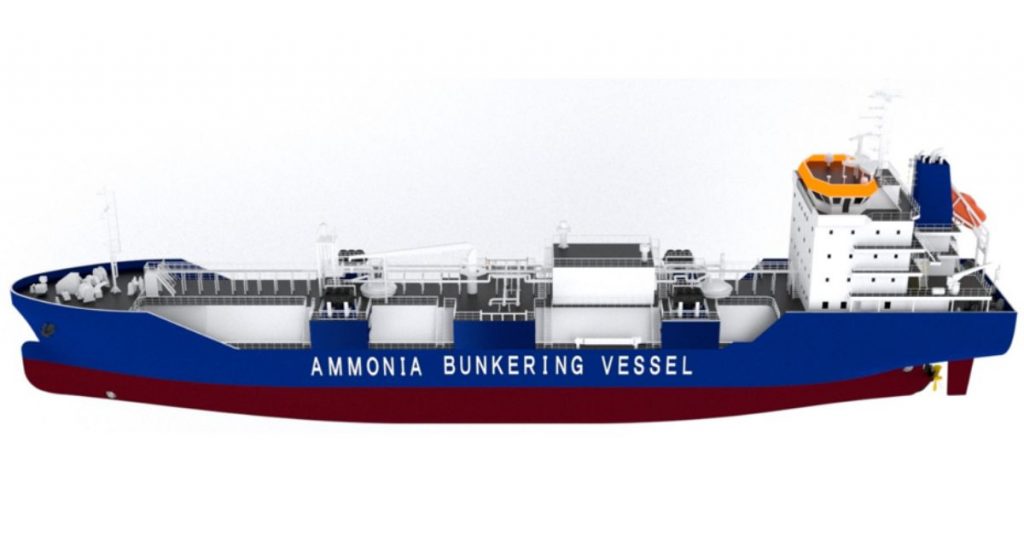
ITOCHU Corporation (headquartered in Minato-ku, Tokyo; Keita Ishii, President & COO; hereinafter “ITOCHU”) announced that it recently signed a shipbuilding contract for the construction of a 5,000 m3 ammonia bunkering vessel (hereinafter the “Vessel”) with Sasaki Shipbuilding Co., Ltd. (hereinafter “Sasaki Shipbuilding”) and an agreement regarding the construction of an ammonia tank plant that will be loaded onto the Vessel with Izumi Steel Works Ltd. (hereinafter “Izumi Steel Works”) (hereinafter, the two agreements will be collectively referred to as the “Agreements”). These Agreements were signed by Clean Ammonia Bunkering Shipping Pte. Ltd. (hereinafter “CABS”), a wholly owned Singapore-based specific purpose company of ITOCHU. In relation to this, CABS has concluded a financing agreement with The Hiroshima Bank, Ltd. for financing a part of purchase price of the Vessel.
Progress in decarbonization in the international shipping
The International Maritime Organization (IMO) has been discussing a range of issues with its members for achieving the international goal of reducing greenhouse gas (GHG) emissions from international shipping to net-zero by or around 2050. In April this year, a draft for revisions to the convention, including the adoption of a system aimed at converting marine fuel for vessels to alternative fuels with low GHG emissions in phases and a system in which economic incentives are provided for the introduction of zero-emission or nearly zero-emission fuel-powered vessels, was approved internationally as a medium-term measure to achieve the above-mentioned goal. When this framework takes effect, initiatives to supply alternative fuels with low GHG emissions and the introduction of zero emission or nearly zero-emission fuel-powered vessels will be accelerated further.
In addition, with ammonia expected to be used as a zero-emission marine fuel among alternative fuels, many interested parties, including ship owners, shipbuilders, cargo owners and other maritime stakeholders, are considering using ammonia-fueled vessels and facilitating the development thereof. Under this situation, the ammonia bunkering business, which supplies ammonia to ammonia-fueled vessels, serves to boost relationships between the maritime industry and the fuel industry. In particular, ammonia bunkering vessels are drawing attention globally as important facilities in the fuel supply chain that play the last one-mile role.
Background behind the Agreements
The Agreements were concluded to pursue the Demonstration Project for Bunkering Ammonia as Marine Fuel in Singapore adopted by the Ministry of Economy, Trade and Industry in Japan as part of the Global South Future-oriented Co-Creation Project (large-scale demonstration in ASEAN member states) (2nd public solicitation). Going forward, with an eye toward the demonstration of ammonia bunkering in Singapore after building the world’s first newbuilding ammonia bunkering vessel (which is to be flagged under the Singapore Registry and is expected to be delivered in September 2027), efforts will be made to facilitate concrete discussions with the maritime stakeholders, including the port authority in Singapore, the Maritime & Port Authority of Singapore (MPA), and the fuel producers, while obtaining support from the Japanese Government.
Future prospects
ITOCHU will establish a safe offshore bunkering operation of ammonia as marine fuel by way of ship-to-ship transfer through the development and construction of the Vessel and demonstration thereof, which serve as an important step for the promotion of the Integrated Project*1). Then, by utilizing the Vessel, ITOCHU will establish connection between the first movers in clean ammonia production and the first movers in the ammonia-fueled vessels and secure initial demand for ammonia as marine fuel, aiming at the commercialization of ammonia bunkering business in Singapore and expansion of similar business model to major maritime transportation points around the world, including Spain (Strait of Gibraltar), Egypt (Suez Canal) and Japan.
In addition, by taking advantage of the expertise and knowledge in the construction of the Vessel and the planned demonstration of ammonia bunkering in Singapore by using the Vessel, ITOCHU will contribute to strengthening the competitiveness of Japan’s shipbuilding industry in the construction of ammonia bunkering vessels and the production of ammonia tank plants, the demand for which is growing rapidly.
ITOCHU has put forth a new management policy, “The Brand-new Deal – Profit opportunities are shifting downstream –” and is pursuing a policy of enhancing its contribution to and engagement with the SDGs through business activities” while listening to all stakeholders, including the market, society and consumers. Going forward, it will continue to promote the Integrated Project of ammonia-fueled vessels and work to realize early social implementation of ammonia-fueled vessels. In doing so, it will contribute to decarbonization in international shipping.
Recent Posts
Biofuels
WinGD Ethanol-Fuelled Engine Completes First In-Service Voyage on Maersk Vessel
Power & Propulsion
Norsepower Rotor Sails Installed on Airbus Cargo Ship Spirit of Toulouse
EV
Estonia Electric Ferry to Combine Steerprop Propulsion with Battery Power