
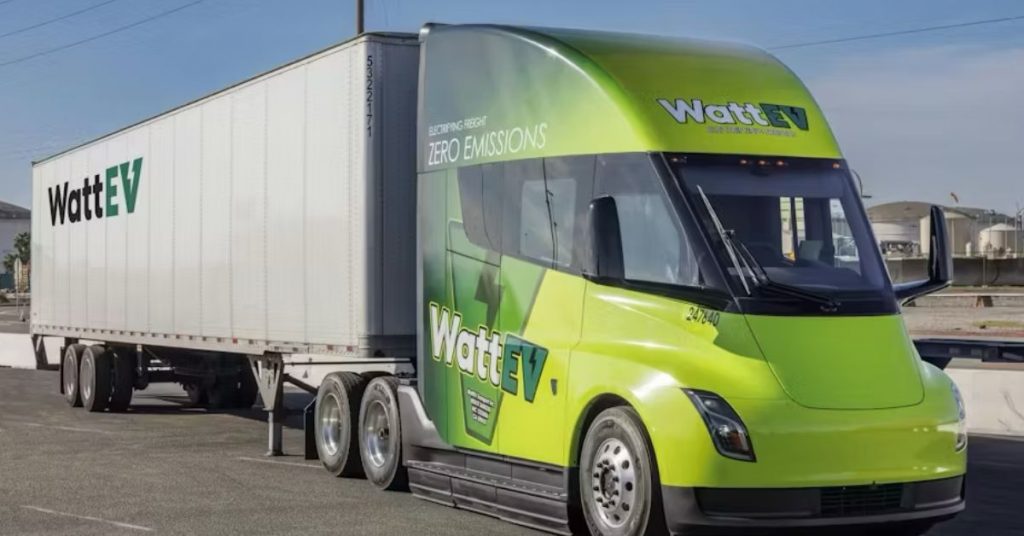
WattEV is expanding its heavy-duty electric truck charging network with three new charging depots across California. The expansion, supported by more than $24 million in grant funding from the State of California, is part of the company’s broader strategy to prepare for the next wave of electric trucks equipped with megawatt charging capabilities.
The new charging locations are being developed at Otay Mesa near the U.S.–Mexico border in San Diego County, Baker along the Interstate 15 corridor between Southern California and Nevada, and the Port of Long Beach, the busiest container port in the United States.
Together, the three sites will feature 29 high-capacity Megawatt Charging System (MCS) units, projected to handle up to 100,000 charging sessions annually. The projects are backed by funding from a California Transportation Commission initiative aimed at advancing zero-emission freight infrastructure along major logistics routes.
According to Salim Youssefzadeh, CEO of WattEV, the industry is approaching a tipping point with the rollout of electric trucks that can charge at megawatt levels. “We see 2026 as a turning point,” he said. “We are building ahead of demand to ensure California’s primary freight corridors are prepared.”
Details of the Charging Sites
Otay Mesa will host 7 MCS chargers and is located just steps from the U.S.–Mexico border. Developed in collaboration with San Diego Gas & Electric (SDG&E), the depot is positioned to support cross-border freight movement.
Baker will offer 10 MCS chargers along the critical I-15 freight corridor, serving traffic between Southern California and Las Vegas. WattEV is working with Southern California Edison (SCE) to bring this site online.
Port of Long Beach will see 12 MCS chargers added, incorporating advanced Silicon Carbide-based medium-voltage rectifiers developed by WattEV’s tech division, Charge America. The site will utilize Solid-State Transformer (SST) technology, which simplifies installation by removing the need for conventional step-down transformers. Chargers will be arranged in a layout similar to traditional diesel stations for ease of use.
Each depot is designed to bring electric truck charging times down to 30 minutes or less, offering performance on par with diesel refueling. Their locations are intended to align with California’s broader freight and logistics strategies.
Integrated Model Driving Zero-Emission Freight
WattEV combines its electric vehicle fleet, high-capacity charging infrastructure, and proprietary freight optimization platform into a unified service offering. Through its Truck-as-a-Service (TaaS) program, the company is currently delivering over 200,000 zero-emission freight miles per month. This integrated approach aims to provide logistics companies with reliable and cost-effective access to electric freight solutions.
Recent Posts
Biofuels
WinGD Ethanol-Fuelled Engine Completes First In-Service Voyage on Maersk Vessel
Power & Propulsion
Norsepower Rotor Sails Installed on Airbus Cargo Ship Spirit of Toulouse
EV
Estonia Electric Ferry to Combine Steerprop Propulsion with Battery Power