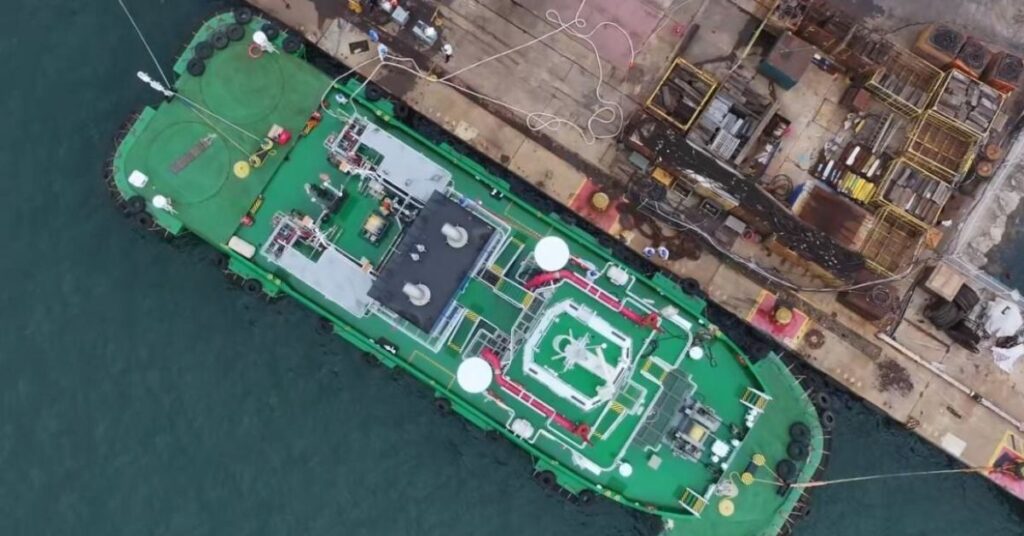
A major milestone in maritime decarbonization has been reached as green ammonia produced by Envision Energy has powered the world’s first green marine ammonia bunkering operation. The event took place at the COSCO Shipping Heavy Industry terminal in Dalian, where China Shipping & Sinopec Suppliers Co., Limited conducted the inaugural bunkering of a 5,500 horsepower ammonia-fueled port vessel.
The ammonia fuel used for the operation originated from Envision Energy’s large-scale green hydrogen and ammonia facility in Chifeng, which is currently the world’s largest of its kind. The achievement demonstrates the establishment of a complete value chain from renewable-based ammonia production to marine fuel application.
Frank Yu, Senior Vice President at Envision Energy, stated that the operation exemplifies the potential for net zero fuels to support decarbonization in sectors such as maritime shipping.
The Chifeng Green Hydrogen-Ammonia Project integrates wind, solar and energy storage systems with Envision’s proprietary hydrogen and ammonia production technology. The facility enables dynamic coupling between renewable power generation and green fuel synthesis. It holds the ISCC Plus certification, marking it as the first verified project for green ammonia with a certified greenhouse gas footprint. The ammonia fuel also carries renewable certification from Bureau Veritas.
The tugboat involved in the operation is fitted with an ammonia dual-fuel engine and a dedicated fuel supply system. The vessel achieves an ammonia substitution rate of up to 91 percent and has received classification as an “Ammonia Fuel Tug” from the China Classification Society.
Following this event, Dalian Port becomes the first in the world to offer bunkering services for biofuel, green methanol, LNG and green ammonia. This development contributes to establishing the port as a clean energy hub in Northeast Asia and addresses a key infrastructure need for international vessels operating on low-emission fuels.
This operation is seen as a foundational model for developing scalable green marine fuel supply chains, advancing broader efforts to reduce emissions in the global shipping industry.
Recent Posts
Biofuels
WinGD Ethanol-Fuelled Engine Completes First In-Service Voyage on Maersk Vessel
Power & Propulsion
Norsepower Rotor Sails Installed on Airbus Cargo Ship Spirit of Toulouse
EV
Estonia Electric Ferry to Combine Steerprop Propulsion with Battery Power