
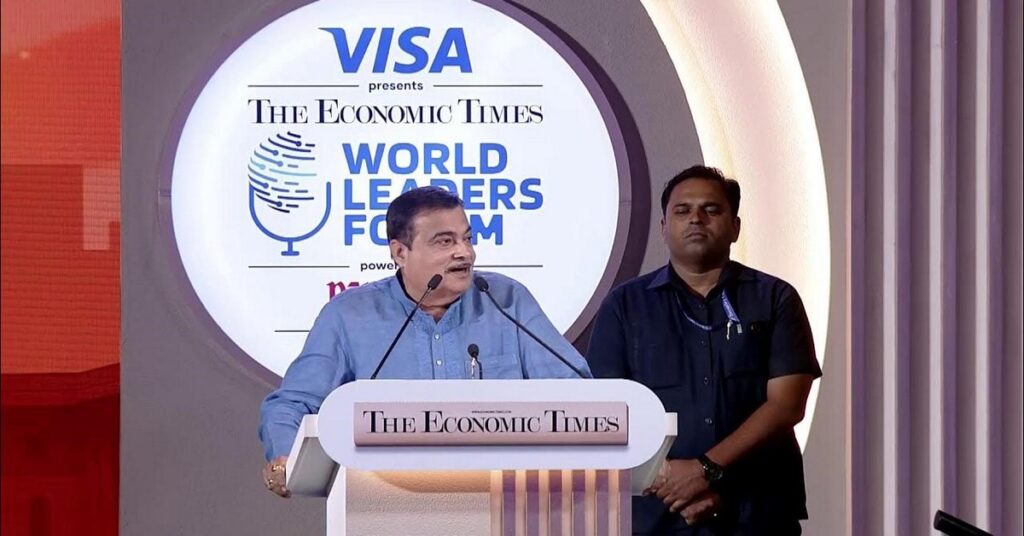
Union Minister for Road Transport and Highways Nitin Gadkari on Friday outlined a series of initiatives aimed at reshaping India’s mobility landscape, with new projects in electric, hydrogen, and biofuel technologies designed to cut fossil fuel dependence and lower transport costs.
Speaking at the World Leaders Forum, Gadkari announced that the government has awarded the first tender for flash-charging electric buses to Tata Motors. The pilot project will begin in Nagpur with support from Siemens and Hitachi. The buses, with a capacity of 135 passengers, will be able to charge for 40 kilometres in just 40 seconds.
“These buses will offer the comfort of an airplane, with hosts, refreshments, and digital screens. More importantly, tickets will cost 30 per cent less than diesel buses,” Gadkari said, adding that the model could transform the economics of public transport.
The minister also confirmed the rollout of hydrogen truck trials across 10 major freight corridors, including Delhi–Agra, Mumbai–Pune, Ahmedabad–Vadodara, Jamshedpur–Kalinga Nagar, and Visakhapatnam–Pariar. Companies such as Tata Motors, Ashok Leyland, Volvo, Indian Oil, Reliance, NTPC and SPCL are participating. Trials will test both fuel-cell systems and hydrogen internal combustion engines, with Tata already developing prototypes for the latter.
Reducing import dependence
India currently imports 85 per cent of its crude oil requirements, with fossil fuel purchases worth nearly ₹22 lakh crore annually. Gadkari stressed that reducing this reliance is central to the government’s transport strategy.
“Our aim is to become an energy exporting nation, not an importing one,” he said, pointing to hydrogen, ethanol, biodiesel, LNG and bio-CNG as part of a diversified fuel mix under development.
The minister highlighted the growing role of waste-to-energy projects. Around 80 lakh tonnes of waste have already been used in road construction, including 20 lakh tonnes from Delhi’s Ghazipur landfill. Similar projects are under way in Ahmedabad and along the Delhi–Mumbai corridor.
At Indian Oil’s Palimurdi facility, rice straw is converted into ethanol, bio-protein and sustainable aviation fuel, producing one lakh litres of ethanol, 150 tonnes of bio-protein and 78,000 tonnes of aviation fuel annually. Gadkari said such projects not only reduce imports but also create new income streams for farmers.
“Farmers are no longer just food providers. They are becoming energy and fuel providers for the country,” he remarked.
The government is also exploring bamboo and crop residue as sources for bio-CNG and hydrogen, while lignin from agricultural waste has been blended with petroleum bitumen for road construction. A test stretch on the Nagpur–Jaipur highway using this mix has been certified as successful.
On ethanol, Gadkari noted that broken rice is already used in production, while isositanol — an ethanol derivative — is being tested as a diesel blend of up to 10 per cent. In Pune, 100 per cent ethanol and isositanol-based generators have been launched, with trials ongoing at the Automotive Research Association of India. Gadkari added that isositanol could emerge as a viable diesel alternative.
Reiterating the government’s long-term direction, he said: “The strategy is not about relying on one solution but on creating multiple pathways — electric, hydrogen, ethanol, biodiesel, LNG, and bio-CNG — to secure the future of mobility.”
Recent Posts
Biofuels
WinGD Ethanol-Fuelled Engine Completes First In-Service Voyage on Maersk Vessel
Power & Propulsion
Norsepower Rotor Sails Installed on Airbus Cargo Ship Spirit of Toulouse
EV
Estonia Electric Ferry to Combine Steerprop Propulsion with Battery Power